


Receive free Fukushima nuclear accident updates
We’ll send you a myFT Daily Digest email rounding up the latest Fukushima nuclear accident news every morning.
Weather permitting, Japan will on Thursday begin the controversial release of radioactive water into the Pacific Ocean from the stricken Fukushima Daiichi nuclear plant, a move furiously opposed by some regional neighbours and fishing and environmental organisations.
Most of the nuclear and radiology experts who have commented on the release support Japan’s plans, however. They accept the conclusions of a two-year safety review by the International Atomic Energy Agency, the UN nuclear watchdog, which found “negligible radiological risk” to people or the marine environment from the plan to pump 1.3mn tonnes of treated water into the sea over the next 30 years.
What is in the Fukushima discharge water?
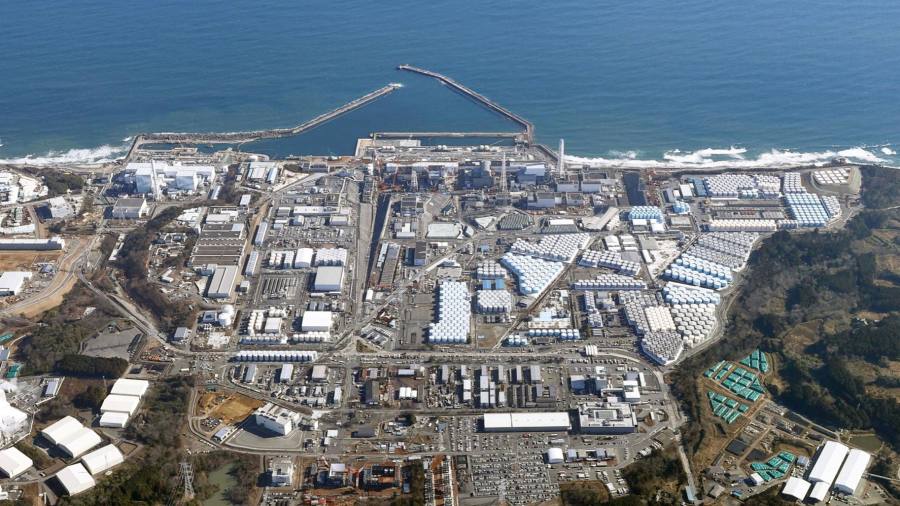
Since the catastrophic 2011 earthquake and tsunami wrecked the Fukushima plant, operator Tokyo Electric Power Co has sprayed seawater over its damaged reactor cores to prevent them overheating.
The contaminated water is stored on site in more than 1,000 huge tanks. Tepco says there is no space to build any more — and no practical alternative to ocean discharge to get rid of the water.
The radioactive liquid is prepared for disposal in a five-stage Advanced Liquid Processing System. Alps uses a series of chemical and physical procedures to remove almost all of the 64 radionuclides (radioactive isotopes) present in the contaminated water.
Tepco says the only significant radioactive material left is tritium, an isotope of hydrogen produced in nuclear reactors, which is also generated naturally by cosmic rays in the atmosphere. Its half-life, the time needed for 50 per cent of its radioactive atoms to decay, is just over 12 years.
It is technically impractical to separate water molecules containing tritium from those composed of non-radioactive hydrogen because they are chemically identical. Instead the treated water containing tritium will be diluted more than 100 times with seawater before being discharged into the ocean through a pipe 1km long.
According to the Japanese government, the concentration of tritium will then be one-seventh of the World Health Organization drinking water standard.
If the water is so clean, are there any scientific objections to the discharge?
“I don’t know any scientists in the UK — or indeed worldwide — in the field of radiological protection who are against it,” said Jim Smith, professor of environmental science at the University of Portsmouth. “As a scientist I would have started the release much earlier and done it much more quickly.”
Geraldine Thomas, a radiation health expert at Imperial College London who has visited Fukushima five times since the accident, agreed. “I kept asking Tepco when they would release the water,” she said. “What worried me was what would happen if there was another earthquake and the tanks split and leaked. How would they handle the public outcry then?”
By the standards of other isotopes produced in nuclear reactors, such as caesium, strontium and iodine, tritium was only weakly radioactive, Smith said.
Proponents of the discharge also point out that the amounts of tritium released annually into the Pacific from individual nuclear plants in China and South Korea are from two to 10 times greater than is planned for Fukushima.
Why then is there so much opposition to Japan’s plans?
Besides politics and anti-nuclear sentiments, some opponents have a deep mistrust of the data and arguments put forward by the plan’s proponents.
The most prominent mainstream scientific organisation outside Asia that publicly opposes the Fukushima release is the US National Association of Marine Laboratories. The organisation stands by a position paper it issued last December that stated: “The supporting data provided by Tepco and the Japanese government are insufficient and in some cases incorrect, with flaws in sampling protocols, statistical analyses and assumptions, which in turn lead to flaws in the conclusion of safety — and prevent a more thorough evaluation of better alternative approaches to disposal.”
“I [have become] even more concerned as I and my colleagues have been performing our due diligence and reviewing the data and answers to our queries from Tepco, the Japanese government and the IAEA,” Robert Richmond, director of Kewalo Marine Laboratory in Hawaii, said this week.
Luk Bing-lam, chair of the Hong Kong Nuclear Society, a forum for people working on nuclear science and technology, said the supportive IAEA review relied heavily on data from Tepco. “Tepco’s safety record is not very good. The Japanese government gave them some sort of boundaries and they worked around those boundaries,” he said.
The Japanese government focused its defence of the release on the relatively harmless tritium, Luk said, while the waste water contained an unknown quantity of more toxic radionuclides.
“No one actually knows the long-term effects of releasing such a large amount of waste water on the natural environment,” he added.
But Thomas said the IAEA and others would be testing the area around the discharge intensively for unusual levels of radioactivity. “Lots of people will be taking water and fish from the sea around Fukushima and you would see other radionuclides accumulating,” she said. “I don’t think we’ll see anything much above background levels.”
Additional reporting by Chan Ho-him in Hong Kong
Read the full article here

