


Unlock the Editor’s Digest for free
Roula Khalaf, Editor of the FT, selects her favourite stories in this weekly newsletter.
The writer is author of ‘Black Wave’ and an FT contributing editor
“We are condemned to hope.” Such were the words of Syrian playwright Saadallah Wannous in 1996 during a speech for World Theatre Day. Syria was under the iron grip of Hafez al-Assad, who also had 35,000 troops occupying Lebanon. Israel and the Shia militant group Hizbollah, a client of both Damascus and Tehran, fought a 17-day war that year.
Hope for Syria wouldn’t come until 2011 when a civilian uprising and an armed rebellion against Assad’s son, Bashar, attempted to overthrow the regime. The depth of despair, division and violence that the regime unleashed on Syria, with help from Russia, Iran and Hizbollah, to stay in power, condemned hundreds of thousands to death and torture and millions to displacement or exile. Assad survived but he ruled over a pile of rubble. Syrians were condemned to hope again — they clearly never gave up.
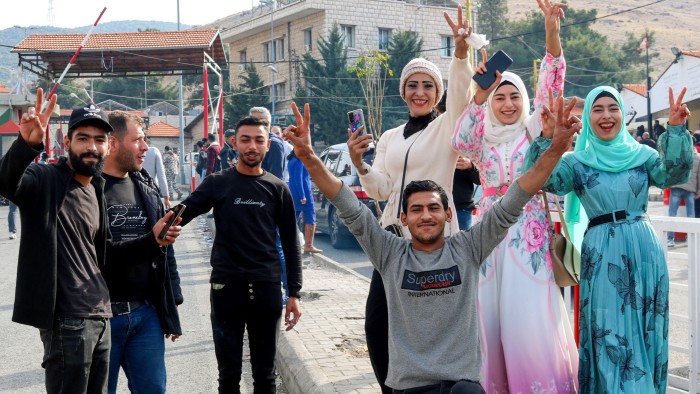
The stunning developments over the past 13 days that led to the rapid fall of the regime have transfixed the world. Statues of the Assads, father and son, have been toppled. Prison doors have been opened. Families have reunited after years of separation across front lines. Thousands are already trying to make their way back to Syria after years in exile. It turns out the answer to the refugee crisis that sent millions of Syrians into neighbouring countries and Europe may simply be the removal of a murderous dictator. Instead, in recent months, more countries were trying to normalise ties with Assad. Italy even sent an ambassador back to Damascus.
Syria broke the world. In August 2013, then US president Barack Obama failed to enforce his own red line over Assad’s use of chemical weapons. Syrians felt abandoned to their fate. There was a spike in foreign fighters travelling to Syria to help the rebels. Soon, Isis was taking over territory from Iraq to Syria. By 2014, millions of Syrians were fleeing the country, including to Europe, where the refugee crisis roiled the politics, leading to the rise of populism, the far right and set the stage for Brexit. The flexible red line was also read as weakness by Russia which intervened to save Assad, increasing its military footprint and testing its war arsenal, including by bombing hospitals.
The Syrian conflict is now proving to be the Achilles heel of the Iranian axis. An ally of the Islamic Republic since its founding in 1979, the Assad regime called on Tehran to help quash the uprising. Hizbollah deployed thousands of men in Syria, transforming from a Lebanese political party and militant group into an Iranian expeditionary force. But Hizbollah’s fighting in the open in Syria for a decade exposed it to Israeli surveillance. This helped Israel’s recent military campaign, which decimated the group’s leadership and destroyed much of its capabilities. Iran’s hubris grew as it added another Arab capital under its control. But helping Damascus also stretched Tehran’s capabilities, siphoned off resources and exposed its vulnerabilities.
It has been a heart-wrenching year in the Middle East, from the Hamas massacre of Israelis on October 7 to the more than 40,000 Palestinians killed in Israel’s war against Gaza to Israel’s ferocious bombing campaign against Hizbollah which devastated parts of Lebanon. The discombobulating series of disasters has left people exhausted by violence, drained by the pain of loss and disillusioned by a western-led order that promises freedom and human rights but fails to uphold these principles in Gaza. Events in Syria are now providing something of a balm. As a friend in Beirut told me: “Being hopeful in 2024 was not on my bingo card.”
The list of challenges for Syria is long, including deep apprehensions about rebel group Hayat Tahrir al-Sham’s vision for the future, the possibility of violent retributions after five decades of oppression and the danger of a resurgence of Isis. Syrians don’t need to be reminded of this — they know, even as they celebrate. They need good faith efforts to support the transition, which also means crucially an end to foreign meddling, including by regional players whose rivalries have played out on Syrian territory.
As for the risk of factional fighting, the country has already endured years of conflict between rival groups. Syrians have been thinking about this moment for over a decade; they may well have forged a new understanding about unity in the crucible of war. There have been celebrations about the demise of Assad even in regime strongholds such as Latakia.
We are condemned to hope again. Hope may not be a strategy — but it can bring down dictators and perhaps even rebuild a country.
Read the full article here

