


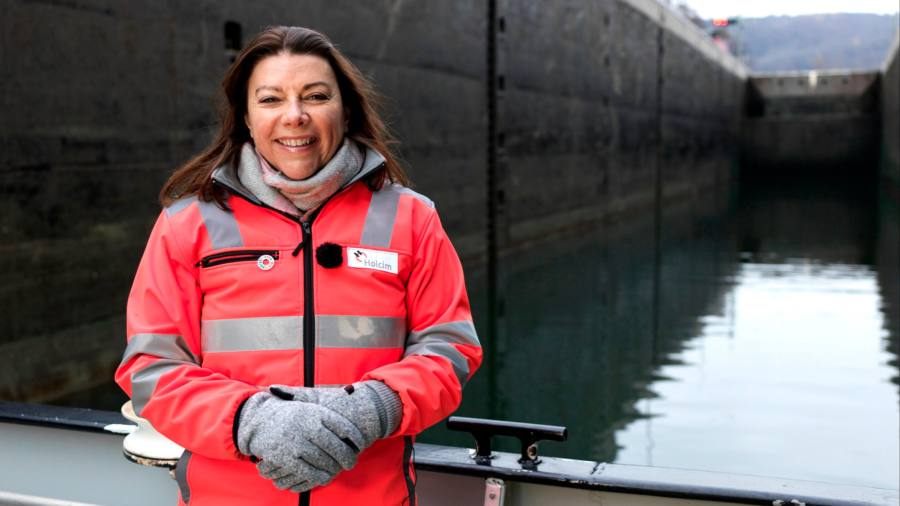
When Magali Anderson, chief sustainability and innovation officer at Swiss cement maker Holcim, recruits for a role on her team, between 50 and 100 people normally apply.
Applications come from people working in well-known non-government organisations, including those focused on the environment, she said. They are looking for a challenge: the cement industry is responsible for about 9 per cent of planet-warming carbon dioxide emissions and the sector is known as “hard to abate”, meaning those emissions are difficult to cut.
“I asked them, ‘what makes you come to us?’,” said Anderson. “They say: ‘I feel I can make a greater difference in the company.’ Impact is driving more and more people.”
A growing segment of workers is concerned about environmental issues, presenting bosses with a host of new challenges: from supporting employees with climate anxiety, to how to hire and retain eco-conscious staff.
Last month, Steffen Krutzinna, a trader at Shell subsidiary Next Kraftwerke, published a LinkedIn post saying he had quit his job after Shell boss Wael Sawan announced a revised strategy that focused heavily on investing to boost oil production. The move came two years after the previous chief executive launched a plan to transform the company into a clean energy provider.
Krutzinna wrote: “I perceive that [new strategy] as a pivotal shift in corporate values, and I feel that short-term profits are above social and environmental responsibilities. I don’t want to be part of that, so I’m out.”
A survey by consultancy Kite Insights of more than 7,000 employees from 10 countries and 15 industries, from oil and gas to fashion, found that 71 per cent said it was important to their motivation and wellbeing at work to take action on climate change.
The research showed “most people are eco-conscious”, regardless of what generation they belong to, according to Sophie Lambin, founder of Kite Insights. “There is a sense of unity around a desire to act [on climate change]. Action at work has the ability to be more than the sum of its parts.”
Katherine Brown, vice-president, inclusive impact and sustainability for Europe at Visa, said employees young and old “really want to be engaged in the conversation” over climate change. This means managers need to listen to staff and consider their suggestions, she added.
She pointed to a recommendation from a member of Visa’s facilities team. With most staff working from home on Fridays, the employee suggested the company could “power down” the top floors of its London building, leaving just the lower floors, including the canteen, open for staff. This has now been done.
Nicola Stopps, chief executive of consultancy Simply Sustainable, said different generations had different demands for their bosses. From their mid-thirties, people wanted tangible evidence that a company “shares their values”, backed up by clear information about what it is doing. They do not want a beautifully designed sustainability report, but clear action in their daily working lives and capital investment such as making buildings more energy efficient, she added.
Climate-conscious members of Generation Z, however, are proving trickier to manage. Now no older than their mid-twenties, they came of age with the Fridays for Future movement, which grew from Greta Thunberg’s school strike over climate change, then mobilised teenagers around the world to follow suit.
“Gen Z are very eco-conscious, they are anxious about climate change,” said Stopps. Managers need to consider how climate anxiety plays into mental health and wellbeing and understand that younger staff have high expectations that employers walk the walk on the environment, she added. Gen Z “are quick to judge and will use social media . . . [they] can sniff out greenwashing way ahead”.
Katy Jarratt, a consultant at recruiter Spencer Stuart, said businesses were becoming aware that younger employees would be key to developing solutions for climate change.
“The people who understand the technology that is going to change the dial on climate change are this age,” she said. These young people have more power to set the terms of their work from management, because “they are the ones who have solutions”.
This even applies when it comes to pay. She recalled one eco-conscious young candidate who, when negotiating remuneration for a post in an extractive company, refused the offer of shares as an incentive because they would not hold investments in a carbon-intensive business.
“They said: ‘I can’t believe you’d think I’d want shares in this industry’,” said Jarratt. The company was forced to come up with something different, offering shares in a “more renewable part” of their operations.
Jarratt added that managers would have to step up if a company was making an announcement that might “trigger” climate anxiety, ensuring they had internal and external communications sorted and were prepared for tough questions from employees. This can be a retention issue: managers who fail to take climate concerns seriously risk being unable to hire the best staff or losing good employees.
“You need to be making sure they have a voice and that it isn’t considered hysterical,” she said. Employees who feel they are considered unreasonable because of their concerns about climate change “are going to feel excluded and leave the company”, she added.
A survey of 2,000 UK office workers from OnePoll on behalf of Supercritical, a company focused on carbon removal, last year found more than half of 18 to 24-year-old workers would consider leaving an employer based on net zero credentials, compared with about a third across all age groups.
Ben Tolhurst, director of Business Declares, a network focused on climate change, said companies also needed to provide clarity and guidance to employees who wanted to take part in climate protests, saying many were concerned about how such action would be viewed by their employers.
It is “something that greater numbers of employees and business leaders are considering”, said Tolhurst. He pointed to recent pickets outside government departments as part of an Extinction Rebellion protest, showing that business people once reluctant to take direct action were now willing to stand outside government buildings.
Deepak Jobanputra, chief sustainability officer at Vitality, the health and life insurance business, said: “As we are recruiting we are getting more and more people asking the question around our environmental credibility. There is a push from these individuals to be doing more.”
Vitality has linked employees’ bonuses to their involvement in training on climate issues, as well as introducing meat-free days in the canteen as part of its efforts around global warming.
Jobanputra said he saw “quite a broad spectrum of views” among the company’s 2,000 employees in the UK. Some are “real champions” of climate issues, for others “it is not top of their mind”.
But Kite’s Lambin warned that managers were missing an opportunity by not tapping into the eco-consciousness of their workforce. Recruitment of people with sustainability skills is a “very hot market”, but it is often “much more efficient to upskill your current employees”, she argued.
“There is a climate and sustainability element in every job,” she said. “It seems crazy to not tap into the eco-consciousness.”
Read the full article here

