


Receive free Indian economy updates
We’ll send you a myFT Daily Digest email rounding up the latest Indian economy news every morning.
Riyaz Ahmed’s mill on the outskirts of Mysuru, part of a fertile agricultural belt in southern India, is stacked with gunny bags full of an unexpectedly precious commodity: rice.
Prices for rice, tomatoes and other staples have surged in recent weeks as the erratic arrival of India’s annual monsoon has upended agricultural production. While heavy rains in some areas washed out crops, their delayed arrival here and elsewhere is stoking fears of poor harvests and even higher prices.
“The monsoon is late . . . and now water is short”, said Ahmed, 69, who has been milling rice for nearly 30 years. “Everyone from the lowest to the highest earners is suffering, including me.”
This surge in food inflation has become a swelling source of concern for Prime Minister Narendra Modi’s government, which last week banned exports of several rice varieties after weeks of public anger over high prices.
The move sent shocks around the globe, with the IMF calling on Modi’s government to reverse its “harmful” decision. India is the world’s largest rice exporter, and many countries depend on it for shipments of the staple.
Analysts said controlling food prices had become a priority for Modi’s Bharatiya Janata party as it prepared for a series of crucial elections, including several state polls this year and the national vote in less than 12 months.
“When it comes to food trade, no government — Modi or anyone — takes a longer-term view,” said Avinash Kishore, a senior research fellow at the International Food Policy Research Institute. “Poorer Indians’ pockets are already being pinched [and] with grain prices going up, no government would want to take that risk, even in a normal year — and this year is an election year.”
The monsoon, which passes across India from June to September, often triggers volatility in food prices. Yet scientists warned that these vital rains are becoming less reliable, leading to more frequent flooding in some areas and droughts in others as climate change alters once-predictable weather patterns.
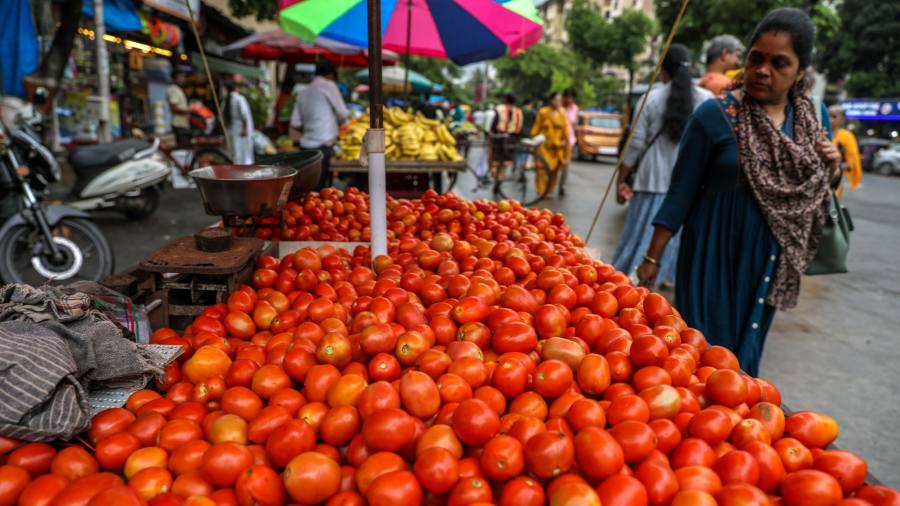
This season has been tumultuous for food markets. Tomato prices have risen about 400 per cent since last month after torrential rains hurt the crop, while the cost of rice has increased 11.5 per cent since last year.
“How to buy? That’s the question I’m asking myself,” said Jeetu Singh, a 32-year-old migrant labourer at a wholesale vegetable market near Mysuru in India’s south-western Karnataka state. “Tomato, rice, dal — everything has gone up.” Another shopper, Jayalakshmi, said she had been cutting back on lentils, oil and other essentials in order to afford her bills.
Though the consumer inflation rate of 4.8 per cent in June remains within the Reserve Bank of India’s target range, the central bank warned this month that the surge in food prices showed “the fight against inflation is far from over”.
The government argued that the rice export ban, which applies only to non-basmati white rice and accounts for about 40 per cent of the country’s exported varieties, would protect domestic consumers while allowing cereal to flow into the global market, helping Indian farmers.
Authorities have responded to the tomato price surge with everything from subsidies to a “hackathon” designed to improve the supply chain.
Higher food prices have in the past proved politically precarious for incumbent Indian governments, with analysts attributing famous election upsets to anger over high onion prices.
India’s opposition has seized on the latest surge to attack Modi’s government. Mallikarjun Kharge, president of the Indian National Congress, the main opposition party, blamed vegetable price inflation on the BJP’s “loot” and “greed”.
“The public has become aware and will answer your hollow slogans by voting against the BJP,” he said this month.
The BJP remains the favourite in national elections, which are due in the first half of next year, but faces a series of potentially tough state polls in Rajasthan and Madhya Pradesh later this year. It suffered a major setback in May, losing control of Karnataka to Congress.
One of Congress’s campaign promises in Karnataka was to double the amount of free rice given to low-income families. Its new state government this month started a cash transfer scheme designed to finance consumption of the grain.
The BJP’s restrictions on rice exports, designed to appease consumers, have upset another powerful constituency: farmers, many of whom stood to benefit from higher prices.
Rajpal Singh, a rice farmer in the north-western state of Punjab, dismissed the export restrictions as a gimmick to manage public perception ahead of the elections. “The government is trying to keep food prices under control because . . . food prices matter the most to a majority of voters,” he said. “They think public memory is short.”
Swamy K, a 68-year-old rice farmer in a village near Mysuru, said he remained loyal to Modi even though he loathed Karnataka’s erstwhile BJP government. But he said his patience with the party was running thin.
“Politicians keep saying that farmers are the backbone of the country, but that backbone has long been broken,” he said. “They put us on posters, but give us nothing.”
Read the full article here

