


Every night for the past 13 years, Rana Aankir has dreamt of her son Raed, his delicate drooping eyes smiling at her as he walks out of the family’s front door in Homs.
In her dreams, he wears the same red sweatshirt he threw over his shoulders before running off to a protest, something she learned only weeks later when he never came home.
Raed was just 16 years old when state security forces swept him up in their crackdown on the popular uprising against Bashar al-Assad’s regime that morphed into a brutal civil war. Over the years, his mother sold most of her belongings to bribe officials for information on which of the regime’s vast network of prisons he was in. It took six years before she learned he was in the most notorious of all: Saydnaya.
“I’ve been searching for him for 13 years. He’s my entire world, he is my life,” said Aankir, who was wandering the halls of the ransacked prison on Monday, desperately searching through stacks of papers and official-looking notebooks for a trace of her long-vanished son. “I need to know what happened to him. I need to find him.”
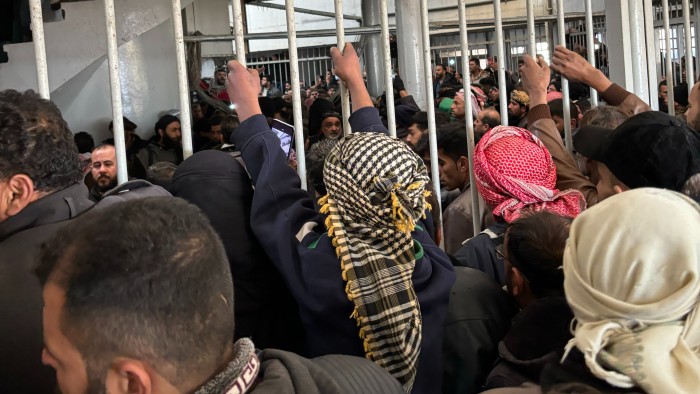
Assad’s downfall on Sunday sparked jubilation across Damascus. Yet the scenes only a day later at Saydnaya captured the despair and devastation left amid the euphoria. Aankir was among thousands drawn to the heavily fortified building on the city’s outskirts, searching for the ghosts of the loved ones that have haunted them since their enforced disappearances. With Assad gone, they hoped they would now finally find answers to years of pain in the labyrinths of his police state.
Like most who turned up in desperation to the prison, she did not find Raed. Instead, she spent the day picking up papers scattered all over the prison complex for clues — “hoping maybe I can read his name somewhere and know if he’s alive”, she said.
On Sunday night a rebel faction from the southern province of Deraa, the Southern Operations Command, reached the prisons and began freeing the first detainees at Saydnaya, replicating what rebels had done in detention facilities across the country.
Videos shared widely across social media showed shocking scenes: prisoners, gaunt and pale, some barefoot in the winter cold and wrapped in threadbare blankets, astounded they were being released. Rebels at the prison on Monday said some of the men released the night before did not even know Bashar’s father, former dictator Hafez al-Assad, had died — an event that took place nearly 25 years ago.
“One man told me he didn’t know where to go now, This prison has been his home for 30 years and he doesn’t remember where his family lives,” one rebel fighter said.
Rights groups, whistleblowers and former detainees say torture was systematic in Assad regime prisons, with secret executions rampant. But Saydnaya, also known as “the human slaughterhouse”, held an especially dark place in the Syrian imagination: a facility of industrialised cruelty, it has long been synonymous with torture, death and despair.
In a 2017 report, Amnesty International found that many of the tens of thousands of people who have been detained there over the decades were locked up for offences as simple as congregating in small groups during the 2011 uprisings that descended into war. They were subjected to routine beatings by prison guards that included brutal sexual assault, electric shocks, bone crushing and more.
Rights groups say that dozens of people were secretly executed every week in Saydnaya, with Amnesty estimating that up to 13,000 Syrians were killed there between 2011 and 2016. An estimated 20,000 people were detained in the prison, it said.
A Syrian military defector known as “Caesar” smuggled out more than 53,000 photographs in 2013. Rights groups say these showed clear evidence not only of torture, but also of rampant disease and starvation in Assad prisons.
The Caesar photographs only emboldened the regime: for decades before that, the prison’s power stemmed from its mysteries. Afterwards, soldiers and guards openly posted videos of gut-churning torture, showing the Syrian people that the horror stories they had whispered about were real and, oftentimes, worse. This fear helped cement Bashar and Hafez’s grip on power.
Many died, and their families were intentionally never told, the wounds of having permanently missing relatives left to fester. Last week, a UN report blamed the regime for withholding basic information about its detainees, saying this amounted to “unimaginable psychological torture” for the families.
In the chaos of that first evening, people grabbed prison ledgers and documents, taking them home or scattering them all over the compound. Lawyers and rights groups say those will be essential for tracing the missing and prosecuting the guilty.
Those families who did not find their relatives camped out overnight, lighting small fires to keep warm. But by Monday morning, that hope had begun turning to angst and despair, amid rumours there were untold thousands still trapped in underground levels of the prison.
Cars were abandoned by the roadside, as people clambered up the hills around the prison long thought to be rigged with landmines to reach it faster. Once there, they were met by the rebels who attempted to impose order on an already chaotic scene and prevent the crowds from rushing the complex. “Please don’t stop us, we just want to find our loved ones,” screamed one man, who was nearly crushed in attempts at crowd control.
Saydnaya’s architecture was clearly intended to confuse, its maze of corridors littered with clues of the horrors meted out there. In one hall, there were cages tall enough to fit a row of men. On the lower levels were the solitary confinement cells, one former inmate said: cramped, windowless and fetid, not wide enough for a person to sleep outstretched on its hard floor.
People had brought shovels and prayer beads to help in the effort. Others roamed aimlessly through metal staircases and cell blocks, reading scribbled notes on walls and letters left behind by prisoners.
Syria’s White Helmets, emergency responders who travelled all the way from the north-western province of Idlib to help excavate the prison, brought mobile machinery to target areas one defector had told them housed underground cell blocks.
Whenever they thought they had found a door or a way to access the underground prison, rebels hushed the crowd into silence by shooting guns in the air.
But hours of digging produced nothing but dashed hopes.
By the early afternoon, the leading Saydnaya prisoners’ advocacy group said they believed that all the remaining prisoners had already been released and urged everyone still at the building to go home.
But people refused to believe. Wild rumours spread, including that a group of detainees had been taken from Saydnaya to an unknown destination before rebels over-ran the prison.
Later on Monday, footage emerged on social media that showed rebels discovering a refrigerated compartment at the Harasta hospital, in the Damascus suburbs, with multiple bodies left behind in a pile, covered in white sheets. Toe tags indicated they were prisoners of Saydnaya.
Read the full article here

