


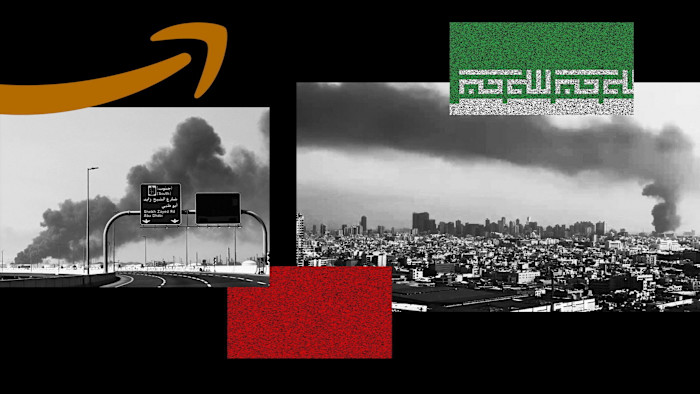
The rapid expansion of American-owned data centres in the Middle East has opened up a new front for Iran’s retaliation against the US, complicating Gulf ambitions to build multibillion dollar AI facilities in the region.
Drone strikes on Amazon Web Services facilities this week in the United Arab Emirates and Bahrain highlight the vulnerability of cloud facilities — prominent symbols of US tech power in the region and hard to defend against air attack.
Fars News Agency, an outlet affiliated with the Islamic Revolutionary Guard Corps, said on Thursday that Iran targeted Amazon and Microsoft facilities in recent drone strikes.
Experts say Amazon’s facilities were likely targeted by Iran. Microsoft said it had not experienced any outages in the region.
The strikes mark what is believed to be the world’s first military attack against the US “hyperscalers” that dominate the global cloud computing market.
That could create a chilling effect on the UAE and Saudi Arabia’s plans to spend billions of dollars on local AI infrastructure in the coming years, a crucial plank of the oil-rich states’ efforts to diversify their economies.
“The Iranians view data centres as part of the conflict,” said Matt Pearl, a director at the Center for Strategic and International Studies, a think-tank. “This is one way of having an actual impact on the region.”
Amazon’s cloud unit AWS has for several days been working to recover services in Bahrain and the UAE, after data centre attacks took down services across the region, affecting consumer apps including online banking.
The company confirmed that two of its facilities in the UAE were “directly struck” by drones, knocking out two of the group’s three so-called availability zones, which help provide redundancy in case of failure. One site in the region is close to Al Maktoum International Airport in Dubai, according to DC Byte, a data centre intelligence group.
An AWS data centre in Bahrain was also affected by a nearby attack. The group operates at least three facilities on the Gulf island including one located in Hamala, near a local military base and the King Fahd Causeway, a road bridge connecting the island state with Saudi Arabia. Another facility borders an aluminium smelter, while one site sits adjacent to the University of Bahrain.
“Even as we work to restore these facilities, the ongoing conflict in the region means that the broader operating environment in the Middle East remains unpredictable,” AWS told clients. “We strongly recommend that customers with workloads running in the Middle East take action now to migrate those workloads to alternate AWS Regions.”
But moving IT workloads can be complex and expensive for the hyperscalers’ corporate customers, especially if sensitive data must be moved across borders.
Several defence and tech analysts said the data centre attacks appeared deliberate and part of a pattern of Iranian strikes on civilian infrastructure, including airports, energy facilities and ports.
Google and Microsoft, the other two major US cloud computing providers, declined to comment on what measures they were taking in response to the growing conflict in the region.
Microsoft announced just last month that it planned to open a new Azure facility in Saudi Arabia by the end of this year, serving customers including local utility provider Acwa and Qiddiya Investment Company, one of the kingdom’s flagship “giga projects”.
Owen Rogers, senior research director for cloud computing at Uptime Institute, an IT infrastructure consultancy, believes the AWS attack was the first time a US Big Tech company’s data centre had been targeted in a military operation.
He said that while data centres serving military needs may be smaller and “hidden away”, a large commercial facility like AWS’ would typically have thousands of customers in the region, creating significant “concentration risk”.
Sam Winter-Levy, a fellow at the Carnegie Endowment for International Peace (CEIP), said data centres in the region were growing in their strategic importance to the US and its allies as Gulf regimes sought to build themselves up into major AI hubs.
The drone strikes highlighted that these could be “soft targets”, Winter-Levy added, with distinct features including air conditioning units, diesel generators and gas turbines. “They’re sprawling facilities and if you knock out some of the chillers you can take them fully offline.”
Saudi Arabia’s Humain and the UAE’s G42, two of the Gulf’s state-backed AI groups, have committed to financing vast data-centre clusters in the region and signed large deals with Nvidia, Amazon and Microsoft. The UAE is also building one of OpenAI’s huge “Stargate” clusters in Abu Dhabi.
“[These strikes] could fundamentally change the risk calculus for private investors, insurers and the tech companies themselves [to invest in the region],” said Jessica Brandt, a senior fellow at the Council on Foreign Relations. “The Gulf sold itself as a safe alternative to other markets. That argument just got harder to make.”
One US tech industry veteran now based in the Gulf said that even though the UAE would likely still want to finance Stargate, the conflict could make it harder for such projects to attract the overseas engineering and construction personnel needed to build it.
He likened the OpenAI project to Intel’s multibillion-dollar chip manufacturing plants in Israel, which are protected by the Israeli military and surrounded by air defences. “You have to build in protection, it’s table stakes” for a project of Stargate’s cost and scale, he said.
Mohammed Soliman, a senior fellow at the Middle East Institute (MEI), a DC-based think-tank, said it fell to regional leaders to put in place safeguards against commercial facilities.
“You can’t add a special layer of defence for data centres,” he said. “This is a question of air defence and this applies not only here, but also in Taiwan and Ukraine.”
Soliman said that the companies who had invested in the region were not blind to some of the risks attached in the area, but cautioned that the US had “made a political decision” to incorporate several Gulf states as “part of its AI ecosystem”.
“This isn’t going to stop anyone building data centres,” he said.
But the ease with which Iran was able to target data centres has raised doubts over how AI infrastructure can be protected worldwide.
CEIP’s Winter-Levy said: “This is a harbinger of what’s to come and these types of attacks are not going to be limited to the Middle East.”
Read the full article here

