


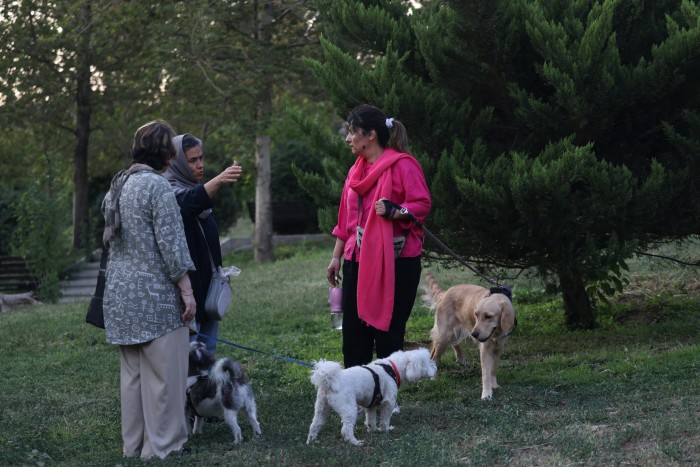
Before the 12-day war between Israel and Iran, Nima, a Tehran dog owner in his thirties, was worried about walking his beloved Labrador, as prosecutors in several Iranian cities cracked down on canines in public.
But now his pet plays happily with other dogs in a grassy park in the west of the Iranian capital on a hot summer evening, its owner confident that authorities are focused elsewhere.
“The priorities have shifted. For now, they are busy looking for Israeli drones,” said Nima. “They look the other way.”
Earlier this year, Iranian dog owners faced tightening curbs on taking their pets into public spaces and even cars, with prosecutors citing concerns about public order, safety and health.
It was the latest in a long series of crackdowns on areas of daily life that left many Iranians resentful and fearful of seemingly arbitrary punishments. These ranged from the petty — such as the dog walking crackdown — to the serious, including the Islamic republic’s requirement that women wear hijabs.
Now, amid the aftermath of the traumatic conflict with Israel in June — in which more than 1,000 Iranians were killed — there are signs authorities are easing off and offering more social freedoms.
Analysts and residents said the shift came as the government sought to avoid antagonising the population and to harness the national solidarity that emerged during the conflict. Rather than social control, it has tried to focus resources on big issues such as rebuilding its armed forces, combating Israeli espionage and managing the beleaguered economy.
“They may not open up politically but I believe we’ll see more space socially. Many women are removing their hijabs,” said Sara, a flight attendant.
Taghi Azad Armaki, an Iranian sociologist, said: “Our political system is so burdened with fundamental problems that its vision is clouded by other concerns,” especially in the wake of Israel’s attacks.
He argued that “a natural and quiet process of social change” had begun to unfold. “That’s how civil liberties evolve around the world. Not through bloodshed, but through pressure, resistance and gradual realisation over time.”
The Iranian regime faces acute vulnerabilities. Israel’s surprise attack on June 13, which included assassinations of top military figures and nuclear scientists, demonstrated its deep espionage penetration of Iran and left many of the country’s military ambitions in tatters. The economy has also been battered by western sanctions and inflation.
Israel’s assault, however, has helped reawaken a sense of patriotism among Iranians polarised along political and ideological lines, including those who have long chafed against the restrictions on daily life.
The Islamic republic’s leadership, in turn, has tapped into this heightened sense of nationalism by invoking history, literature and patriotic songs rather than religious themes.
After the war, President Masoud Pezeshkian thanked people for “putting aside their grievances so that the enemy wouldn’t be able to exploit the situation”, saying that people who disagreed with the Islamic republic were not necessarily its enemies. “The only way to build the country is through unity and accepting diverse views,” he said.
Pezeshkian — who campaigned last year on a platform of moderation and social reform — has faced resistance from hardliners, casting doubt on how much real change he can introduce.
But in the aftermath of the war, parliament speaker Mohammad Bagher Ghalibaf, a hardliner, echoed Pezeshkian’s sentiments. “Today Iranians are divided into only two groups, patriots and traitors to the homeland,” he said, adding that the US and Israel “miscalculated” the Iranian people who “displayed actions that were even more impactful than our missiles”.
Despite the hunt for alleged infiltrators — detaining suspected Israeli collaborators and even accelerating the deportation of Afghan migrants — the system appears to be quietly showing more flexibility in other areas.
For example, authorities appear no longer to be enforcing the rules that had previously made dog walkers liable for fines and even the potential confiscation of their animals, pet owners say.

Female bikers are another group benefiting from less strict oversight. Authorities have long withheld motorcycle licences from women, but Haleh, 22, who previously had her motorbike confiscated, said she was taking advantage of the postwar laxity to ride without worrying about police.
The Islamic republic for now remained focused on “chasing Israeli spies and expelling undocumented Afghans”, she said. “The number of women bikers has gone up and this will eventually force the system to take a step back and give them what they want.”
The Islamic republic’s hijab requirements have long been one of the most contentious social issues and prompted social unrest in the past.
But during the war, the government issued a rare apology, citing “system errors” for a spate of warning text messages sent to women who had driven without wearing Islamic headscarves.
It assured women who received such messages during the conflict that they would not face car impoundments or fines, extending a relaxation of the rules that began before the war.
Pezeshkian had already declined to implement a law passed last year imposing tougher penalties on women opting not to wear hijabs, despite pressure from hardliners.
“We cannot force women to wear hijabs,” Pezeshkian said last week, adding that “force and confrontation” was not a solution.
Hamidreza Jalaeipour, a reformist activist, suggested the establishment should “reward the people by halting policies that have disillusioned them”. Former conservative lawmaker Mansour Haghighatpour said social restrictions such as internet censorship or mandatory hijabs for women must be loosened.
“All I want is for my children to grow up free and live how they want,” said Tahmineh, a housewife. “Why can’t we be like other countries where people with different ideologies live side by side?”
Azad Armaki said that, in Iran, it had often been wars, not revolutions, that acted as “catalysts for transformation”. “Revolutions tend to lead to ideological confrontations, but wars are followed by a focus on development and democratisation,” he said.
Some remained doubtful, however, that the Islamic republic would truly transform. “They have always prioritised ideology over patriotism. That doesn’t change overnight,” said Fariba, an artist.
For Anahita, a dog owner in her late twenties, it remains a surprise that “dogs have suddenly become beloved creatures. They even commemorate and praise them”.
A ceremony was held in Tehran after the war to celebrate Red Crescent rescue dogs that had sniffed out injured people from under rubble. That contrasted with the views of some Islamic scholars, who have linked dogs with impurity.
As Anahita and her husband held a husky and two smaller dogs on leashes, she added: “For the time being, they are distracted elsewhere. They don’t have time for dogs.”
Read the full article here

