


Unlock the Editor’s Digest for free
Roula Khalaf, Editor of the FT, selects her favourite stories in this weekly newsletter.
Japan’s long-dreaded “big one” earthquake could kill almost 300,000 people along its urbanised Pacific coast, create 12.3mn evacuees and cause $1.8tn of economic damage, a new government forecast has warned.
The report, published on Monday in the first update for a decade, centred on a worst-case scenario for the destruction that could be wrought by a magnitude 9 quake in a 900km-long ocean trench where tectonic plates intersect that is known as the Nankai Trough.
Disaster planners based their forecasts on a quake and associated tsunami that would hit along most of Japan’s coastline west of Tokyo.
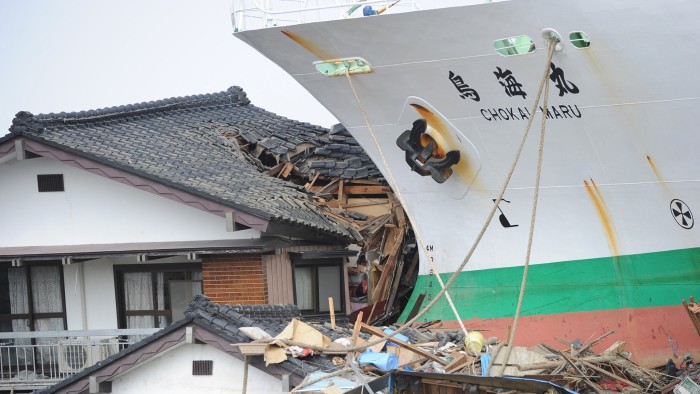
The new report said a megaquake striking with the same force as the magnitude 9.0 tremor that devastated Japan’s north-eastern coast in March 2011 would cause widespread building collapses, tsunamis and fires.
The fiercest damage and the heaviest loss of life and property would occur if the quake struck on a winter’s evening, a time when large numbers of people would either be crowded on public transport and stations, or cooking and heating themselves in fire-prone wooden homes.
The death toll under those circumstances could reach 298,000. The economic damage from direct destruction of buildings and infrastructure, combined with the wider disruption, would run at ¥270tn ($1.8tn), equivalent to roughly half the country’s annual GDP, the report showed.
Similar to the 2011 quake, an all-engulfing wave would be the greatest killer, with the government estimating the tsunami would claim around three times as many lives as the tremor and resulting building collapses. Together they could injure about 950,000 people and destroy 2.35mn houses.
The worst-case death toll is lower than the estimate of 330,000 made in the previous version of the report 10 years ago, a fall credited largely to the strengthening of buildings, development of mobile phone-based warning systems and better general government preparedness.
But the new forecast upgrades the potential economic damage by 26 per cent from the previous report — a change that reflects three years of rising inflation and greater capacity for data analysis on the way that tsunamis and flooding would affect different zones.
The spectre of a massive, hugely destructive quake has always haunted Japan, which is among the most seismically active areas in the world, suffers frequent destruction at nature’s hands and where a large ratio of the human population is clustered in a handful of coastal cities.
In 2017, a new warning system was installed to improve Japan’s readiness for a Nankai megaquake. To widespread alarm, the system’s first alert was triggered last August by a large, but ultimately non-destructive, 7.1-magnitude quake.
Immediately after that, seismology experts said a massive quake had become relatively more likely, prompting a wave of purchases of emergency supplies and equipment by nervous householders.
A government panel of experts said in January that there was an “around 80 per cent” chance of an earthquake of magnitude 8-9 occurring in the Nankai Trough over the next 30 years, slightly higher than the previous estimate.
More than 20 of Japan’s 47 prefectures, including the densely populated metropolises of Tokyo and Osaka, would be directly affected by such a quake. The heaviest death toll, according to the new report, would be suffered in the industrial heartland of Shizuoka Prefecture, where the government fears more than 100,000 people could be killed.
Read the full article here

