


Stay informed with free updates
Simply sign up to the Japanese business & finance myFT Digest — delivered directly to your inbox.
“Vanilla” buybacks are no longer enough to placate shareholders of Japan’s biggest companies, with a string of conglomerates sacking chief executives and selling assets as the country’s corporate governance drive gains pace.
Toyota, Japan’s most valuable company, unveiled plans last month to trim its board from 16 members to 10 and make half of them independent, up from 40 per cent previously. It will also create a separate supervisory committee meant to enable stronger audits and monitoring of management.
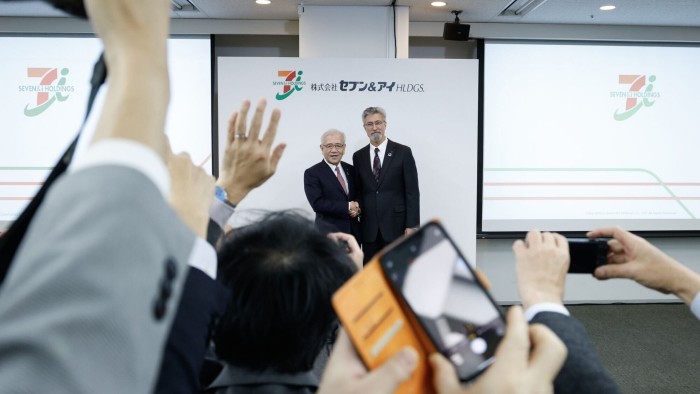
Seven & i Holdings, owner of the 7-Eleven convenience store chain, has embarked on a radical restructuring and replaced its unpopular chief executive, while consumer electronics group Panasonic is restructuring, cutting costs and exploring the sale of several businesses, including its iconic but struggling TV unit.
Other groups that have replaced their chief executives or are considering sales of non-core assets include Rohm Semiconductor, which is overhauling management as it prepares to report its first annual loss in 12 years, and Kyocera, which in January signalled plans to divest low-profit units responsible for $1.3bn, or 10 per cent, of revenue.
The moves are part of what investors and analysts say is a growing appreciation by companies that they can no longer rely on share buybacks, which have hit successive records in recent years, to keep investors happy, with one fund manager describing it as the staid or “vanilla” option.
“Calls for board changes were one of the biggest themes in last year’s [annual meetings], and that call is only going to get louder this year,” said Nicholas Smith, an analyst at CLSA in Tokyo. “The very last thing that Japan investors want is ‘more of the same’.”
Their demands come amid a broader corporate governance overhaul by the government, stock exchange and regulators. In 2014, less than 10 per cent of Japan’s 500 largest listed companies had at least one-third outside directors. Now, the portion is more than 98 per cent.
This has emboldened investors to seek tangible changes beyond one-off returns of capital, including board reforms and higher dividends.
“Investors see large buybacks as a sign that management has run out of profitable growth ideas to reinvest cash flows in,” said Smith. “It doesn’t inspire confidence . . . the corporate governance revolution in Japan is far more about shaking up management to raise margins and raise growth than about buybacks and asset stripping.”
“Assuaging investors by writing a larger cheque is easy,” said David Mitchinson, partner at specialist Japan fund Zennor Asset Management. Selling non-core assets and focusing operations is “much harder” and the “next stage of reform”.
Seven & i Holdings, which is in the middle of a takeover battle with Canada’s Alimentation Couche-Tard, unveiled plans this month to list its North American business in the US and replace Ryuichi Isaka with its first foreign chief executive, Stephen Dacus, to fend off investor dissent.
It has also planned up to ¥2tn ($13bn) in share buybacks after selling a stake in non-core stores to Bain Capital.
Companies have also been unwinding parent-subsidiary shareholdings, which the Tokyo Stock Exchange has said could lead to mistreatment of minority shareholders. Retailer Aeon this month announced it would buy out shareholders in two subsidiaries.
A person familiar with Toyota’s thinking said its board changes were a pre-emptive move to satisfy investors ahead of its annual meeting in June.
Last year, two US proxy firms advised shareholders against reappointing the chair after the company came under fire over testing data scandals at subsidiaries. Akio Toyoda was re-elected with 72 per cent support, a drop from 84 per cent a year earlier.
At a press conference last month, Takanori Azuma, head of human resources at Toyota, denied the board changes were linked to the testing data scandals and said they were aimed at improving board discussions and part of a “constant evolution”.
Activist shareholders have already started to go on the offensive, rallying investor support for their proposals to companies with annual meetings this month.
Oasis Management and 3D Investments have staged campaigns to overhaul governance at cosmetics maker Kao and beer producer Sapporo respectively.
Read the full article here

