


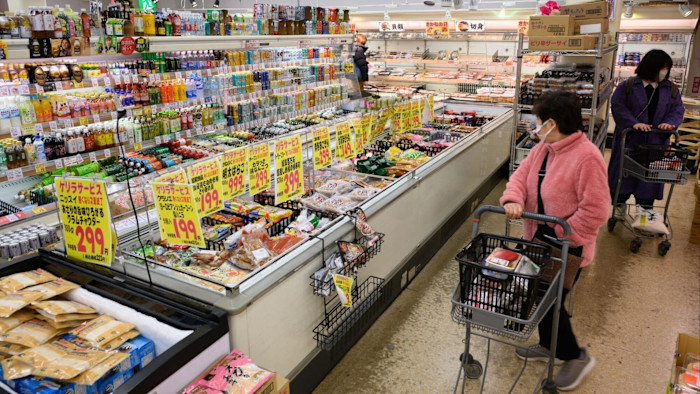
In the bicycle park outside OK supermarket in Tokyo’s Togoshi district, Fumiko Kobayashi is loading her basket and rucksack with shopping she increasingly struggles to afford. Three years ago, the same purchase cost ¥6,000 ($39); now, she says, it costs ¥10,000.
“Our household budget has been compressed, and my income isn’t going up,” said the 74-year-old pensioner, who said her vote in next month’s general election would not go to Prime Minister Sanae Takaichi and the long-incumbent Liberal Democratic Party.
Across the city at another OK branch, 36-year-old office worker Yukie Ohara used to shop at a higher-end supermarket but now makes a longer trek to a gekiyasu, or “dirt cheap”, discounter.
“I’m voting for Takaichi because I think she is trying to change things . . . at least, I think we should give her a chance to prove herself,” said Ohara.
The February 8 snap election, for which Takaichi has put her three-month premiership on the line, is expected to hinge on the votes of millions of similar voters: the setsuyaku ikka, or “frugal families”, of middle Japan, scrimping where they can in an economy suddenly jolted by inflation and rising interest rates.
There are few better barometers than OK itself, which has more than doubled sales within a decade. Household brands compete for shelf space with lesser-known names in its narrow aisles, where products are stacked high and presentation comes second to price. OK is opening more than 10 stores per year across Japan’s two biggest conurbations.
The bigger picture, said analysts, is that Japanese politics are adapting to the country’s stratifying middle class.
“In better days, the candidates and the parties would assume almost everyone was middle class. But now there is a sense that the decline of Japan and of its economy is sufficiently large that people who once felt middle class are really feeling the effect of rising prices in a way they never did before,” said Koichi Nakano, a political scientist at Sophia University.
“The parties see these people as floating voters and they have to go after them.”
Like many political analysts and economists, OK’s boss highlighted fundamental changes in voters’ finances. “We are really seeing a kind of polarisation,” said Ryotaro Ninomiya, president of OK Corporation, who added that some people “really are struggling” to make ends meet.
With some Japanese cushioned by generous state support and sizeable assets, the “polarisation and concentration of wealth is becoming more pronounced”, he added.
More voters than ever before are in the setsuyaku ikka category. Median household income has slid from ¥5.5mn ($36,000) in 1993 to ¥4.1mn in 2023, according to labour ministry statistics.
Bookstores stock entire sections on penny-pinching strategies, while daytime TV shows feature cookery experts teaching cost-saving cuisine. Polling shows food prices as voters’ top concern.
Takaichi’s promise at the launch of her campaign to suspend a consumption tax on food for two years was aimed at responding to those anxieties. The main opposition bloc has pledged to cut the tax indefinitely.
But some warn such a strategy is dangerous. Outside Tokyo station on Wednesday, Yuichiro Tamaki, leader of the Democratic Party for the People, another opposition party, said Japan’s fiscal strain had been driven by “election-driven handouts” and advocated broader tax relief to lift overall take-home pay for the middle class.
Financial markets are concerned that an election fought around food prices and pledges of government spending could put pressure on national finances. Takaichi’s consumption pledge triggered a surge in long-term government borrowing costs.
It is not only supermarkets that are braced for changing consumer habits. Convenience stores and clothing retailers are also being squeezed by a bifurcation between the wealthy and the thrifty.
“Japanese people overall are becoming less affluent and more price sensitive,” said Takuro Ueji, co-head of Japan at AlixPartners, a consultancy specialising in restructuring. “High-end brands continue to perform well, but mid-tier brands and retailers are struggling. The mass market, in particular, is becoming less and less wealthy.”
Even though supermarkets and food suppliers might earn higher profits from a consumption tax cut, retail executives are not convinced.
OK’s Ninomiya said it would probably weaken the yen and push up interest rates, risking a “negative cycle” of more handouts and further currency depreciation. “Part of the reason Japanese people feel much poorer right now has to do with the weak yen,” he said.
Mieko Nakabayashi, a political scientist at Waseda University said that, while food prices had been a feature of the past two elections in 2024 and 2025, the political focus was now at unprecedented levels.
Takaichi’s high approval ratings suggested the prime minister was immune to arguments that her early policy proposals might exacerbate cost-of-living concerns, rather than tackle them, Nakabayashi said.
“People seem to like her, but I don’t think voters are distinguishing between her plans to increase government spending, and their own problems with inflation,” said Nakabayashi. “More government spending is presented as something that helps ordinary people, but it can make inflation worse.”
Yoshitaka Takahashi, another pensioner shopping at OK in Togoshi, said food had gone from 30 per cent to 50 per cent of his monthly spending. But he disagreed with the prime minister’s proposal to suspend the food consumption tax.
“Consumption tax going to zero means it has to come from somewhere else,” said the 70-year-old former engineer.
Still, he added that the prime minister’s charisma and candour overshadowed her other proposals. “I’m voting for Takaichi,” he said.
Data visualisation by Haohsiang Ko in Hong Kong
Read the full article here

