


Stay informed with free updates
Simply sign up to the Geopolitics myFT Digest — delivered directly to your inbox.
The writer is an FT contributing editor, chair of the Centre for Liberal Strategies, Sofia, and fellow at IWM Vienna
In an old joke, two fortune tellers meet and after a few obligatory minutes of respectful silence one says to the other, “Looking into the future, I see that you will be fine. But what about me?”
I was reminded of this story when, at a recent public talk in Vienna, a member of the audience asked me how, at the moment, a liberal-minded European could be an optimist about the future of Europe.
The questioner had a point. In the wake of Donald Trump’s victory in the US presidential election, with wars in Ukraine and the Middle East, contending with a faltering economy and paralysed by fear of migration, Europeans have started to resemble Chance, the character in Hal Ashby’s film Being There.
In a role played brilliantly by the late Peter Sellers, Chance lives sheltered away, tending to the garden of a mansion and watching television.
When he is finally evicted and forced to confront the real world, he is soon attacked by a knife-wielding thug. The only response he can muster is to take a television remote control from his pocket and try to change the channel. Chance survives. The future of the EU, however, should not be taken for granted.
In recent years, Europe has been busy trying to defend a status quo that in fact ended long ago, speaking a language that is no longer comprehensible. It has wasted energy and money in an effort to restore a world that will not come back.
Now European democracies are on the verge of a nervous breakdown. They are threatened simultaneously by voter anger and elite panic. Voters dream of punishing the elites, while the establishment wishes it could tranquillise the electorate.
The recent decision of Romania’s Constitutional Court to annul the results of the first round of the presidential elections because of alleged foreign interference — but also probably because the ruling parties did not like the results — suggests that the panic of the elites could become more dangerous than the anger of the voters. Meanwhile, governments’ attempts to mobilise national unity in the face of external threats are failing to persuade people to rally round the flag.
The only way for liberal-minded Europeans to overcome their pessimism is to try to understand how and why they were betrayed by their own excessive optimism at the end of the cold war. Until they grasp just how misplaced this “end of history” triumphalism was, they will remain haunted by the spectre of things falling apart.
Looked at in sober retrospect, 1989 no longer appears to have been liberalism’s high noon. It was in fact also a year of great promise for radical Islam. In that year, an Islamist insurgency (in Afghanistan) defeated a superpower (the USSR) for the first time. The withdrawal of Soviet troops from Afghanistan turned out to be transformative — not only for Islamists but also for ordinary Russians.
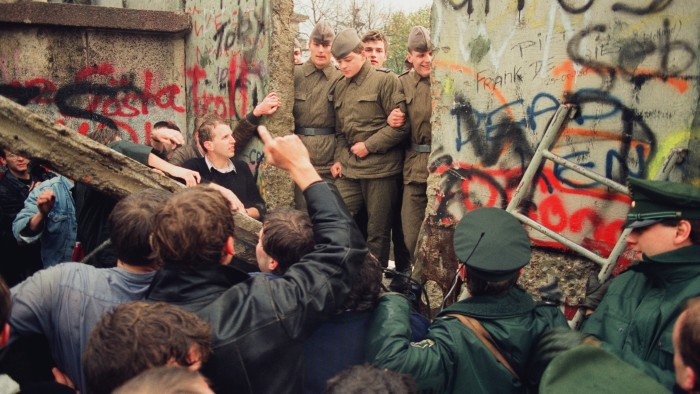
When, in 2019, the independent Levada Center asked Russians what defined 1989 for them, most pointed to the humiliation of the Soviet withdrawal rather than, say, the first free elections in Poland in more than 40 years or the fall of the Berlin Wall. It is not the end of communism but Moscow’s loss of its superpower mystique that has shaped Russians’ memories of 1989.
Looked at from today’s vantage point, the resilience of the Communist regime in China is a more significant historical marker than the failure of communism in Europe. Moreover, the rise of the so-called middle powers such as India, Turkey and Brazil is a more important force in shaping the new geopolitical landscape than the constantly cited rivalry between the US and China.
Likewise, technology and demography — our relationship with artificial intelligence and the fear of shrinking and ageing populations — will henceforward be more decisive factors in shaping national politics than the ideological struggle between democracy and autocracy.
It may turn out that the most important thing to have occurred in 1989 was the departure of a 17-year-old Elon Musk from his native South Africa. His experience as a young white man in the final years of apartheid has clearly helped to shape his current political outlook. Musk’s evocation of the violence of everyday life in South Africa in the 1980s is echoed by Trump’s dystopian vision of contemporary America. What alternative is there but to find a way to Mars?
Dancing to an ever-changing tune may be exhausting for the liberal-minded European, but it can also be liberating. When, decades hence, people look back at 2024, it is entirely possible that neither Trump’s victory nor the rise of authoritarianism around the world will seem as consequential as they do now. The lesson Europeans need to absorb is that history is married to nobody — it is single and takes many lovers. So there’s no need to panic.
Read the full article here

