


Unlock the Editor’s Digest for free
Roula Khalaf, Editor of the FT, selects her favourite stories in this weekly newsletter.
Microsoft said it had succeeded in harnessing a new state of matter to create the basic building blocks of a quantum computer, capping a 20-year struggle on the frontiers of physics that many in the quantum world had dismissed as unworkable.
The US technology giant said it believed the development would enable it to build a practical quantum computer by the end of the decade and eventually leapfrog others in the field.
The claim adds a new twist to the race to create a new form of advanced computing that has drawn in some of the biggest US tech companies and become central to the struggle for tech leadership between the US and China.
Microsoft’s claimed breakthrough follows years of research into a type of particle that comprises a fourth state of matter, distinct from solids, liquids and gases. The existence of the particles, known as Majorana fermions, was first theorised in 1937, although scientists have struggled to demonstrate they actually exist.
Microsoft chief Satya Nadella said eight years ago that its work on the technology had put it “on the cusp” of a “quantum revolution”. But it was not until 2022 that the company’s scientists were even able to record effects that they believed were caused by the particles.
The US tech group placed its bet on the theoretical particles after deciding that they offered the best route to overcoming the biggest obstacle to building a practical quantum machine. While the bits in a traditional computer represent ones or zeroes, the qubits used in quantum computers are able to represent both at once, or any state in between.
However, most types of qubit only hold their quantum states for tiny fractions of a second, meaning that any information they hold is quickly lost. To make up for this, fully functioning quantum computers will require many extra qubits to run the software needed to correct for errors.
By comparison, the so-called topological qubits Microsoft has been trying to make using Majorana particles are more resistant to error. Information is held across the whole qubit, meaning that even when parts fail, a topological qubit as a whole should retain enough information to make it useful, said Sankar Das Sarma, a physics professor at the University of Maryland.
This greater stability means Microsoft is likely to need only about 100 extra qubits to correct the errors for every one, fully operational qubit, said Jason Zander, executive vice-president of strategic missions and technologies at Microsoft. That is roughly a tenth as many as are expected to be needed in machines whose qubits are based on other materials.
The latest data released by Microsoft, including in a paper published in Nature on Wednesday, represented a significant breakthrough towards creating workable topological qubits, said Das Sarma. However, he said there was still a small chance that the company’s findings could be explained away by something other than the successful harnessing of the elusive particles.
Microsoft’s long-running research effort was plagued by problems making components capable of producing and controlling the particles. The company published joint research with a number of universities in 2018 claiming to have observed the particles but later retracted the paper after admitting to inconsistencies in the data.
Speaking before the latest announcement, one longtime investor in quantum computing compared its ambitious research to the pursuit of cold fusion, the effort to produce a nuclear reaction at room temperature that has become a byword for scientific overpromising.
It also comes just weeks after Nvidia chief executive Jensen Huang forecast that useful quantum computers were still 20 years away — much longer than companies working in the field claim.
In one sign of official US interest in the ambitious technology, Darpa, the US defence department agency charged with developing advanced technologies, this month selected Microsoft to try to demonstrate it could build a large-scale quantum computer.
US start-up PsiQuantum, the only other company selected by Darpa, uses qubits based on photons, and last year announced a $620mn project to build a full-scale quantum system in Australia.
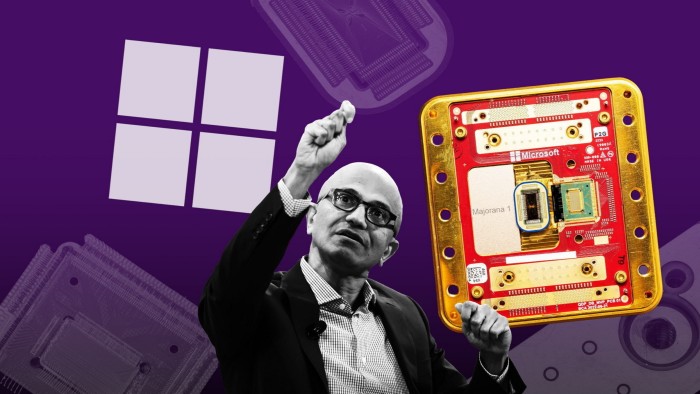
Along with the latest research and data backing its claims to having mastered Majorana particles, Microsoft said it had built the first processor using the technology.
Called the Majorana 1, the chip is based on eight topological qubits. The tiny size of each component meant that it would eventually be able to squeeze up to 1mn qubits on each chip, creating a full-scale quantum computer, the company said.
Read the full article here

