


Receive free Indian politics & policy updates
We’ll send you a myFT Daily Digest email rounding up the latest Indian politics & policy news every morning.
Today’s India is an “illiberal democracy”. Freedom House, the US think-tank, puts it at the same level as Hungary, whose leader, Viktor Orbán, invented that phrase. But it rates the components differently: political rights, notably electoral politics, are healthier in India than in Hungary, but civil rights are weaker. Worse, the latter have deteriorated substantially under BJP rule since 2014. India’s ratings on democracy are still far higher than those of, say, Bangladesh, Pakistan or Turkey. But it is not a “liberal democracy”: Freedom House simply labels the country “partly free”.
Yet, as India’s polity has become less liberal, its government has become more effective. World Bank indicators show that “political stability and absence of violence”, “control of corruption”, “regulatory quality” and “government effectiveness” have improved since Narendra Modi became prime minister. But “voice and accountability” and “rule of law” have worsened. His government is more repressive and more effective than its predecessors
As Ashutosh Varshney of Brown University notes in “India’s Democratic Longevity and Its Troubled Trajectory”, the country’s vigorous democracy was an anomaly. It should not have lasted in an agricultural country with a significant rate of illiteracy. Yes, this democracy was imperfect, with high levels of corruption and violence, not to mention Indira Gandhi’s “emergency” in the mid-1970s. But it worked.
Varshney’s hypothesis is that political ideology played a central role in first creating the democracy and now weakening it. The founders of independent India believed in democracy. Over time, as its politics became more fragmented, politicians thought democracy was in their interest, too, since it allowed them hope to fight another day. But today’s Hindu nationalists have a different point of view: for them, a true Indian must be a Hindu. Their critics are “anti-national” and so inherently treasonous.
This perspective justifies administrative and legal action against independent voices in universities, think-tanks and the media. The government can now designate any individual a terrorist based on personal writings, speeches, social media posts, or literature found in their possession. According to Rahul Mukherji, close to 17,000 civil society organisations have been denied registration or renewal since 2015. Moreover, minority rights, especially of Muslims, are under attack, not just through the law or administrative decrees, but also through vigilante violence.
All this is clearly illiberal. But is it also undemocratic? Majoritarians argue that they are entitled to do what they wish because they won. But a dictatorship of the majority is still a dictatorship. Moreover, without freedom of association and opinion, an opposition cannot function. Rahul Gandhi, a leading opposition politician, has been sentenced to two years in prison for remarks he has made on Modi. Such intimidation makes a competitive democracy infeasible. Moreover, as is too often the case in first-past-the post multi-party elections, the BJP won a huge majority of seats in 2019, despite winning fewer than 40 per cent of votes. This is hardly a true majority.
Yet we must remember that democratic rights do not of themselves fill empty stomachs or produce good jobs. Encouragingly, a recent report from the UN Development Programme argues that between 2005 and 2021, 415mn people were lifted out of “multidimensional poverty”, and the incidence of poverty declined from 55 per cent to 16 per cent. The most rapid declines occurred in the poorest states and union territories. The Modi government must take a good part of the credit for this.
At the same time, as Ashoka Mody notes, the employment record of India is persistently poor. A crucial failure is India’s low (and falling) female participation rate. Moreover, the growth rate has not accelerated under the BJP. Even today’s “India stack” of universal digital access and the successful direct distribution of welfare payments derives from the unique identity system created by Nandan Nilekani, co-founder of Infosys, when Manmohan Singh was prime minister. Moreover, strong and centralised government can make big mistakes. Demonetisation in 2016 was such a mistake. Another was the Covid lockdown in March 2020, which forced some 40mn migrant workers to return home, many of them on foot. Moreover, such governments frequently have over-close relations with business cronies. This one seems to be no exception.
For someone who has long admired the vigour and diversity of Indian democracy, this growing illiberalism is depressing. It is particularly depressing given India’s rising role in the world. I can see no good reason why a predominantly Hindu society should not tolerate minority faiths. I can see no reason either why it has to assail a diverse civil society. Yet that is where the Modi government seems to be going.
Those who worry about this will be reminded that Hindus are highly tolerant. According to a 2021 study of religious attitudes by the Pew Foundation, 85 per cent of Hindus (who are 80 per cent of the population) believe that “respecting all religions is very important to being truly Indian”. Unfortunately, the 15 per cent who do not share this view are 90mn adults. Moreover, nearly two-thirds of Hindus say it is very important to be Hindu to be “truly” Indian. Thus the politics of religious identity carry dangers for both freedom and stability even in India.
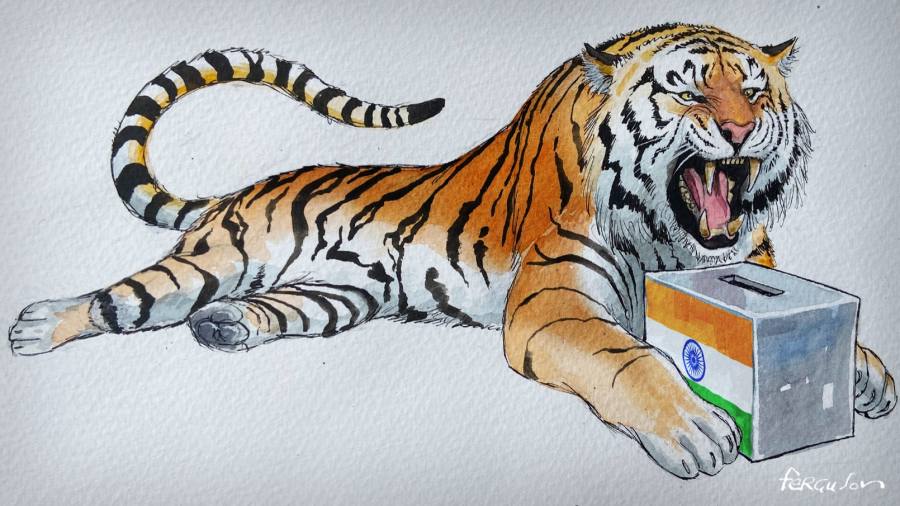
This government rides the tiger of politicised religion on what it hopes to be a long journey towards the destination of creating a modern, prosperous and strong India. The question is not just where it will end up, but whether it can avoid being eaten on its journey.
Follow Martin Wolf with myFT and on Twitter
Read the full article here

