


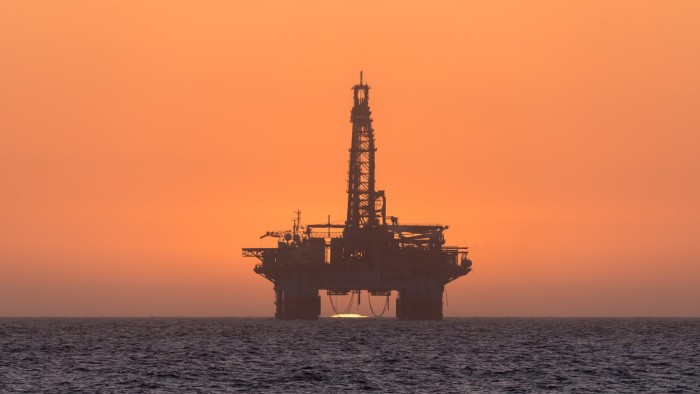
Namibia could double its annual GDP growth to 8 per cent within a decade and reduce its dependence on diamonds because of new offshore oil and gas finds, according to the southern African country’s mining and energy minister Tom Alweendo.
Alweendo’s party Swapo, in power since independence in 1990, hopes the promise of riches from big energy discoveries in the past five years — which have lured TotalEnergies, Shell, Chevron, ExxonMobil and Galp to Namibia — will help it win the November 27 election.
But dissatisfaction with the economy among Namibia’s 3mn people has been rising, increasing the risk for Swapo that it could lose its parliamentary majority as its fellow “liberation parties” did in neighbouring South Africa and Botswana this year.
“If these oil finds are developed to their potential, Namibia could easily double its GDP [growth]. And that’s huge,” said Alweendo in an interview with the Financial Times, when asked about the growth rate.
“But the major focus for us will be on how this resource could help improve the livelihood of the average Namibian.”
Alweendo — an influential leader of Swapo who in 1997 became the first Namibian governor of the country’s central bank — cited the cautionary tales of Angola and Nigeria, which both discovered oil decades ago, but which still suffer from high poverty rates.
“Hopefully, Namibia has learnt enough lessons from others. So, we plan to use these discoveries to create other economic opportunities, and we will insist on strong governance,” he said.
Namibia’s government has faced criticism over its inability to address unemployment of about 20 per cent and high inequality — second only to South Africa — despite its diamond wealth.
Teresia Kaukuhowa, professor at Namibia’s University of Science and Technology, said other elections in the region this year were swayed by economic frustrations. “Namibia’s leaders should heed this sentiment and direct potential oil and gas revenues towards inclusive policies, such as labour-intensive job creation.”
Alweendo said the government had made inroads into inequality, but not fast enough for a population that has doubled in three decades. He conceded this presented a risk for Swapo.
“What we’ve seen in elections elsewhere in Africa this year, it’s all about the economy. People worry about the livelihoods and people are no longer willing to just vote [for] a party because his father did, and his grandparents before that,” he said.
He said Namibia needed to “fast-track” the oil and gas finds — with production potentially beginning as early as 2027 — so that the resulting revenue could be passed on soon. “We all want fast-tracked oil and gas developments,” he added.
In part, that is because Namibia’s budget has taken a hit from falling prices of mined diamonds, which until now provided about half of the country’s export earnings. Their value has fallen as lab-produced diamonds became more common.
Paul Eardley-Taylor, southern Africa oil and gas expert at Standard Bank, said these discoveries were significant enough to potentially reshape Namibia’s economy.
He said energy data group Wood Mackenzie estimated they included 8.9bn barrels of oil equivalent, “which is sizeable”. “But only 11 wells have been drilled so far, so we could see that number increase sharply in the next few years,” Eardley-Taylor said.
He cited Guyana in South America, which discovered oil in 2015 — seven years before Namibia — and whose GDP grew 62 per cent in 2022 and 38 per cent last year, with 42 per cent growth expected this year.
“Guyana represented the biggest emerging market offshore discovery in recent times, but potentially Namibia’s reserves could be even larger,” he said.
Eardley-Taylor said Alweendo’s target of fast-tracking production to 2027 was “not impossible”, but would depend on how accessible the oil is in shallower waters, and the flexibility of legislation.
Analysts say Namibia’s natural resources will play a big role in the election.
“A lot of Namibians feel that, 34 years after independence, their lives haven’t improved that much economically, despite resources like diamonds and uranium,” said political analyst Ndumba Kamwanyah. “People are sceptical that the new discoveries of oil and gas, as well as green hydrogen, will benefit the majority.”
The signs for Swapo are ominous, he said. in the 2019 election, Swapo lost its two-thirds majority for the first time, while support for late president Hage Geingob plunged from 87 per cent to 56 per cent. It lost further ground in 2020 local elections.
This time Swapo has nominated Nandi-Ndaitwah Netumbo as president, who would be the first female head of state.
“It is possible that Swapo may still win the election, but it will not be a landslide. And if there’s no clear winner, and there is a run-off, that would be bad news for Swapo,” said Kamwanyah.
Namibia’s government also faces pressure from environmental activists. The country is rich in renewables, in the form of sun and wind.
“In the end, we all want climate justice,” said Alweendo. “But is there any justice in saying to Namibia, don’t develop this find, when other countries have benefited from this [oil and gas] for decades? If Africa were to monetise all its fossil fuels, it would still contribute less than 5 per cent of global emissions.”
Read the full article here

