


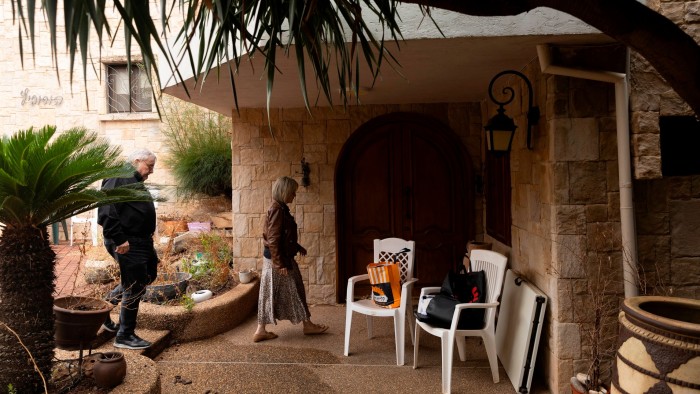
After his hometown of Kiryat Shmona was evacuated at the start of the conflict between Israel and Hizbollah last year, student Raz Malka told himself that as soon as he had the chance to go back safely, he would take it.
But when a ceasefire finally took effect on Wednesday, offering the hope of an end to 13 months of fighting, the 24-year-old found himself wavering about whether to return to Kiryat Shmona, which lies just 2km from Israel’s contested border with Lebanon.
“I have a big question mark in my head,” he said. “Because I don’t know if two years from now a [Hizbollah] soldier will come and invade northern Israel, and we will find ourselves in the same situation that we saw with our own eyes on October 7 in the south. And this is hard for me.”
Tens of thousands of Israelis now face the same dilemma: whether to take the risk of going home.
Hizbollah began firing at northern Israel last October in solidarity with Hamas after the Palestinian militant group’s devastating attack on the country’s south.
In response, Israel evacuated about 60,000 people from communities in a 5km-deep strip of land abutting its border with Lebanon, which has since suffered mass displacements and widespread destruction from Israeli attacks.
For the last year, the evacuees have been scattered across the country, their lives on hold as they camped out in hotels, resorts and other temporary accommodation.
Creating the conditions for them to return home has become one of Israel’s main war goals.
But the country is split on whether Wednesday’s ceasefire deal will help achieve that, or even whether it is a good idea.
The agreement, which appeared to be holding on Wednesday, stipulates that Israel will gradually withdraw its forces from Lebanon over 60 days, while Hizbollah must keep its forces behind the Litani river, some 30km from Israel.
A snap poll by Israel’s broadcaster Channel 12 in the hours after Israeli Prime Minister Benjamin Netanyahu announced the deal on Tuesday night found that 37 per cent of Israelis backed it, 32 per cent opposed it, and 31 per cent were unsure.
In Haifa, the largest city in Israel’s north — which Hizbollah increasingly targeted with rocket salvos as the war continued — some locals said the time had come to make a deal.
“Of course I would like Hizbollah to be completely destroyed,” said Asaf, who works in a small store near the city’s Rambam hospital. “But I am not naive enough to think that can happen.”
But those who live closer to the border not only fear Hizbollah’s rockets, but are also afraid, after October 7, that the Lebanese militant group could one day carry out cross-border raids of its own. Some are angered by the terms Israel has agreed.
“We sacrificed a year and two months out of our homes, sacrificed our economy, our communities, our families for nothing,” said Nisan Zeevi from Kfar Giladi, a kibbutz less than 2km from the border with Lebanon, who before the war was general manager of a start-up hub in Kiryat Shmona.
“The end point should have been like between North and South Korea: a 4km dead zone, no one there. No one,” he said.
“We put our faith in the international community [at the end of the last war with Hizbollah] in 2006. We thought for 17 years that they were making sure that there is no Hizbollah near our border. And it was all fake . . . [The deal] is a huge mistake.”
In Kiryat Shmona on Wednesday, there were small signs that some of the past year’s disruptions were easing. Traffic lights, which blinked orange for months, had been switched back on.
The GPS signal once again showed locals their actual location, rather than placing them in Beirut, as it did while signals were jammed to deflect guided missiles and drones.
But the city remained deserted. Almost all shops were closed. And the scars of the last year remained visible. In the bus station just off the main road, three buses damaged by rockets stood side by side, one with all its windows blown out and its insides incinerated.

A few hundred metres away, two workmen had finally begun repairing the scorched and twisted metal of a shop front that was hit by a rocket several months ago.
Igor, a 35-year old working in an electronics shop on Kiryat Shmona’s main road, said he expected that 80 per cent of the city’s 24,000 people would eventually return.
But he said he could understand those who would not. He did not trust that the Lebanese army and UN forces would keep Hizbollah away from the border, and had bought a gun to make himself feel safer.
“I don’t like it, because I don’t think it’s good for everyone to have weapons, like in the US where they shoot each other all the time. But I need it for my security,” he said. “I am not afraid of the rockets. I am afraid [Hizbollah] will come to my home.”
In a convenience store a couple of doors down, the cashier, Shay, said there had been a small increase in the number of people in the town since the ceasefire was announced. But he guessed most were still waiting to make up their minds about the future.
“Now we are meant to have two months of calm,” he said. “People will come back and see their homes, clean them up, see what has been damaged. And then later they will decide whether they are coming back for good.”
Cartography by Cleve Jones
Read the full article here

