


The writer is a professor at the Fletcher School and currently chairs the Truth, Justice, and Peace Commission on south-east Nigeria
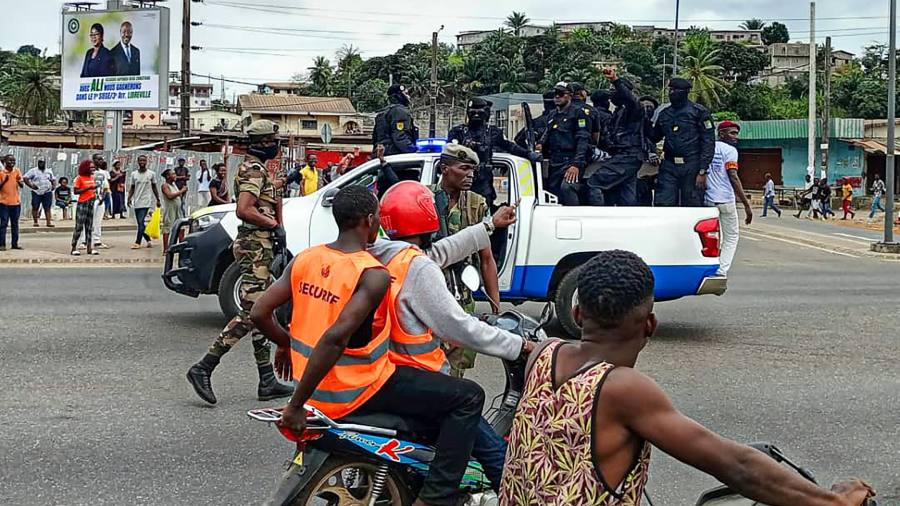
All over Gabon, the small central African country and former French territory, spontaneous celebration greeted news of the ouster of President Ali Bongo by the military this week. Gabon’s electoral commission had just declared election results in his favour under cover of darkness following days of internet shutdown, a curfew and border closures, yet citizens poured on to the streets celebrating his expulsion rather than his victory. The plausible explanation is that Bongo lost the election but, instead of leaving office with dignity, tried to hang on to power by manipulating the results with the complicity of officials beholden to his family.
This is the third coup attempt in Gabon’s history and the first to succeed. It is also the 22nd coup attempt in Africa since 2013, and the 11th successful one since the military ousted Robert Mugabe in Zimbabwe in 2017. Other countries in which military coups have succeeded since then include Burkina Faso, Chad, Guinea, Mali, Niger Republic and Sudan.
In February 2009, the African Union called attention to a “resurgence” of military coups around the continent. Events since then suggest that they have been ineffective in addressing the underlying causes of these events. The response to recent trends has been largely to pathologise coups in Africa. In October 2021, UN secretary-general António Guterres complained of “an epidemic”. Others speak of an African coup contagion.
This kind of language hinges on three assumptions. The first is that all military takeovers are the same. This is not entirely accurate. The ousting of Sudan’s dictator, Omar al-Bashir, in April 2019 followed a popular uprising that made the country ungovernable under his rule. While it had the power to bring down Bashir, however, the uprising did not have the organisation to install a legitimate successor. The military exploited the resulting political vacuum to seize power. When a similar uprising forced President Blaise Compaoré from power in Burkina Faso in October 2014, General Honoré Traoré also assumed transitional authority in what was loosely described as a coup.
The second is that coups are only executed by the military. This is the default assumption of the international diplomatic community of institutional behaviour. The result is that civilian rulers who overthrow constitutional orders under which they were installed mostly get away with it. In Guinea, for instance, the term-limited former president, Alpha Condé, needed a civilian coup to turn him into president for life. In 2020, he organised a violent referendum in which scores were killed, with the pre-determined outcome of changing the constitution in order to succeed himself. The international community watched much of this in complicit silence only to find its voice after the military overthrew Condé in September 2021. They then promptly called for a restoration of “constitutional order”. In reality, however, Condé had destroyed whatever constitutional order there was. There was none left to restore.
The third assumption is that every civilian government overthrown by the military is both legitimate and a democracy. Gabon illustrates how this attitude brings democracy into disrepute. Ali Bongo succeeded his father, Omar, who died in June 2009 after ruling for nearly 42 years. The day after Gabon’s presidential election of August 27 2016, opposition candidate and former chair of the African Union, Jean Ping, claimed victory, calling on his opponent, Bongo, to congratulate him. Bongo’s response was to recite a proverb: “You must not sell the skin of the bear before you’ve killed him.”
On August 31 2016, Gabon’s electoral commission awarded the election to Ali Bongo, giving him a margin of 5,594 votes over Ping, who won in six of the country’s nine provinces as well as the overseas votes. Bongo’s winning margin came from his native Haut-Ogooué region, which recorded an impossible 99 per cent turnout, 95 per cent of which was allocated to him. While the EU questioned the deep flaws in the election, the African Union ignored them, directing its attention instead to the violence that followed the declaration of results.
Ping reluctantly took the matter to the constitutional court, which issued its decision affirming Bongo’s victory in the middle of the night. When the soldiers struck this week, the most they could do was oust a dynasty; there was no democracy left to overthrow.
Much of the response to military coups in Africa is both uncritical and superficial, leaving the continent’s citizens with a choice between illegitimate civilian rule or messianic military misrule. Civilians who use elections to retain power illegitimately can be more dangerous than soldiers who execute coups. The former abduct entire countries but the latter merely abduct those who make the former a habit.
The international response that forces citizens of African countries to choose between categories of dangerous political kidnappers is what really needs to change. If the world can learn to treat civilian coups in Africa with the same sense of alarm that it reserves for military takeovers, it is likely to have greater success in seeing an end to both.
Read the full article here

