


Nina, a 23-year-old village school teacher, goes from store to store every morning searching for food in the mountainous region of Nagorno-Karabakh, where she and her parents have been trapped for the past eight months.
They are among the tens of thousands of ethnic Armenians, living in the remote corner of the Caucasus Mountains, who have been cut off from their traditional supply routes by Azerbaijan, the latest twist in a bloody, decades-long dispute — one which Russia, the historic power broker in the region, had sought to contain.
Distracted and drained by its costly invasion of Ukraine, Russia is losing its grip on countries and conflicts across the former Soviet region, which Moscow likes to term its “near abroad”.
In Nagorno-Karabakh — which was won by Armenia soon after the fall of the Soviet Union and held for decades, before being largely recaptured by Azerbaijan in 2020 — Russia had named itself a guarantor of security in a 2020 ceasefire agreement and promised to keep open the region’s connecting route through the town of Lachin.
But since then, Azerbaijan has put up barricades and roadblocks on the Lachin route. It says these are necessary in order to stop weapons being smuggled into the territory. After accusing Armenia of shooting at its checkpoint in mid-June, Azerbaijan tightened access even further, creating what the EU has termed a “near total blockage of the Lachin corridor”.
In Nagorno-Karabakh, Nina worries about her hometown’s bare shop shelves, power cuts, scarce medical supplies and empty fuel tanks — she said the situation was the “worst it has ever been” and “nearing a humanitarian catastrophe”.
Residents spoke of fearing hunger; local authorities warned of malnutrition among babies and pregnant women. The UN Secretary-General has expressed concern over reports of a “deteriorating humanitarian situation”, and called for “unimpeded movement” along the Lachin road.
For Lusine, a mother of three who gave birth in February after roadblocks had already gone up on the Lachin corridor, baby food and medical care were among her biggest worries.
“There is no gas, no electricity, no food [or] baby nutrition,” she said. “Patients, and I’m not an exception, can’t get proper medical treatment” because of drug shortages, as well as a lack of fuel for ambulances, she added.
It is a crisis that Russian peacekeepers have failed to prevent. Though almost 2,000 were deployed, as per the 2020 ceasefire, to protect “the connection between Nagorno-Karabakh and Armenia”, this link has been severed.
“It’s totally evident that Russia has no authority in this territory anymore,” Nina said, speaking by phone from the region’s capital, known to Armenians as Stepanakert. “People feel let down by Russia as a great power.”
The first roadblocks set up in December split her family in half overnight, with her younger sisters caught in the Armenian capital Yerevan, where they were studying at the time.
The enclave’s de facto leader Arayik Harutyunyan said on a recent call with reporters that the blockade had resulted in food shortages, as 90 per cent of foodstuffs were normally imported from Armenia. “There is a near-total lack of fuel . . . Health and other essential services are working with great difficulty. Medications have run out, putting lives at risk,” he added.
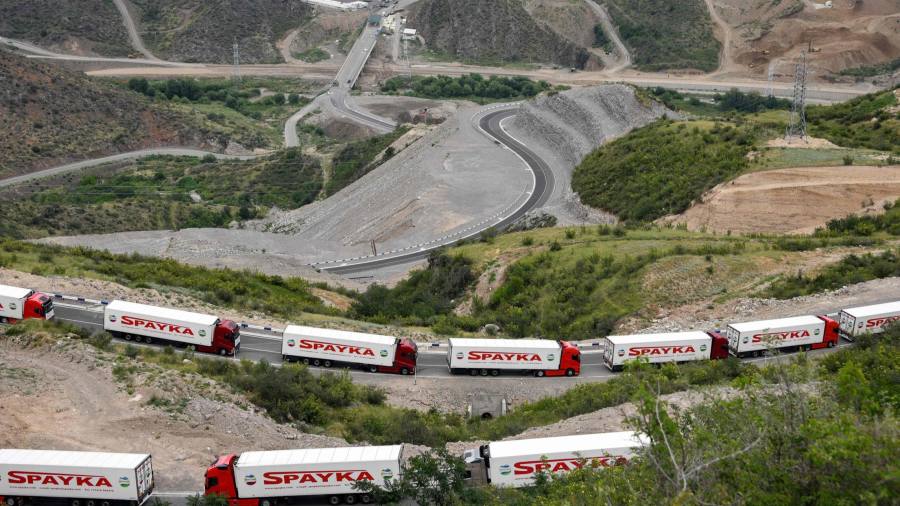
Armenia sent a convoy of 19 trucks carrying humanitarian aid for Nagorno-Karabakh last month. But the convoy was stopped at an Azeri checkpoint and has now remained there for more than two weeks.
This was “yet another example of Azerbaijan’s effective humiliation of Russia”, said Richard Giragosian, director of the Regional Studies Center, a think-tank in Yerevan. Russian peacekeepers, stationed just beside the checkpoint, “are increasingly embarrassed by their failure to uphold the terms of a Russian-crafted and Russian-imposed ceasefire”, he added.
Azerbaijan sees the aid trucks as “theatrics” by Armenia, said Elin Suleymanov, Azeri ambassador to the UK. Baku had offered to provide aid and supplies through the town of Agdam in Azerbaijan, he said, but residents of Nagorno-Karabakh refused.
“They’re stubborn because they try to politicise it,” he said. “They don’t want to accept the fact that Karabakh is a part of Azerbaijan, that’s the problem. It’s not a humanitarian problem, because you could solve it in 10 minutes . . . It’s an artificial crisis.”
Nagorno-Karabakh is home to a small but fiercely independent ethnic Armenian community. The territory was located inside Azerbaijan when the Soviet Union fell apart, but was claimed and won by Armenia in a brutal war in the 1990s that killed and displaced tens of thousands of people.
Azerbaijan’s forces, backed by Turkey, swept through the region in 2020, reclaiming lands lost to Armenia in that earlier war. But the victory was incomplete, and mountainous Nagorno-Karabakh still retained a degree of autonomy, divided from Azerbaijan by a thin line of Russian peacekeepers.
For residents of Nagorno-Karabakh, turning to Baku for help now would be unacceptable; they view the offer as a way of tacitly absorbing them into Azerbaijan. “No one here is ready to accept [their] humanitarian aid,” Nina said.
Others see the escalating humanitarian situation as a way to trigger an exodus. It is “indirect ethnic cleansing”, said Giragosian, of the Regional Studies Center. “Not by bayonet, but rather by creating unbearable conditions.”
Suleymanov, the Azerbaijani ambassador, said Baku instead wanted to achieve full integration of the people of Nagorno-Karabakh. “They are our citizens”, he said, adding that he believed they would be passport-holders soon.
He said the situation must “normalise” to bring longstanding peace and that Armenians should come to terms with losing what he described as a “war of occupation”, referring to the three decades that Armenia held Nagorno-Karabakh.
Weakened by its defeat in the 2020 war, Armenia has been actively engaged in diplomatic talks with Azerbaijan in Brussels, Washington and Moscow, and the two sides are inching closer to a peace deal.
In comments that shocked many in Nagorno-Karabakh this spring, Armenia’s prime minister Nikol Pashinyan said he was ready to recognise Azerbaijan’s territorial integrity, and its control over the enclave.
“We call on Armenia not to take this step,” Nagorno-Karabakh’s president said in his recent call with reporters. “We have a right to self-determination.”
The sharp shift in Armenia’s stance over Nagorno-Karabakh “is a very strong example of how Russia has lost the ability to significantly shape events” in the region, said Maximilan Hess, author of Economic War: Ukraine and the Global Conflict Between Russia and the West.
Russia, traditionally Armenia’s backer, failed last year to deliver weapons ordered and paid for by Yerevan. The departure of Ruben Vardanyan, a Russian-Armenian billionaire with longstanding ties to Moscow, from his post as first minister in Nagorno-Karabakh was also seen by some as a sign of Russia’s declining influence.
The trend is not limited to Armenia. In central Asia, “Moscow is no longer the determinant power,” Hess said. “It is still perhaps still the most significant player, as it is in the Caucasus, but what it says no longer goes, and its influence will continue to erode the longer Putin’s wanton invasion of Ukraine continues.”
If Baku and Yerevan make headway on a peace deal, however, it could lead to a mass displacement of people from the disputed enclave. “On the current path, I very much fear that . . . there will be no more Armenians living in the territory of Nagorno-Karabakh, because they will feel unsafe,” Hess said.
In Nagorno-Karabakh, the memory of the war is still fresh. “I’d rather die than become a resident of Azerbaijan,” said Nina, who lost friends in the conflict. “Many people from my circle fought, and many died, and I do not understand how, after all of that, I could be a carrier of an Azeri passport.”
Read the full article here

