


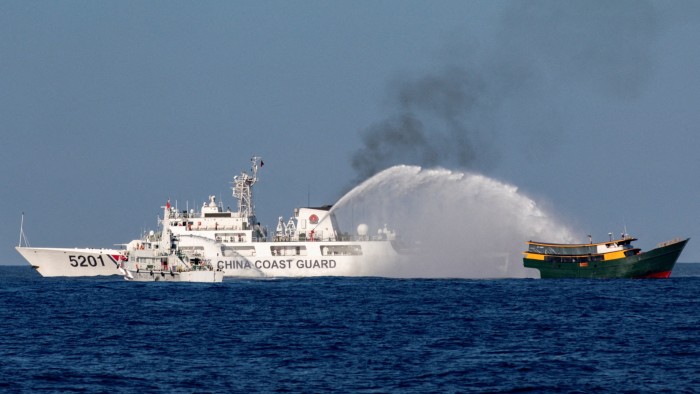
Two years of escalating confrontation in the South China Sea have persuaded the Philippines that going head-on against Beijing is not viable as it tries to police one of the world’s largest maritime territories.
Direct clashes with the Chinese coastguard — accused of behaving “like Vikings” — threaten to exhaust Manila’s limited resources, according to Philippine government officials. They said the country had to balance securing its western flank, where China is most active, with the need to safeguard the rest of its maritime interests across 7,000 islands where smuggling and piracy are perennial threats.
“We cannot go toe to toe with China,” said Jonathan Malaya, assistant director-general in President Ferdinand Marcos Jr’s National Security Council. “We are not a rising superpower like China who has enormous resources at their disposal, so we have to live with what we have.”
The government is now employing a mix of diplomacy, drones, new laws and new naval infrastructure to try to protect its maritime rights, said government officials.
The more measured approach is part of an effort to secure and effectively govern the waters, straits and coastline of the world’s second-largest archipelago. Since Marcos took office in June 2022, he has refocused national security from combating internal insurgents and crime to external defence.
The Philippines’ fisheries and maritime resources are crucial to the country’s economy. But policing its vast waters strains its coastguard, and the many straits cutting through its territory make it vulnerable to invasion and other foreign military incursions.
The Marcos government’s pushback against China’s claims over almost the entire South China Sea has attracted the most international attention, as Manila has publicised how Chinese coastguard ships try to assert control in the Philippines’ exclusive economic zone by often violently targeting military or coastguard vessels.
The clashes were shown most dramatically in June near Manila’s military outpost at Second Thomas Shoal, where Chinese coastguard forces used axes and spears to hack at Philippine boats and a sailor lost a thumb.
“I never expected someone who wants to be a superpower to behave like Vikings,” said Vice-Admiral Alfonso Torres, chief of the Philippine military’s Western Command.
The Chinese force claimed Philippine vessels had rammed a Chinese coastguard ship during what Beijing called a legitimate law enforcement operation against Philippine boats “illegally trespassing” in Chinese waters.
But since the two sides reached a temporary deal allowing the Philippines to resupply Second Thomas Shoal with less Chinese disruption, Manila has toned down its transparency strategy.
“There will be listener fatigue. People will say: ‘What are these guys doing repeatedly banging their heads against the wall?’” said defence secretary Gilbert Teodoro. “Transparency will still be the principle, but we have to show the world that we strategise our moves.”
In September, the Philippine coastguard withdrew a ship from Sabina Shoal, another reef in its EEZ after a five-month deployment because its sailors had run out of food and water and the vessel needed repair after being rammed by a Chinese coastguard ship.
Chinese maritime militia and coastguard vessels have since massed in large numbers in the area.
But Philippine officials said Manila had to live with that. “It is not our territorial sea but the EEZ, so it is more our economic rights that are at stake,” said Malaya. “Given the limited resources the Philippine government has, we can presently tolerate these things so long as they don’t lead to land reclamation or new island building.”
Andres Centino, chief adviser to Marcos on maritime policy, said the lesson from the Sabina episode was that having an extended physical presence at any isolated land feature was not a sustainable approach.
Instead, he said, the Philippines would increasingly rely on satellites, drones and uncrewed surface vehicles to monitor Chinese activity.
Some of those missions are now conducted by autonomous surface vessels provided by the US. Torres said the Western Command now had three Mantas, small uncrewed boats also known as T-12, and three Devil Rays, 11m-long autonomous speedboats. A group of US soldiers known as Task Force Ayungin are providing additional technical support.
The new systems were necessary to counter China’s use of various irregular tactics, said Torres.
Manila’s new capabilities are part of a modernisation drive aimed at enabling its military to protect the country’s entire maritime domain effectively.
In November, Marcos signed two laws outlining his country’s maritime zones and archipelagic sea lanes, designating just three sea lanes for international shipping traffic.
“There are too many entry and exit points, and we do not have the capacity to monitor them all,” said Centino. Including the necessary communication with the International Maritime Organization, Manila expects to have a new, complete regulatory regime in place in about two years.
To implement it, the Philippines is upgrading runways and piers on some small outlying islands and planning several new naval bases and detachments, including on its Pacific-facing east coast, according to Teodoro.
“It is not directed towards China,” said Centino.
But one area where Manila’s capabilities fall short is the Benham Rise, an undersea ridge off the east coast of Luzon which the UN has recognised as an extension of the Philippine continental shelf.
China has been conducting maritime surveys there, an indication that more friction between the two countries can be expected.
Read the full article here

