


Receive free North Korea updates
We’ll send you a myFT Daily Digest email rounding up the latest North Korea news every morning.
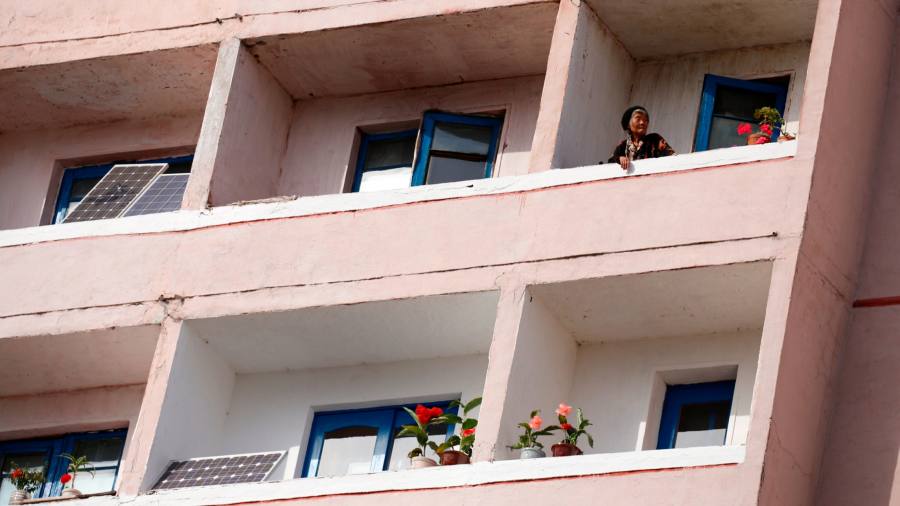
North Korea is increasingly turning to solar power to help meet its energy needs, as the isolated regime seeks to reduce its dependence on imported fossil fuels amid chronic power shortages.
Prices of solar panels have dropped in recent years thanks to an influx of cheap Chinese imports and a rise in domestic assembly of panels within North Korea, according to the Stimson Center think-tank in Washington.
This has allowed many North Koreans to install small solar panels costing as little as $15-$50, bypassing the state electricity grid that routinely leaves them without reliable power for months. Larger solar installations have also sprung up at factories and government buildings over the past decade.
Jeong-hyeon, a North Korean escapee, told the Financial Times that many residents in Hamhung, the second-most populous city, “relied on a solar panel, a battery and a power generator to light their houses and power their television”.
But solar power is still only a partial solution to the country’s energy woes. “It’s really hard to get electricity when the rainy season comes,” Jeong-hyeon added. “We would turn the light on when we ate and then we turned it off right away.”
North Korea’s ramshackle electricity grid draws on ageing hydro and coal-fired thermal power stations, many of them built during the cold war with Chinese and Soviet assistance. UN sanctions restrict the regime’s imports of refined oil and petroleum products. Pyongyang relies on shipments from China and Russia, as well as networks of smugglers and organised criminal groups.
“North Korean citizens buying and installing solar panels at their homes illustrates not only the challenges they face but the initiative they show in replacing basic services the state doesn’t provide,” said Martyn Williams, a senior fellow at the Stimson Center. While millions of North Koreans lacked a reliable power supply, national monuments and statues of the regime’s past rulers were routinely floodlit at night, Williams noted.
The need for alternative power sources is even more acute in remote areas. One North Korean escapee told researchers from the Stimson Center’s 38 North programme that they only received electricity for a few hours a year, on January 1, so they could watch leader Kim Jong Un’s new year address.
According to Statistics Korea, a South Korean government body, North Korea’s total power generation capacity in 2021 was 8,225 megawatts. The equivalent figure for South Korea, which has a population approximately twice that of the North, was 134,000MW.
Under North Korea’s two-tier energy system, which prioritises industrial facilities, the only way for many citizens to access electricity is to pay state functionaries to allow them to install cables to siphon off power from local factories.
“We found that people wouldn’t inform on each other about it because it was understood to be a net gain for the community overall,” said Natalia Slavney, a research analyst at the Stimson Center.
David von Hippel, a senior associate at the Nautilus Institute in California who has worked on renewable energy projects in North Korea, said Pyongyang’s interest dated back to the 1990s when the country suffered power shortages in the wake of the collapse of the Soviet Union.
In 1997, the regime sent a delegation of engineers and officials to the US National Renewable Energy Laboratory in Colorado. The delegation also met US energy department officials in Washington.
“North Korea may not have the greatest weather conditions for solar, but it is no worse than Britain or South Korea,” said von Hippel. “Using renewables is congruent with North Korea’s national philosophy of self-reliance.”
Renewable energy has also provided an opportunity to extract money from UN climate programmes. Pyongyang received millions of dollars in UN funding between 1997 and 2014 for projects ranging from small wind energy developments to improving seed production for sustainable agriculture.
The regime has accelerated the construction of solar installations over the past decade, according to the Stimson Center, with a wind and solar farm run by the air force and panels on the finance ministry, central bank, foreign exchange bank and IT ministry as well as an ice cream factory outside Pyongyang and a chicken farm.
The Korea Energy Economics Institute in Seoul estimates that 2.88mn solar panels, mostly small units used to power electronic devices and LED lamps, are now in use across North Korea, accounting for an estimated 7 per cent of household power demand. The KEEI estimates that more than 1mn panels were transported into North Korea from China in likely contravention of UN sanctions.
Other, cheaper panels were probably assembled in North Korea with photovoltaic cells imported from China, said von Hippel. “Producing the cells requires facilities for manufacture of high-purity silicon and tooling I don’t think they have access to,” he said.
Signs have emerged in recent months, however, that the regime intends to assert tighter control over the sector. In June, a state television broadcast encouraged citizens to give up their panels and connect to collectivised solar energy farms.
The private panels demonstrated how citizens were “becoming more self-supporting and self-sufficient” from the government for electricity, said Ji-young, an escapee and former Pyongyang resident.
“In theory, a solar farm might be more efficient than individual panels scattered across the population,” said Williams. “But the whole reason people buy these panels is because they cannot trust the state to supply them with the power they need.”
Read the full article here

