


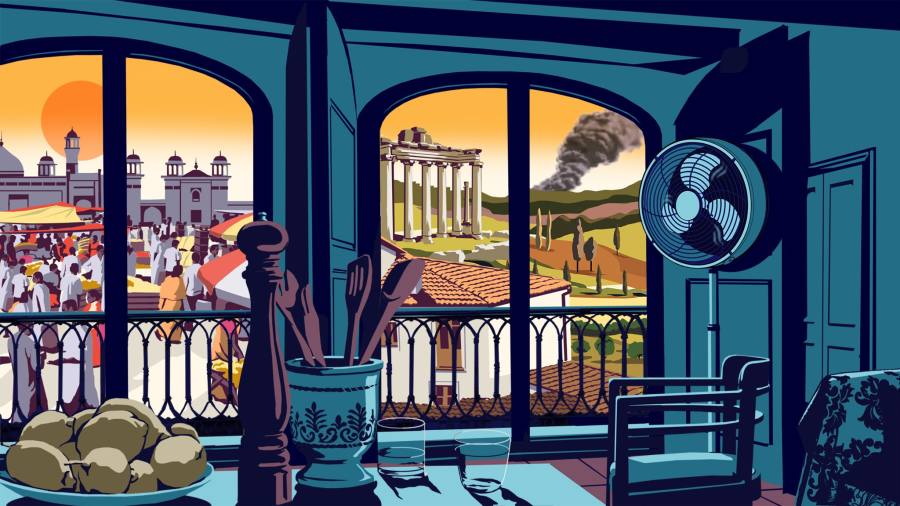
My phone pinged with an incoming message. “I hear it’s super-hot in Rome,” read the text from a London-based friend. “Take care.” Hours later, another message, this time from an old friend in New Delhi, whose college-age son was planning a sightseeing trip to Rome this weekend. Could he possibly stay?
I was taken aback. In the past week or so, southern Europe has been in the grip of two successive searing heatwaves respectively dubbed Cerberus, the mythological three-headed guard dog, and Charon, the ferryman of Hades.
Here in Rome, tourists have baked at the Colosseum and tried to refresh themselves with furtive splashes from Bernini’s majestic baroque fountains, while 28 emergency help points were set up across the city to offer water and medical support. In the middle of this inferno, did my friend’s son really still want to come?
My friend, Jyoti, seemed sanguine. Her son was a Delhi boy who’d grown up playing tennis in the city’s baking summers, when temperatures often rose to between 42C-45C. “He’s very resilient to heat,” she wrote to me. “The Delhi courts were crazy-hot and he was playing every day from age eight to 18.”
Having lived for more than a decade in New Delhi myself, I know what that heat feels like. And I was reminded just how gruelling it can be to live in such a brutal climate as I trudged through the unusually desolate, oven-like streets of Rome this week, after a meeting that ended at midday.
Rome’s temperature hit a record high of 41.8C on Tuesday, and while walking to my office I hit a stretch of sidewalk that had literally melted under the sun. After carefully picking my way across the liquefied black goo, I looked back at my footprints, wondering if I would find them there later, once the weather cooled.
Stories about melting pavements were common in India, where the kind of sizzling temperatures now roiling Europe typically go on for weeks each summer. And the recent days have felt like an early warning sign that Italy’s normally pleasant conditions could increasingly resemble India’s dystopian weather as climate change takes hold. But my Italian friends are bemused by the current excitement over what they see as typical summer weather.
“It seems that the foreign media are more amazed about this heat than the Italians,” said Francesca, who grew up in the 1980s in the same Rome neighbourhood where I now live. Notwithstanding this week’s heat record, she recalled the mercury reaching at least 40C several times in her life, including once when she was a young teenager just starting to wear heels. She clearly remembers it, she said, because her heels sank into the soft, melted pavement.
Like Indians, Italians have traditionally avoided going out in the summer afternoon heat, while southern Italy even has a word — controra — to refer to the hours most appropriately dedicated to a nap at that time of year.
Francesca’s grandmother used to warn that stepping out between noon and 5pm on a summer’s day was as risky as going out between midnight and 5am, as you didn’t know who you might encounter. “Only crazy people go out during the summer when it is so hot,” my friend recalled her grandmother saying.
It seemed to be Italy’s own riposte to Noël Coward’s popular song, about how only “mad dogs and Englishmen go out in the midday sun”. That was a phrase I heard often in India, where the streets on a summer Sunday afternoon were sometimes so empty and still that I felt like the only person alive.
Many Italian friends share the gut feeling — based on their own memories — that the current weather is consistent with what they expect from a hot country. Visiting a nearby beach this weekend with friends, I wondered if most Italians had even noticed the heat warnings — the seaside was packed with people, cheerfully partying in the sea and in their beloved beach clubs, as much of the country will do in the weeks ahead.
The risk, though, especially for those for whom a protracted escape to the sea is not feasible, is that climate change will make searing heat episodes far more frequent — and more extreme, as many Indians are convinced that it already has done in their own country in recent decades.
Jyoti’s experience is telling. She recalls that while she was a child in Delhi in the 1970s, 40C was still an unusual and dramatic event, which prompted families to order children indoors to take cover. By the time I got there in the 1990s, no one blinked at 40C, and 42C days were routine, with a sprinkling of 44C or 45C days added to the mix.
I learnt that in a hot climate it is best not to live in a top-floor apartment, which gets pounded by the sun. My New Delhi landlords all invariably lived on ground floors, while their tenants rented the hotter flats above. As your socio-economic status improved, you literally moved down in life — into cooler, lower-floor apartments — not up.
Living in a sweltering terrace apartment — known as a barsati — owned by a retired navy man, I developed unusual ways to find relief from the heat, even during the frequent power cuts that left me without so much as a ceiling fan. If I doused myself in water, didn’t dry off, then lay flat on my tiled floor, I could briefly feel a bit cooler, as the water on my skin evaporated.
Water also had to be managed. Many Delhi property owners have huge black tanks on their roofs to store water, as the municipal supply is insufficient and erratic — a problem also seen in poorer parts of Italy, such as Sicily. Yet in summer, the water that flowed from these tanks into my shower or sink from the so-called cold tap was so scalding that it could not be used immediately. Instead, I downloaded water into a giant plastic rubbish bin in my shower, where it stood and cooled first.
As India has grown wealthier, experiences of extreme heat have diverged, with the wealthy largely insulated from the discomfort. Affluent Indians live in air-conditioned bubbles — with their flats, cars, five-star hotels, shopping malls and airports chilled to comfortable levels — and step outside only for brief recreation.
The poor, often doing physical jobs in the heat of the day, are left to bear the brunt of the searing temperatures: Indian official figures suggest that 11,000 people died of heat strokes between 2012 and 2021, with the true toll undoubtedly higher.
As I sit now in my unairconditioned Rome apartment, with the shutters closed to keep out the heat and my standing fan whirring at top speed, I feel grateful to be in a place where it still cools down at night, allowing me to open the windows to get a refreshing breeze and sleep peacefully without the noise of an air conditioner.
But I also wonder how long that will last. I worry that one day children growing up alongside my 11-year-old daughter here in Rome will look back at weeks like this, and wonder how such heat levels became all too routine, and how the threshold for really hot days rose ever higher.
“There is a resilience that builds in when you face the same harsh conditions again and again,” Jyoti told me. “It’s the same with all species. Like the frog in the boiling water, you adjust — until you are dead.”
Amy Kazmin is the FT’s Rome correspondent and a previous South Asia bureau chief
Find out about our latest stories first — follow @ftweekend on Twitter
Read the full article here

