


The writer is a science commentator
The A3 poster hangs off the bottom of the kitchen blackboard, just below the Middlesex County Cricket Club fixture list and the bin lorry timetable. Given the team’s sorry T20 performance this season, it is the only pin-up among the trio that brings any joy.
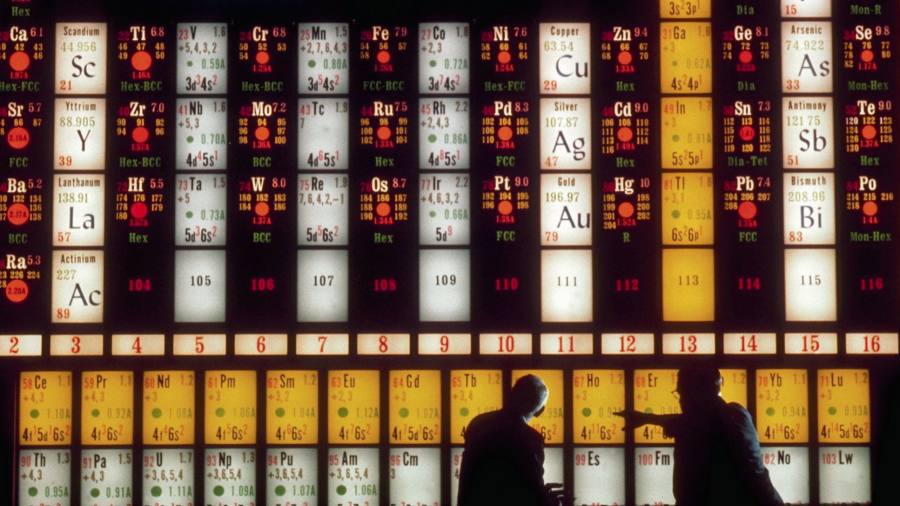
It is, of course, a pullout of the periodic table. The grid, familiar to all schoolchildren, orders all the known elements into rows and columns according to their properties.
Soon, it will not be quite as familiar to some: education authorities in India have confirmed that the periodic table, as well as the topic of evolution, is to be dropped from some school textbooks. The announcement prompted protest by teachers, who fear the omissions — intended to streamline a pandemic-disrupted curriculum — will dent India’s reputation for science and technology. The theory of evolution is fundamental to biology — and the periodic table is literally elemental to our understanding of the world.
Each square in the array represents one element, which is a substance that is made up of only one type of atom. Each element has its own name, symbol and unique “atomic number”, which is the number of protons in the nucleus of one atom. An atom of hydrogen, which has the symbol H, has one proton in its nucleus and therefore an atomic number of one. There are 118 elements, of which at least 92 are known to occur naturally (the rest are mostly lab-made and generally unstable). The four newest elements were formally added in 2016.
The origins of the periodic table, however, go back to the 1860s. Russian chemist Dmitri Mendeleev, building on the work of others, took the 63 known elements — including hydrogen, oxygen, nitrogen, chlorine and potassium — and ordered them according to repeating (periodic) patterns in their chemical properties. He also noticed gaps, which he accurately predicted belonged to undiscovered elements.
I have always had a soft spot for Mendeleev’s creation. For the record, I exhibited no special talent for chemistry, gaining a grade B in the subject at A-level — a gratifying turn-up, given an unfortunate mock practical during which my exam paper accidentally met a Bunsen burner.
That shortcoming, I am ashamed to say, still catches me out: in 2019, I wrote a column in praise of the periodic table’s 150-year anniversary, only to mix up atomic number with mass number. There is just something about chemistry that, even today, makes me think: must try harder.
This probably explains my fascination with it: to me, chemistry feels more like sorcery, the periodic table a Rosetta Stone that I will never truly decrypt. But I still take pleasure in this triumph of tabulation: the names, the characters, the histories.
There are elements named after places of discovery: berkelium, darmstadtium, moscovium and tennessine. There are elements named after people: einsteinium, mendelevium and seaborgium, after American chemist Glenn Seaborg, who had a hand in discovering 10 elements. Meitnerium commemorates Lise Meitner, who really ought to have won a Nobel; she was nominated nearly 50 times. Then there are the ones that sound like props in a Marvel movie: krypton, europium (used in banknotes), promethium, thorium and neptunium (produced as waste from nuclear reactors).
The most recently added elements, made by colliding smaller elements together, exist only fleetingly before decaying. Chemists are now trying to create elements 119 and 120 by similar means. If researchers can muster the energy needed, they may one day reach a rumoured “island of stability”, packed with even heavier but longer-lasting elements.
What a thrilling endgame that would be. Give me 120 over T20 any day.
Read the full article here

