


Receive free Semiconductors updates
We’ll send you a myFT Daily Digest email rounding up the latest Semiconductors news every morning.
An influential South Korean lawmaker has strongly criticised Washington’s interventions in the global semiconductor industry, in a sign of the disquiet in Seoul over US efforts to corral Asian allies into its economic security agenda.
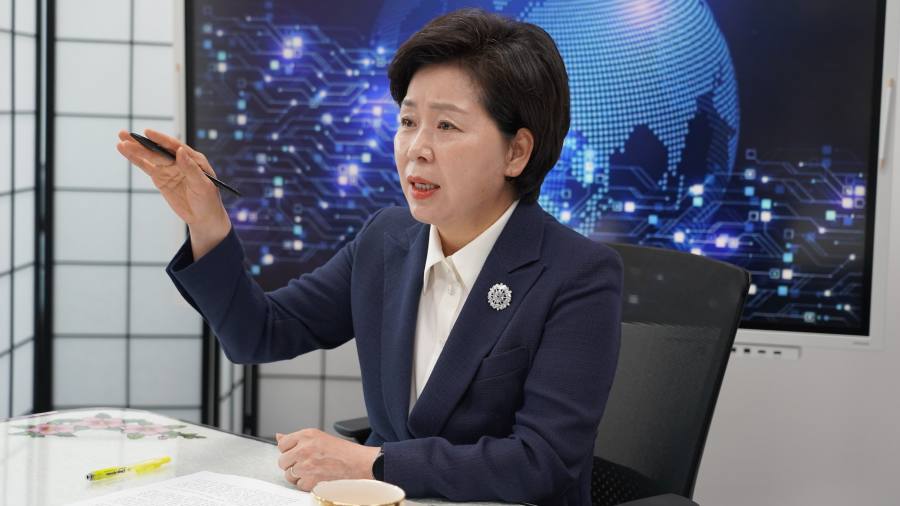
Yang Hyang-ja, a former chip engineer and Samsung executive who chaired a ruling party committee on South Korea’s semiconductor competitiveness until early this year, said that measures to curb China’s ability to access or produce advanced chips risked damaging relations with its Asian allies.
“If [Washington] continues to try to punish other nations and to pass bills and implement ‘America First’ policies in an unpredictable manner, other countries could form an alliance against the US,” Yang told the Financial Times in an interview.
“The US is the strongest nation in the world,” she added. “It should consider more of humanity’s common values. Appearing to use its strength as a weapon is not desirable.”
The US has passed legislation offering tens of billions of dollars in subsidies to non-Chinese chipmakers to increase semiconductor production in the US, in exchange for restrictions on their ability to upgrade or expand their facilities in China.
The Biden administration has also imposed sweeping export controls on critical chip manufacturing tools to China and prohibited US nationals and companies from offering direct or indirect support to Chinese companies involved in advanced chip manufacturing.
But there are concerns in Seoul that the US measures will provoke a backlash from Beijing, disrupting finely calibrated supply chains and threatening profits.
Lee Jae-myung, the leader of South Korea’s leftwing opposition Democratic party, has accused the conservative government of harming the country’s economic and security interests by siding too closely with the US and Japan against China and Russia.
Yang, a former Democratic party member who formed her own technocratic party, Hope of Korea, in June, acknowledged that “US tech war measures are not harming our semiconductor industry yet because sanctions against China could actually reduce output, leading to higher prices”.
But she added: “The more the US sanctions China, the harder China will try to make rapid technological progress. China will provide more national support for the goal. Then it will pose a crisis to South Korea, given China’s abundant talent and raw materials.”
“The US should abandon its current approach of trying to get something out of shaking and breaking the global value chain,” she said.
Yang added that the US had benefited from South Korean and Taiwanese expertise in manufacturing memory and processor chips respectively, saying it was “trying to demolish the status quo through sanctions”.
Many analysts said the US measures actually helped South Korean chipmakers by hampering the progress of their Chinese competitors.
The biggest long-term threat to South Korea’s semiconductor industry, they said, was not supply chain disruption but the rise of state-backed Chinese rivals such as YMTC, which has made rapid progress in closing the technological gap with leading Korean chipmakers in the Nand flash-memory sector.
Troy Stangarone, senior director at the Korea Economic Institute of America, notes that US tech giant Apple had considered using YMTC’s Nand flash-memory chips for the current iPhone 14, until political pressure from US lawmakers forced it to abandon the option.
“The Apple-YMTC episode demonstrated both how far the Chinese have come in the Nand memory sector, and how Korean companies have benefited from US intervention,” said Stangarone.
The FT has also reported that US export controls helped thwart an alleged attempt by a renowned South Korean semiconductor expert to build a “copycat” memory chip plant in China. According to Korean prosecutors, the plant “would have caused irrecoverable losses to the [Korean] semiconductor industry”.
Yang accepted that the US-China tech war had bought South Korea time to develop its own technologies but added that the country’s semiconductor industry was in a “very precarious situation”.
The lawmaker, who was instrumental in passing the K-Chips Act this year to boost tax credits for companies investing in chip manufacturing in South Korea, said the country had to address what she described as neglect of its own engineering talent.
“In Taiwan, technicians get treated better than lawyers and judges. But in Korea, they are not treated well,” said Yang, who is also a member of a cross-party committee on cutting-edge technologies.
“Smart Korean students want to become doctors, dentists or oriental medicine practitioners rather than to become engineers,” she said. “Only technology can set us free from all these geopolitical problems.”
Read the full article here

