


Stay informed with free updates
Simply sign up to the Politics myFT Digest — delivered directly to your inbox.
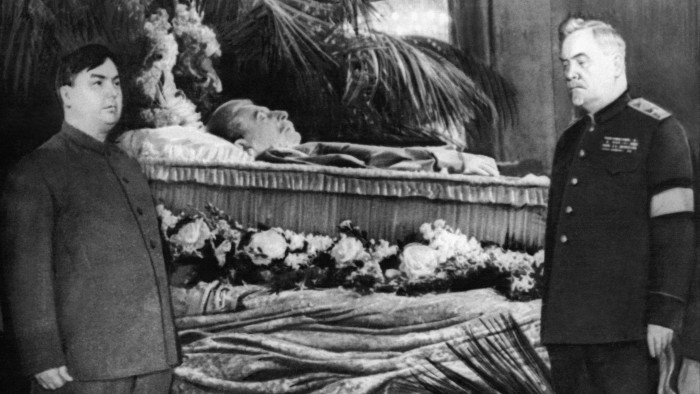
There is a riveting scene in Bruno Monsaingeon’s documentary film about Sviatoslav Richter in which the world-famous pianist talked about performing at Stalin’s funeral in 1953. Abruptly summoned back to Moscow, Richter was whisked from the airport to play by the Soviet leader’s open coffin.
He complained that he had to stuff a score under the piano’s pedals to make them work and the orchestra’s subsequent rendition of Tchaikovsky’s sixth symphony clashed with the military band outside playing Chopin’s funeral march. From a musical point of view, Richter recalled: “The whole thing was repulsive.”
That a musician, who had lived through the entire Stalinist era, could so casually gloss over the significance of the dictator’s death showed an astonishing indifference to worldly events. But this chimes with the tradition of “inner emigration” that evolved in both Nazi Germany and Stalinist Russia as a coping mechanism under totalitarianism. Unable physically to flee their country, many emigrated internally instead. For Richter, his interior world mattered far more than the external world; the eternal genius of Bach outshone the temporary omnipotence of Stalin.
Richter may have been exceptional in his ability to tune out the outside world. But inner emigration has re-emerged in Russia today as an antidote to renewed authoritarianism. And in many other countries, too, people appear to be losing interest in the news, retreating from public life and prioritising their inner world. “I intend to emigrate from within,” one longtime, but disillusioned, Republican wrote to The New York Times after last year’s US presidential elections. “I find this once-unthinkable retreat from being engaged in politics necessary but also sad.”
This desire to switch off is understandable. There is a lot of bad news in the world: wars in Ukraine, Gaza and Sudan, the ominous rise of nationalism and the looming catastrophe of climate change. There is also the phenomenon of Donald Trump, who dominates the airwaves, not just in the US but around the world.
As the technologist-turned-philosopher James Williams memorably wrote, Trump is like a “distributed denial of service attack against the human will”. Just as hackers mobilise armies of bots to bombard internet sites to overwhelm them and render them useless, so Trump has mastered “strategic distraction”.
In the US, an AP-NORC opinion poll conducted in December found that 65 per cent of people felt the need to limit their consumption of political news because of information overload or fatigue. That trend was higher among Democrats (72 per cent), who had just lost the presidential election, than victorious Republicans (59 per cent), which may be understandable.
One difference today is the increasing volume, velocity and invasiveness of news, making it harder to escape. Social media is designed to be addictive and keep us swiping. Anyone who has wasted an evening doomscrolling through Facebook, X, TikTok and YouTube will know the feeling. All too often, according to a research paper published last year in the journal Computers in Human Behaviour, doomscrolling can lead to feelings of “hopelessness”, “helplessness” and “existential anxiety”.
In his recent book Superbloom: How Technologies of Connection Tear Us Apart, Nicholas Carr warns of the dangers of “our frenzied, farcical, information-saturated time”. Our individual and collective dependence on social media, and the powerful grip of the giant tech companies, now make it impossible to change the system. So our only hope of “salvation”, Carr writes, lies in wilful acts of excommunication and standing on the edge of the information flow. “If you don’t live by your own code, you’ll live by another’s.”
Carr has a point that we should minimise distraction. But as someone who works for a media organisation, I have an obvious interest in people continuing to follow the news. And, yes, the industry bears some responsibility for deterring readers with our “if it bleeds, it leads” negativity. Yet attention is arguably the most precious asset we possess. We should be paying at least some of it to follow the most important issues of the day.
It is understandable that those, like Richter, who live under totalitarian regimes retreat into their own inner worlds. But democracies depend on the active participation of engaged citizens, not just passive acceptance. Inner emigration can morph into dangerous escapism, leaving the field open for extremists to exploit.
Read the full article here

