


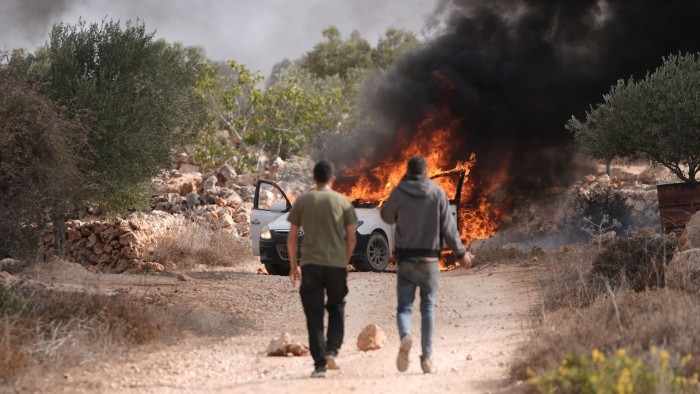
Abdullah Awad and his family have endured years of violence from Israeli settlers. But the ferocity of the latest attack on his farm near Turmus Ayya in the occupied West Bank still left his children screaming in terror.
“The settlers had axelike sticks with nails attached. So, they intended to injure us badly or kill us. Thank God we were awake when they came, so we could move away a bit,” he said, describing how about 15 masked men smashed his house’s windows, doors, solar panels and water tanks.
“There were many assaults. This was not the first, and won’t be the last . . . but since the start of the war [in Gaza], they have become more violent. The situation has changed.”
The assault on Awad’s home, near the settlement of Shilo, was part of a wave of settler violence that has swept through the West Bank in recent weeks, with the number of attacks on Palestinians and their property spiralling to a level unseen in almost 20 years.
Many of the attacks — including one notorious incident last month in which a masked settler was filmed clubbing a woman unconscious — have targeted farmers trying to harvest their olive trees, which make up a central part of the Palestinian economy.
But the violence has also spread far wider. In the past two weeks alone, settlers have carried out dozens of attacks, including torching a mosque in Deir Istiya, setting fire to homes and cars in a village near Bethlehem, and rampaging through an industrial estate near Beit Lid.
“The settlers are totally emboldened, and the attacks are spreading, in the north, centre and south [of the West Bank],” said Ibrahim Dalalsha, director of the Horizon Center for Political Studies in Ramallah.
“But the attacks are also inside Palestinian communities. In the past I recall harvest seasons [where there were attacks] in open fields, on the outskirts of towns and villages. This time they are really going deep inside.”

Settler violence has often increased around the time of the olive harvest, when Palestinian farmers venture into more remote areas of the West Bank where both their olive groves, and many of the illegal outposts set up by Jewish settlers, are located.
But this year has been exceptional. According to the UN’s humanitarian arm, OCHA, in October settlers carried out more than 260 assaults on Palestinians resulting in casualties, property damage, or both — the highest number in any month since the agency began tracking the violence in 2006.
As the violence has spiralled, and drawn international criticism, senior Israeli officials, including Prime Minister Benjamin Netanyahu and Avi Bluth, the head of the military in the West Bank, have belatedly condemned the settlers’ actions. Earlier this week, the army also took the rare step of dismantling a settler outpost that was illegal even under Israeli law.

But activists and Palestinian officials say that a big factor in the escalating violence is the near-total impunity that violent settlers enjoy. In a gesture of defiance, the settlers who torched the mosque in Deir Istiya also scrawled a message on its wall, reading: “We’re not afraid of Avi Bluth.”
Even before Hamas’s October 7 2023 attack, which triggered the war in Gaza, settlers carrying out attacks on Palestinians rarely faced legal consequences. According to the Israeli rights group Yesh Din, in the 18 years before the war, 94 per cent of investigations into settler attacks were closed without anyone being indicted.
Since the war began, Palestinian officials say the situation has deteriorated further, with the military rarely intervening to protect Palestinians, and in some cases even supporting settlers.

“In the past, when there were attacks, there were investigations. Palestinians viewed these as a sham. But at least there was a process,” said Dalalsha. “These days we do not hear of anything.”
The Israeli military and police did not respond to requests for comment.
In combination with a dramatic expansion of settlements and their outposts — both of which are illegal under international law — driven by Netanyahu’s government, settler violence had forced 44 Palestinian communities off their land since the start of the war, according to the Israeli rights group B’Tselem.
“When you look at what is happening, there is an order to [the attacks] . . . It’s not just individuals and settlers. They are backed by the Israeli system,” said Yair Dvir, from B’Tselem. “There is a very clear goal which is to forcibly displace the Palestinians and force them into the big cities.”

Among the places targeted is Sinjil. The town of some 5,000 people north-east of Ramallah has long had to contend with settler violence. But since a new settler outpost was established to the south earlier this year, the assaults have become far more frequent, according to the mayor, Moataz Tawafsha.
“There is no day without an attack,” he said. “They steal tractors, burn stuff that belongs to the farmers, prevent farmers from reaching their land. Every day. They never stop.”
A few kilometres away in the valley outside Turmus Ayya where Awad lives, settlers have established another outpost, setting up a metal cabin and makeshift tent in the middle of the plain, and mounting an Israeli flag on an abandoned, half-finished Palestinian building.
The mayor of Turmus Ayya, Lafi Adeeb Shalabi, said the presence of the settlers and restrictions imposed by the military had deprived locals of access to hundreds of hectares of land around the outpost on the valley floor, which is home to thousands of olive trees.
The loss of access had cost farmers millions of shekels, he said. But the settlers were aiming to do far more. “They are trying to destroy the history of Palestine . . . This land belonged to our families, to our great great-grandfathers,” he said. “And when we try to defend it, they say we are terrorists.”
Read the full article here

