


Unlock the Editor’s Digest for free
Roula Khalaf, Editor of the FT, selects her favourite stories in this weekly newsletter.
Syria’s central bank has flown in fresh banknotes from Russia to alleviate a severe shortage of cash that has left its economy struggling to function.
The central bank said on Friday that Syrian pounds had arrived “from Russia to Syria via Damascus international airport” but did not confirm the quantity of currency. The cash was badly needed after bankers and businesses said the shortage was severely impeding business.
The flight underscores an area of continuing dependence on Russia for Syria’s new government, which faces difficulties in procuring banknotes from the west because of sanctions on the state, forcing it to negotiate the delivery from a country that was closely allied with the overthrown regime of Bashar al-Assad.
A textile manufacturer and retailer, who asked not to be named, said the shortage had reached the point where “people have stopped putting money in the bank because they worry they can’t take it out”.
Rumours had circulated on Syrian social media about the arrival of the eagerly awaited notes, but the central bank said on Friday that “the figures circulating about the size and quantities of this money” were “completely inaccurate”, without confirming details.
Foreign minister Asaad al-Shaibani told the Financial Times last month that, under Assad’s government, the central bank would order shipments of printed currency from Russia when needed. Goznak, the state-run Russian printer, supplies the notes, which must be constantly replaced.
Western banknote printers would not immediately be able to top up supplies and would be reluctant to provide Syria with cash in light of the continuing sanctions against the country, according to banknote experts, leaving the new government reliant on Goznak for now.
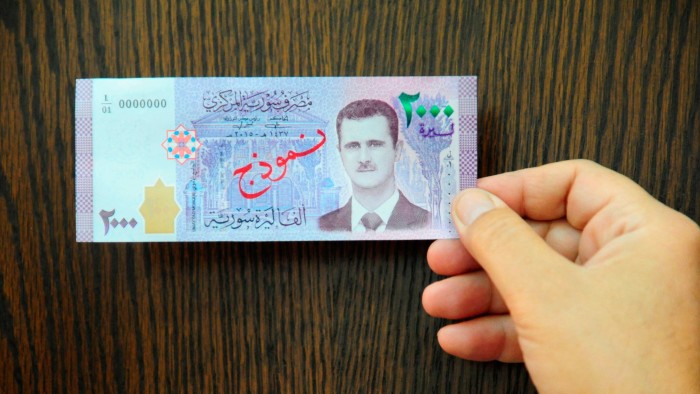
It also remains unclear whether the new regime is seeking to take some Syrian banknotes out of circulation. One of the two most widely used notes, the 2,000 Syrian pound bill, sports the image of Assad, who is now living in Russia.
The central bank lifted a temporary limit on withdrawals at the end of last month, but business and retail clients seeking cash from banks are still frequently turned away.
Some private banks have been receiving up to S£600mn (about $65,000 on the widely used black market) each day from the central bank in recent weeks, two bankers told the Financial Times, speaking on condition of anonymity.
The amount is nowhere near enough to keep businesses afloat, businessmen say. Manufacturers and traders cannot access most of their bank deposits to pay suppliers and salaries.
“Traders have been paying employees from their [cash] reserves, and that has worked for two months, but how much longer could they last?” said one banker.
Transfers between banks are still available, with businessmen occasionally using this method to buy and sell goods — a system one trader likened to “pseudo bartering”.
The impact of the cash shortage has been exacerbated by a lack of information on how many Syrian pounds are in circulation.
Unlike most central banks, Syria’s does not produce weekly statements with details on the amount of banknotes in circulation. Its website is inaccessible, adding to the opacity surrounding its operations.
Banknotes are often destroyed and taken out of circulation on a daily basis due to wear and tear, with central banks around the world constantly replenishing their stock.
Syria’s two-decade-old private banking system was mainly used for commercial purposes, with citizens tending to hold on to their own cash.
People’s tendency to avoid the banking system had grown in the years leading up to the fall of Assad when the regime began requesting financial information from Syria’s small number of private banks in a bid to apply ad hoc taxes on big earners.
Syria’s economy had already been shattered by 13 years of civil war, widespread corruption under the Assad regime and western sanctions, including on its banking sector.
Businesses say that, despite the widespread euphoria that greeted Assad’s ousting, their sales have plummeted. Some are also under pressure following the removal of export restrictions, which means they must now sell existing stocks at a loss.
“People are not spending because they don’t know what’s going to happen,” said the textile businessman. “Companies are not spending because there’s no cash revenue, and the main priority is paying employees.”
Western governments, meanwhile, have kept most sanctions on Syria and its banking sector in place. Some officials, including the EU, have drawn up road maps for easing measures in stages.
“There are a number of signs of confusion and lack of clarity,” said Jihad Yazigi, editor of news outlet Syria Report. “The economy is a big, big issue . . . a crucial test for the new authorities in Damascus will be to ensure [a] steady supply of . . . energy and bread and, more generally, ensuring the economy restarts.”
Read the full article here

