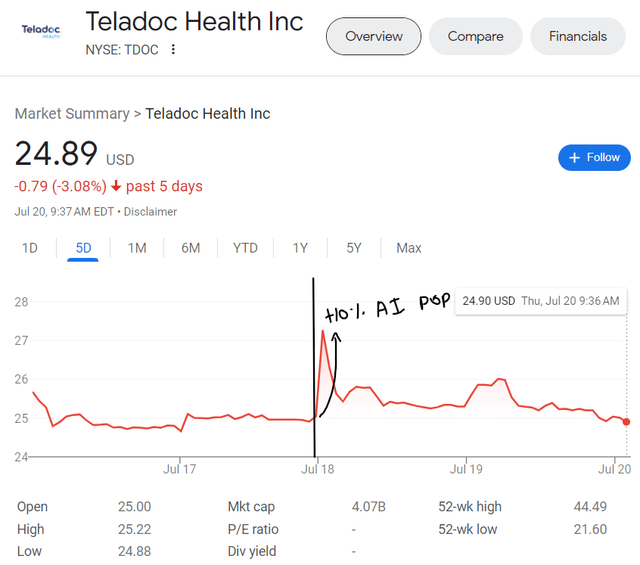
In early trading on Tuesday, Teladoc (NYSE:TDOC) stock popped +10% after announcing an expansion of its long-running partnership with Microsoft (MSFT) to integrate artificial intelligence tools for clinical documentation into its Solo telehealth platform for hospitals and medical groups.
GoogleFinance
As of writing, TDOC stock has given up all of its recent pop and more; however, this new AI collaboration with Microsoft-Nuance is a significant deal for the virtual care giant as it attempts to cement its leadership position in the telehealth industry in the era of artificial intelligence.
Teladoc Is Stepping Up Its AI Game In Partnership With Microsoft
By integrating Microsoft’s Azure OpenAI Service, Azure Cognitive Services, and Nuance Dragon Ambient eXperience (“DAX”) into Teladoc Health’s Solo platform for hospitals and medical groups, Teladoc is set to automate clinical documentation during virtual patient exams, which in turn, would help ease the existing administrative paperwork burden on clinicians and other healthcare workers, freeing up time that can be utilized to deliver better patient care.
Here is what Teladoc’s Chief Medical Officer, Dr. Vidya Raman-Tangella had to say about this AI partnership:
Administrative burden and staff shortages are major reasons why clinicians are leaving the profession. We are focused on using AI to reassert and build the doctor-patient relationship at a time when technology frequently does the opposite. We are proud to partner with Microsoft and Nuance to break new ground.
At first glance, AI-powered clinical documentation may seem like a nothingburger; however, according to the American Medical Association, physicians spend two hours on administrative tasks for each hour of care provided. After being integrated into Teladoc’s Solo platform, Nuance DAX, an ambient clinical documentation solution, will autonomously record patient encounters with precision and efficiency right at the point of care. This would allow for final clinician review and signoff, enabling clinicians to engage with patients in a more natural and conversational manner, eliminating the need to divert their attention to type notes during virtual care visits. While the Solo-DAX integration is still in pilot, any Solo hospital client using Teams and an Epic electronic health record will be able to utilize the tool, provided they acquire a DAX license.
Additionally, the Teladoc Health Medical Group is integrating Nuance DAX Express, a workflow-integrated, AI-powered clinical documentation application that is the first to combine Nuance’s proven conversational and ambient AI with the newest and most capable AI model, GPT4, in the Azure OpenAI Service. For now, Teladoc and Nuance are training the latter’s AI models for use on virtual urgent care visits; however, we would eventually have AI models developed and deployed for Teladoc’s other services like primary and mental healthcare.
According to Diana Nole, Executive Vice President and General Manager of Healthcare at Nuance (a Microsoft company):
Adding Nuance DAX and DAX Express into the Teladoc Health ecosystem represents the type of collaborative innovation needed to serve the rapidly changing needs of clinician’s and patients across the care continuum. It addresses the pressing challenge of reducing clinicians’ administrative workloads in some of the most demanding and dynamic care environments in healthcare. Moreover, it combines the efficiency and advanced power of conversational, ambient and generative AI to give physicians the tools and information they need to provide timely, high-quality, reassuring and personalized care in any location, especially in urgent and virtual care circumstances when patients need it the most.
Source: Teladoc Health Expands Collaboration in AI with Microsoft to Address Healthcare Workforce Crisis
While this newly-announced piece of collaborative innovation may not be a game-changer for Teladoc right away, it definitely has the potential to become a robust solution for addressing the healthcare workforce crisis in the long run.
And clinical documentation is just one potential use case for artificial intelligence in the telehealth industry. Given their histories, I am sure Teladoc, Microsoft, and Nuance are not done innovating together. Teladoc and Microsoft have been strategic partners since 2021 when Teladoc Health’s Solo platform was integrated with MSFT’s Teams platform. Henceforth, I expect to see many other AI-powered features being added to Teladoc’s platform over the coming weeks, months, and years.
Where Is TDOC Stock headed?
While TDOC stock has been a dud for a pretty long time now, the company is back to positive free cash flow generation and a revenue growth re-acceleration looks inevitable given Teladoc Health’s culture of innovation. In my previous note on Teladoc, we discussed its recently-launched “Provider-Based Care” for weight management and prediabetes programs. And this new AI partnership showcases Teladoc’s drive to keep innovating for all stakeholders in the burgeoning telehealth industry.
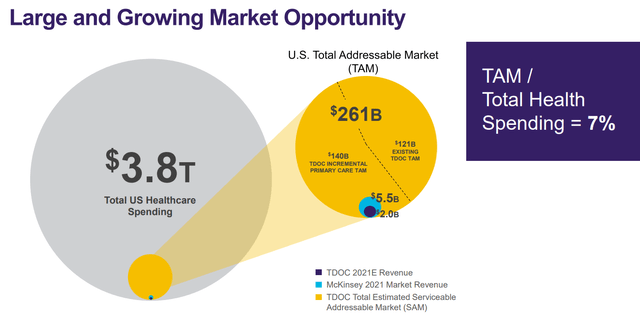
As we have seen in the past, telehealth represents a massive market opportunity set, and Teladoc has a sizeable lead in this industry based on technology platform and scale.
Teladoc Investor Relations
With a unique whole-person care platform and ~$900M of cash on its balance sheet, Teladoc is well-positioned to pounce on a humongous TAM that’s still growing! Telehealth is not a fad, and Teladoc is not just a COVID stock.
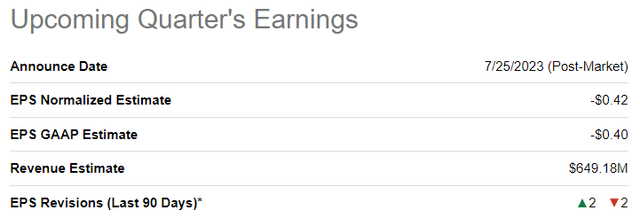
What To Expect From Teladoc’s Upcoming Q2 2023 Quarterly Report?
Going into Teladoc’s Q2 2023 report (to be published on 25th July 2023), consensus analyst estimates for Teladoc’s upcoming quarterly report are standing at:
Revenue: $649.2M (vs. management’s guidance of $635-660M)
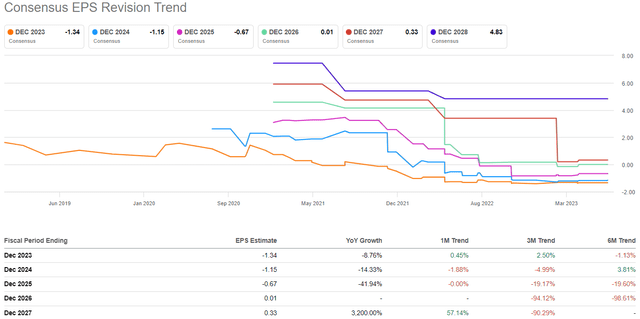
Normalized EPS: -0.42 (vs. management’s guidance of -$0.55 to -$0.45)
SeekingAlpha
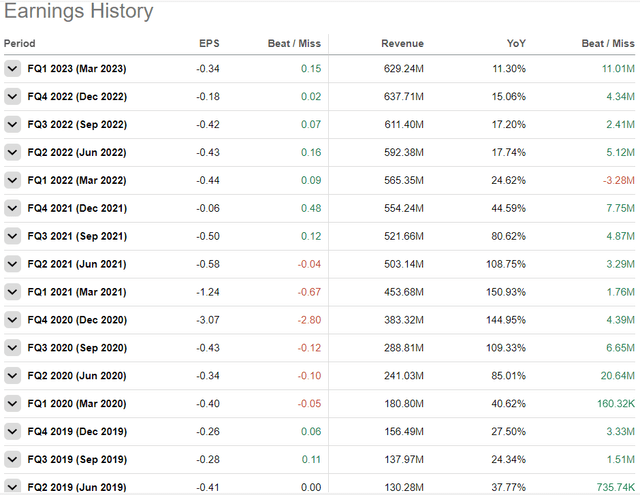
Given management’s history of guiding conservatively, I think Teladoc’s long-standing track record of beating revenue estimates will continue in Q2 2023. While Teladoc is not growing as rapidly as investors would like, I think Teladoc’s double-digit revenue growth rate is very healthy after a pandemic-induced pull-forward in demand for telehealth solutions.
SeekingAlpha
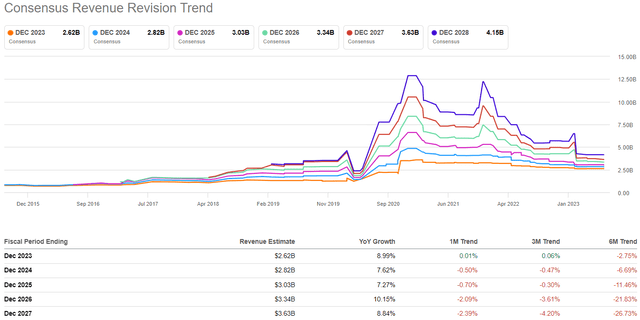
Over the last three months, Teladoc’s consensus revenue estimates for 2023 have been raised slightly by +0.06%, with 23 ‘Up’ revisions and 2 ‘Down’ revisions.
SeekingAlpha
SeekingAlpha
SeekingAlpha
In 2022, Teladoc’s revenue grew by ~18% y/y, and for 2023, it is now projected to grow revenue by ~9% y/y (up from the pre-Q1 projection of 8.3% y/y). As I see it, Teladoc is set to deliver high-single or low-double-digit growth for the foreseeable future. While Teladoc has turned free cash flow positive, it is still unlikely to turn profitable for the next couple of years.
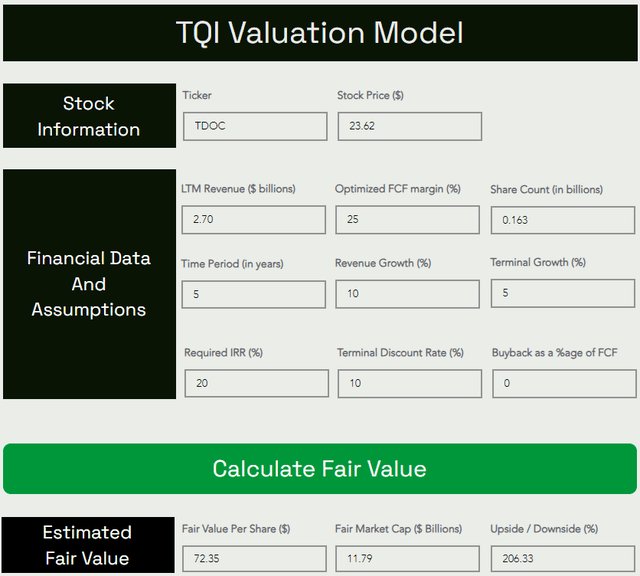
Here’s our updated valuation for Teladoc (including estimated FY-2023 revenue):
TQI Valuation Model (TQIG.org)
According to our valuation model, Teladoc is worth ~$72.35 per share, i.e., 206% more than its current stock price of $23.62 per share. Clearly, Teladoc is trading at a massive discount to its fair value.
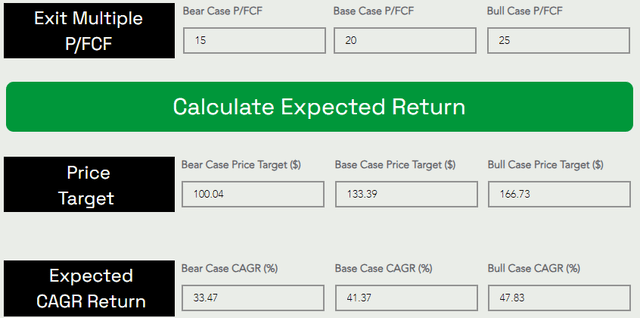
Based on a 2027 exit multiple of 20x P/FCF, Teladoc stock could grow from $23.62 to $133.39 at a CAGR rate of 41.37% for the next five years.
TQI Valuation Model (TQIG.org)
Since Teladoc’s 5-yr expected CAGR return far exceeds our investment hurdle rate of 20% for growth stocks, I rate TDOC a “Strong Buy” at current levels.
TDOC’s Technical Chart and Quant Factor Grades
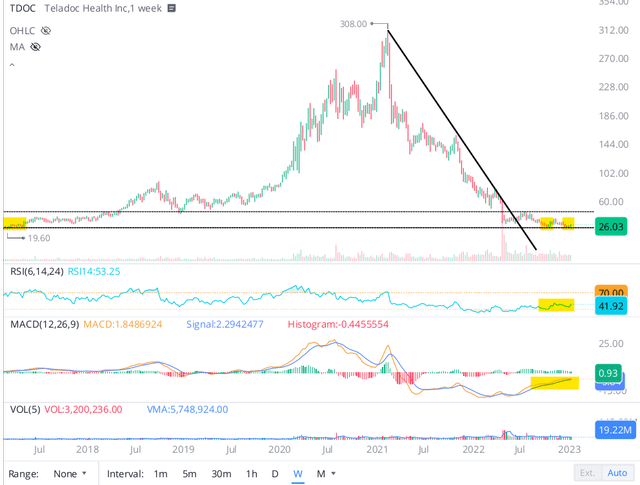
In my previous update, I shared the following technical view:
Since May of 2022, Teladoc’s stock has been forming a Stage-1 base pattern in the range of $20-$40 per share.
WeBull Desktop
With Teladoc currently trading closer to the low end of this base, I think a long-term investment here is fine. However, a breakdown of this base could send the stock into a tailspin. In my opinion, such a breakdown is very unlikely; however, given the current macroeconomic environment, I can’t rule it out for now.
Source: Teladoc Stock Is Showing Signs Of Life
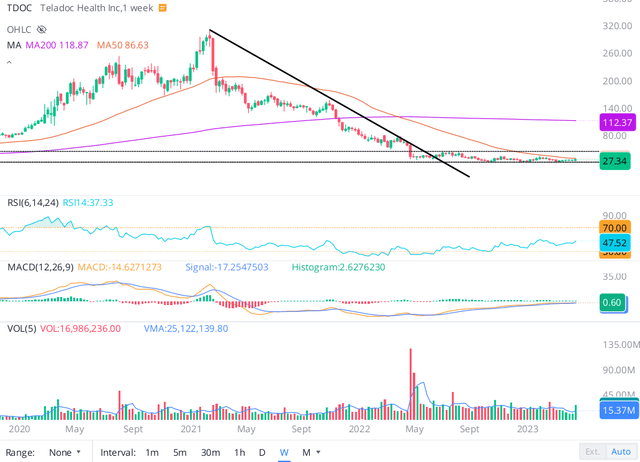
Two months later [in April 2023], Teladoc’s chart is not looking much different, with the stock still hovering near the $26-$27 level.
WeBull Desktop
Technically, Teladoc is likely to remain rangebound unless the stock could break out from the $20-$40 range.
Source: Teladoc Is Just Getting Started
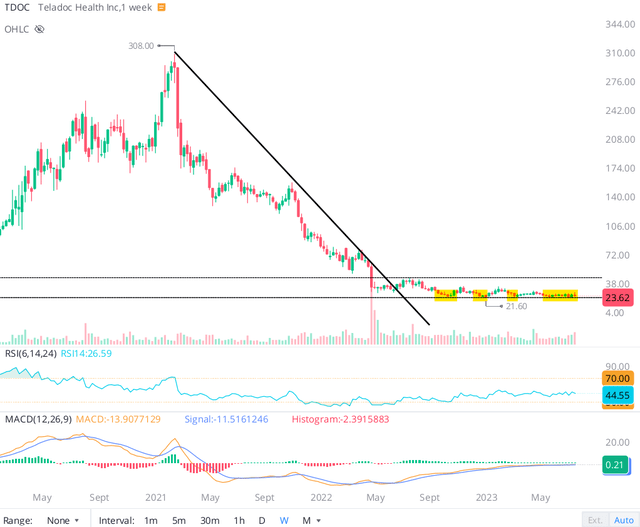
Over the last three months, we have seen a continuation of the rangebound action in Teladoc’s stock, and the technical setup remains unaltered. Hence, we need to watch for a breakout or breakdown of the $20-40 range for the next big move in the stock.
WeBull Desktop
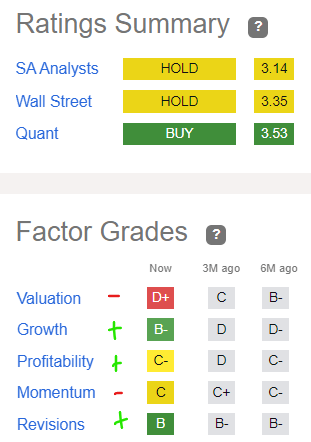
With quant factor grades having turned supportive, Teladoc is a solid long-term buy in the $20s (lower end of the Stage-I base). According to SA’s Quant Rating system, Teladoc is now rated a “Buy” with an overall score of 3.53/5.
Teladoc’s Quant Rating (SeekingAlpha)
Over the last three months, TDOC’s “Growth”, “Profitability”, and “Revisions” grades have improved from ‘D to B-‘, ‘D to C-‘, and ‘B- to B’; whilst “Valuation” and “Momentum” grades have deteriorated from ‘C to D+’ and ‘C+ to C’, respectively. The quant rating system is based on relative data, and while Teladoc appears to be expensive on a relative basis, it is very attractive on an absolute basis as we saw in the previous section.
Concluding Thoughts
Artificial Intelligence is the red-hot theme of 2023. While there are loads of AI wannabes out there, Teladoc’s data advantage as a system of record for the telehealth industry renders it an attractive bet on AI. By partnering up with Microsoft-Nuance, Teladoc is set to add automated clinical documentation capabilities to its Solo platform.
While Teladoc’s near-term growth trajectory remains uncertain, Teladoc is creating a paradigm shift in the healthcare industry by selling unique whole-person care solutions as a bundle to clients. With a humongous TAM in front of itself, Teladoc is set for sales growth re-acceleration over the coming years. Based on fundamental, quantitative, technical, and valuation analysis, Teladoc remains a compelling long-term buy in the low $20s.
Key Takeaway: I rate Teladoc a “Strong Buy” in the low $20s.
Thank you for reading. If you have any thoughts, questions, and/or concerns, please share them below.