


Unlock the Editor’s Digest for free
Roula Khalaf, Editor of the FT, selects her favourite stories in this weekly newsletter.
Something about the great return to the office does not make sense.
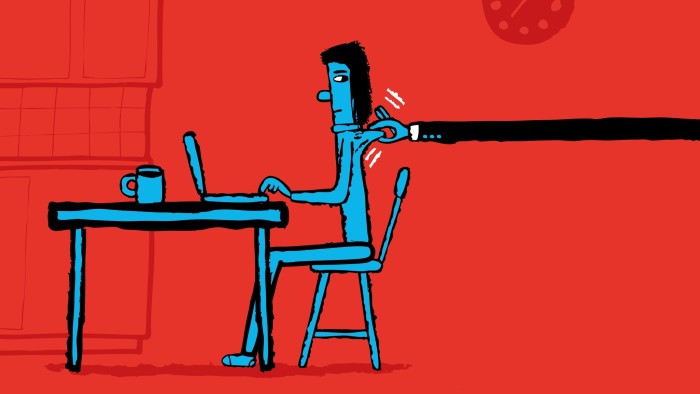
For the past few years, all kinds of large employers have been tightening their rules on working from home.
They have decided it is time for many of their staff, in the words of British businessman-turned-TV star, Lord Alan Sugar, “to get their bums back into the office”.
Not all companies joined Goldman Sachs and Tesla and demanded a full-time return. But many followed IBM, Deutsche Bank and even Zoom, poster child of the remote work revolution, and brought in tougher homeworking rules.
But here’s the odd thing: so far at least, the statistics suggest working from home levels have remained noticeably steady. This is baffling, even for experts who were studying remote working long before the pandemic made the practice mainstream. “I’m genuinely puzzled,” Stanford University economist, Professor Nick Bloom, told me this week.
His research, which includes monthly surveys of thousands of US workers, shows the share of work they do from home soared from well below 10 per cent before Covid to 61 per cent at the height of the pandemic in 2020, before sinking back to around 30 per cent in 2022.
But those levels have stayed remarkably flat since late 2023, never dropping below 26 per cent. You can see a similar pattern in office visit levels.
So what explains the gap between this stubborn persistence of remote working and all the news about staff being dragged back to the office?
It could be a matter of perception. The immovable rules of news mean a company doing something unpopular or disruptive, such as cutting back remote work days, tends to be more newsworthy than one sticking to business as usual.
Perhaps the idea of the great remote work rollback was always out of whack with the less exciting reality of the many employers who have quietly plugged away with existing hybrid working arrangements.
There are reasons to think so.
Some of the biggest fans of working from home are smaller, younger, less well known companies that are, as Bloom points out, among the fastest growing firms. Their expansion may be offsetting more noticeable cuts in homeworking at older businesses.
Also, the longer hybrid working lasts, the more evident its advantages become for some firms.
I sympathise with remote work critics who worry that distracted, atomised home workers can be less productive, less responsive and more disconnected than their in-office counterparts. Some office work is best done in person, especially if it requires real-time checks and fast decisions. But I’m not surprised by research showing the increasingly common hybrid pattern of working three days a week in the office and two at home can make both workers and finance directors happy.
When a large Chinese travel tech company called Trip.com did a six-month trial to compare such workers with full-time colleagues, it found hybrid working boosted job satisfaction and, crucially, reduced quit rates by a third. There was no sign of a drop in performance.
Managers were more positive about hybrid working after the trial than before it, to the point that, when the experiment ended, the company decided to extend the hybrid policy to all employees at once.
Their logic was simple, according to a paper Bloom and colleagues published on the trial last year. “Each quit cost the company approximately $20,000 in recruitment and training, so a one-third reduction in attrition for the firm would generate millions of dollars in savings.”
Since Trip.com announced its decision, other Chinese tech firms have adopted similar hybrid policies.
For all that, 2025 may be the year when work from home rates finally tumble. Companies such as Amazon, PwC and Starbucks made headlines last year for tougher rules that were not due to start until January. Tighter policies at other businesses, such as WPP, the advertising group, are not due to begin until April. The re-election of Donald Trump, who ordered federal workers back to the office full-time on the first day of his presidency, could embolden more chief executives to act. Maybe we are nearing the end of a long calm before a return-to-office storm.
Yet even if this happens, the idea that work patterns will ever return to what they were before the pandemic tore them asunder is at this point very hard to imagine.
Read the full article here

