


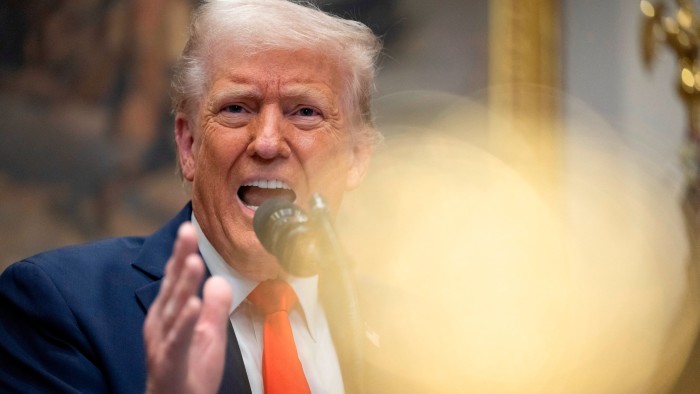
“The president masters the art of the deal. He is a negotiator-in-chief,” White House press secretary Karoline Leavitt told Fox News last month, referring to Donald Trump’s efforts to put pressure on Ukraine and Russia to agree a ceasefire.
Leavitt was nodding to Trump’s 1987 business bestseller, Trump: The Art of the Deal. The book runs through a series of property deals that Trump, then a brash young developer, was working on in the late 1980s, illustrating his dealmaking approach.
As US president, Trump is now wielding tariffs, foreign policy, executive orders and regulatory changes to shock trading partners, government institutions and companies to change their stance. But do dealmakers, diplomats and officials believe the negotiating tactics he claimed helped him succeed in business have any merit?
The Art of the Deal is an unreliable memoir, ghostwritten by Tony Schwartz, who in 2016 publicly declared his deep regret at his role in boosting Trump’s reputation. “I put lipstick on a pig,” he told The New Yorker. He also described the “deep sense of remorse that I contributed to presenting Trump in a way that brought him wider attention and made him more appealing than he is.” (Trump’s riposte: “He didn’t write the book. I wrote the book.”)
Still, deal experts, even those opposed to Trump’s policies, recognise some grains of truth in the tactics described in the book and practised by Trump in his first and second terms as president. They also highlight the many pitfalls of his domineering approach.
Take Trump’s description of his “simple and straightforward” dealmaking style: “I aim very high, and then I just keep pushing and pushing and pushing to get what I’m after. Sometimes I settle for less than I sought, but in most cases I still end up with what I want.”
The president’s declarations that the US should own Greenland, take back control of the Panama Canal and make Canada the 51st US state fit this template. “He comes up with these outrageous anchors that within 24 hours people are talking about,” says Bob Bordone, who founded the Harvard Negotiation & Mediation Clinical Program, which runs courses in negotiation and conflict management at Harvard Law School. The technique unsettles counterparties and shifts talk towards extreme outcomes.
Ben Smith, director of consultancy Kearney and an adviser to the US government when George W Bush was president, applauds Trump’s appetite for “big bold deals”. One important lesson from The Art of the Deal is: “If you’re going to spend all the time to do a deal, do a big one,” he suggests. “The effort to do a $100mn acquisition is actually equivalent to the effort to do a $10mn acquisition.”
Dealmakers are unanimous on the importance of persistence. It is “one of the key words not only in dealmaking but in managing and running companies and countries”, according to veteran Italian banking executive Corrado Passera, who also served as a minister from 2011 to 2013.
But Passera adds a caveat: “Sometimes ‘pushing, pushing, pushing’ is the right way to get to your result, but there’s a balance beyond which you lose your counterpart . . . The best deals are at least partially win-win situations.”
John Bolton, who served as Trump’s national security adviser during his first term but is now a vocal critic, says that “throughout his career [Trump] has gotten away with acting like that — and people cave”.

“Some individuals . . . plough through the conflict like a battering ram,” warns neurologist Joel Salinas, co-author with Bordone of Conflict Resilience, about how to deal with disagreement. Such an approach was evident in Trump and vice-president JD Vance’s public dressing-down of Ukraine’s Volodymyr Zelenskyy in February. Such an attitude “eliminates the room for more than one perspective”, says Salinas, leading to inferior outcomes.
“This might-is-right approach — the Trump approach — of ‘who cares if they hate me, what’s important is that they fear me’ — may be productive in the short term,” says Passera, but not in the long term. Alluding to Trump’s frequent insistence that he has more “cards” than his negotiating partners, Passera says the aggressive style may “win the hand, but not necessarily the game”.
Smith speculates that Trump’s fear-based negotiating stance reflects his experience in real estate. Property is not a “multi-inning game”, unlike, say, the technology industry, where companies have to do deals with rivals and then work with them.
The approach is even less applicable to geopolitics. “Just trying to rely on power: that’s bullying,” says Cath Bishop, a former UK diplomat and leadership coach. Bolton says Trump “doesn’t have a philosophy, he doesn’t do grand strategy, in international security at least. Everything is transactional, episodic, ad hoc and filtered through the prism [of] ‘Does this benefit me?’”
Trump’s self-promotional tendency was already evident in The Art of the Deal, where he describes his use of “truthful hyperbole . . . an innocent form of exaggeration — and a very effective form of promotion”.
Former Goldman Sachs deals banker Marco Alverà, now chief executive of green hydrogen company TES, sees hype as another way of projecting confidence, which can play “a big part in dealmaking”.
In his 1987 book, Trump describes not getting involved in one difficult Manhattan property deal as a “critical mistake”. Alverà is also a strong advocate of leading from the front, having used his personal capital to push through pipeline agreements when he was chief executive of gas company Snam. “Make sure people get it that you care,” he says.
But Bordone says the danger is that heavyweight principals, particularly presidents, can muscle in and upset delicate negotiations. “Leaders can be very good [deal] closers, but, if not, they should show up for the signing,” he says.
Perhaps the Art of the Deal aphorism most evident since Trump returned to office is “sometimes it pays to be a little wild”.
In the book, Trump writes about how he applied the principle when threatening to “bring a lawsuit for murder” against a bank official trying to foreclose on a farmer’s widow. But it also fits the US president’s market-moving unpredictability about the scope and scale of tariffs, finally announced this week. Bill Reed, chief executive of US commodity trading company CCI, said recently that the policy fog had led to a potentially damaging “wait-and-see” approach to investment: “Uncertainty [is] tying up resources, dealing with things that may or may not happen.”
Dealmakers acknowledge, however, that unpredictability is a legitimate tactic, if used sparingly.
Passera recalls meeting union representatives when he took over as head of the Italian post office in 1998. They produced a list of people he should appoint to important roles. To their shock and that of his fellow executives, he swept it into the bin. A walkout and strike followed but Passera says the signal that he wanted to change the rules eventually won the unions round and led to greater long-term mutual respect. On the other hand, he says, “if unpredictability becomes unreliability, you lose the trust and respect of your counterpart”.
“Wild isn’t good because that creates a fear,” adds Bishop. But creative negotiating tactics can sometimes open up new routes to desired deal outcomes. “I like that Trump is questioning things that people haven’t questioned before. I just don’t like his answers to those questions.”
Read the full article here

