


The frames that held Bashar al-Assad’s portraits on the walls of the Damascus governorate building are now bare. Instead, the photos serve as doormats for visitors and employees to trample as they walk in — a reminder that they are in a new Syria.
Shattered glass, broken furniture and a crumpled flag littered the floor, a reminder of the rebel groups’ lightning rise to power. But upstairs, administrators picked by the former insurgents were already at work untangling the mechanics and serpentine bureaucracy of the Assad regime’s Ba’athist state.
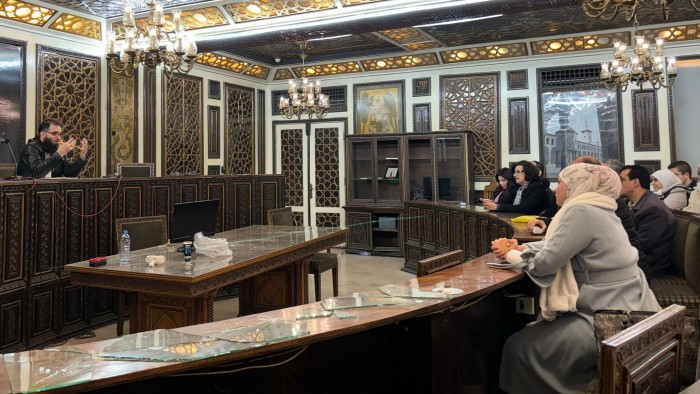
On Tuesday they gathered about 30 heads of department in an ornate room, in a meeting witnessed by the Financial Times, whose focus was an imminent cull of ineffective staffers in the local government.
Officials involved in the transition have promised to create a new, unified Syria, reconciling the rebel-held government in the northwestern province of Idlib, known as the Syrian Salvation Government, with the capital they rebelled against for 13 years.
But the roots of the leading rebel group, Hayat Tahrir al-Sham, as a Sunni Islamist former affiliate of al-Qaeda have led to deep worries among some minorities about how they plan to govern this broadly secular state after toppling the Assad regime three days ago.
“It’s all going to become one. All the government bodies will be dissolved: no Salvation Government, no factions, nothing,” said Mohammad Yasser Ghazal, a 36-year-old technocrat in the rebel government seconded from his job to help reconfigure the Damascus governorate. “It will all soon be dissolved into one Syrian republic.”
Ghazal and his colleagues displayed a strong command of the state apparatus they inherited just hours earlier, and hinted that HTS’ plans to overhaul it had long been in the works. But the task they face is formidable. Syria’s dysfunctional state institutions became engorged by corruption, cronyism and centralised power over five decades of rule by the Assad dynasty.
In his lilting Aleppan accent, Ghazal asked the department chiefs to list their remits and explain their departments’ functions. The two-hour meeting showcased how Assad’s government was “stopped in time”, he later told the FT in an interview.
Employees quoted government handbooks from the 1930s and 1960s, and were unable to answer direct questions about their duties, nor explain why decisions had been made. “The problems piled up, and they let them be,” he said. “They do not see themselves as responsible.”
One man introduced himself as the head of the public relations department, which he said included “international co-operation” as well as a division for “festival and events management”. Asked what this division did exactly, the civil servant answered, “flags”.
“There’s a department for flags?” Ghazal asked incredulously.
“Yes, when foreign dignitaries come, we put up a lot of flags,” he said. “We hang them from the poles. It’s a big job.”
The same department head also had a translation division, staffed by two employees who spoke English. Ghazal asked if there were Russian or Iranian translators — states that propped up the Assad regime and frequently sent envoys — and was told there were none because representatives of these countries brought their own.
“But you didn’t have English-speaking dignitaries visit?”
“No,” the department head said.
Ghazal shook his head. “A ridiculous state,” he said.

Ghazal will eventually take on many of the duties of the governor in a newly created position of city council president. Raised in the United Arab Emirates, Ghazal, who pointed to his long beard as a reflection of his devout religious faith, left his civil engineering career in Saudi Arabia in 2014 to relocate to Idlib, which was in the throes of civil war. The urbane former engineer eventually helped set up the Syrian Salvation Government four years later.
He met the department chiefs in a room shaped like an auditorium — suitable for the previous regime’s style, in which one person had the microphone and issued directives to be unquestioningly obeyed. The gilded hall featured the names of ex-governors going back 60 years, a reminder of the compact the previous regime held with loyalists: put in the work, and we will glorify you.
Civil servants were ordered back to work this week, as the SSG’s Mohamed al-Bashir was named prime minister of Syria’s new interim government for the next four months. Its future shape is being negotiated in ministries across Damascus, after rebel-affiliated technocrats like Ghazal descended on the city.
On Tuesday evening, Bashir convened a meeting of SSG ministers with those of the deposed regime to begin the process of transferring power to the new caretaker government that will be in place until March. Draped behind him were the new Syrian flag and that of HTS.
Damascus’s provincial government has a vast remit, ranging from approval of barbers’ licenses to beautification to housing, construction, tourism and electricity. The day’s tasks included understanding the extent of the corruption embedded in this local government machinery, including weeding out phantom jobs with no purpose other than to extract state salaries.
Ghazal described “organised corruption” and rampant bribery in government circles, the result of “crumbs” meted out to government employees whose average salary had been reduced to the equivalent of $25 per month, a result of the crippling economic crisis that has gripped the country since 2019. The bloated and ineffective state was key to the regime’s undoing, after its rapacious ways spread discontent across Syria.
At the meeting, another man introduced his Reconstruction and Rehabilitation department: set up in 2012 to rebuild areas destroyed in the civil war, it — like others — waited over a decade for long-promised funds that never came. Ghazal jotted down the information, muttering “fictional” out loud, in English.
The atmosphere in the room was charged, but people felt comfortable enough to air their grievances. One woman screamed about discrimination she experienced under the previous leadership for being a Christian, accusing the state of making her pay $25,000 in bribes. Another woman accused her of lying.
Ghazal politely asked them to bring these issues to him later, but let them carry on. He addressed employees with “excuse me” and “if you please” — a respectful tone almost never struck by men in his seat.
But old habits die hard: employees referred obliquely to the “crisis” and “the events” — regime euphemisms for the war that had decimated their country for much of the past two decades. “Which crisis?” Ghazal asked, before realising they had meant the uprisings and war to which he had given his life for the past decade.
Ghazal spoke of the new government’s aversion to the old regime’s atavistic procedures. In Idlib, a long-neglected corner of the country that was fully cut off after rebels took it over early in the conflict, everything is digitised and you can get an ID in five minutes, he said. In Damascus, it could take months, and usually needs a bribe.
It took 15 minutes for Financial Times journalists to receive their media accreditation from the recently arrived government — unimaginable in the Kafkaesque old regime, which had not awarded Western journalists permits to enter the country in years.
A technocratic government is being put in place for now, Ghazal told the FT, but moving forward with its plans will “require political recognition [and addressing] the terrorist designation, which I think is soon”.
HTS, an Islamist group formerly affiliated with al-Qaeda, is branded a terrorist organisation by the UN, the US and other states. Its leader, Abu Mohammad al-Jolani, has a $10mn US bounty on his head.
He cut ties with al-Qaeda in 2016 and has sought to rebrand the group as a more moderate government-in-waiting. But it maintained control in Idlib with an iron grip, and UN agencies have documented abuses.
On Tuesday, outgoing US secretary of state Antony Blinken said Syria’s “transition process should lead to credible, inclusive, and nonsectarian governance”.
Ghazal insisted his state would not take government workers’ sectarian affiliations into account, only the value of the work that each brings.
“You saw how the [Assad] regime raised them: they call us Sidi [‘my master,’]” he said. “You feel they are broken. [We just want them] to get out of that mindset. You’re a person with self-dignity, I’m not your master or anything. I am an employee, like you.”
Read the full article here

