


Receive free Brazil updates
We’ll send you a myFT Daily Digest email rounding up the latest Brazil news every morning.
With eyes black and empty, an emaciated family traverses the bone-scattered scrubland as vultures circle above. Cândido Portinari’s 1944 painting, Migrants, is an unsparing, haunting depiction of the horrors faced by refugees who fled Brazil’s arid northeastern interior in the late 19th and early 20th century.
Tormented by hunger and drought, hundreds of thousands died. Tens of thousands more migrated to Brazil’s coastal cities, rapidly inflating their populations. But now, a century on, the flows are being reversed. According to new census figures, many of the nation’s large urban coastal centres — previously a magnet for migrants — are rapidly shrinking. By contrast, cities and towns in the vast interior are booming as agribusiness brings opportunities to areas which were once barren and inhospitable.
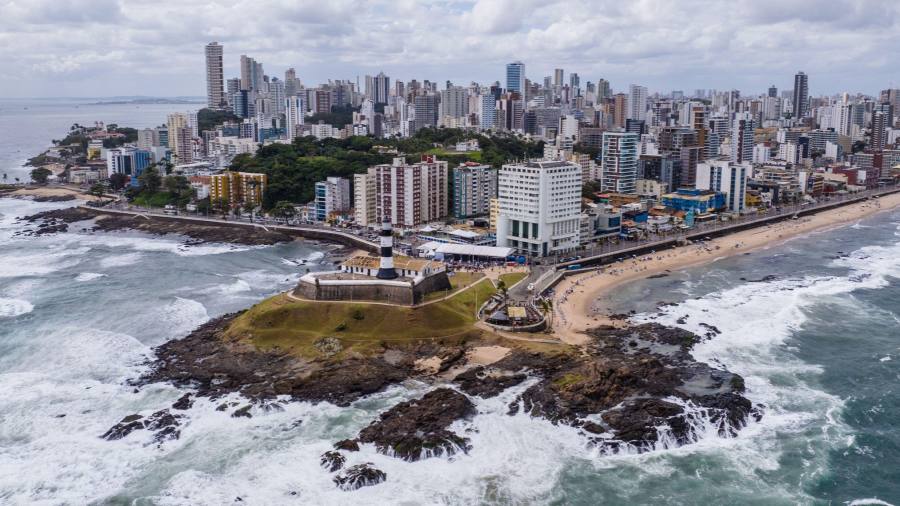
In the 12 years between this census and the previous survey in 2010, the population of Rio de Janeiro fell by 1.7 per cent, while Porto Alegre, in the south, shrank by 5.4 per cent and Belém, on the Amazonian coast, by 6.5 per cent. But among the big cities, nowhere was the drop as vertiginous as in Salvador, a historic municipality on the northeastern coast in the state of Bahia. It lost almost 10 per cent of its inhabitants — some 260,000 people.
“In the past, we had the ‘rural exodus’ — people fleeing drought in the interior and ending up at the coast,” says Rodrigo Cerqueira, a demographics researcher at a government statistics institute in Salvador. “Now we are seeing the opposite movement.”
Perched on a long peninsula, bounded by the Atlantic on one side and a large bay on the other, Salvador could make strong claim to be Brazil’s most unique city. Founded almost 500 years ago by the Portuguese as the colonial capital, it is among the oldest continuously inhabited settlements in South America.
Today its historic centre is in varying states of disrepair, with dilapidated tenements abutting centuries-old baroque churches, monuments to the city’s former slaving fortunes. The old town is still dominated by a plaza named pelourinho, after the stone pillars used to whip African slaves.
The city today has a proudly Afro-Brazilian culture, boasting African-influenced food, clothing and religion, including candomblé, a fusion of several west African beliefs that has incorporated elements of Catholicism. But Salvador has long been in economic decline. While in the 20th century, the city surfed on the wealth of the regional cacao trade, it now lacks a motor for growth beyond tourism. With dwindling opportunities and increasing concerns over security and gang violence, many are opting to leave.
“Those who have a little money go to the interior. There they have soyabeans, agriculture, which is providing jobs and improving the region,” said Lello Vasconcelos, who runs a small shop in Salvador’s old town. “Here we have problems with security, education, the issue of violence. Salvador doesn’t have an industry, it doesn’t have social inclusion.”
The city was also hit badly by the 2015 outbreak of the mosquito-borne Zika virus, which can cause serious birth defects. Cerqueira, the demographer, believes this, combined with coincident dengue and chikungunya epidemics, affected the birth rate and contributed to the sharp population decline. The interior, on the other hand, has seen a boom in infrastructure and welfare policies. “The government arrived and built roads, bridges and developed water supplies,” he says. “This attracted a lot of people back.”
Luis Eduardo Magalhães, a city almost 1,000km inland from Salvador, is one such example. Three decades ago the area was desolate scrubland; today it is a hub for the production of soyabeans, most of which are exported to China. Between the last two censuses, the population of the municipality has jumped 80 per cent.
“They said that the region would not be prosperous, that it was too far from everything,” said Odacil Ranzi, a local farm owner. “Today western Bahia is an example for the state and the country. I don’t see myself leaving for anywhere.”
Read the full article here

