


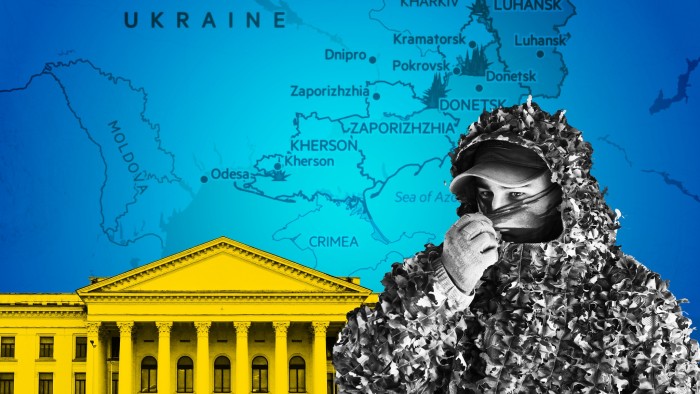
A small group of battle-hardened snipers in Ukraine’s 93rd mechanised brigade recently received a disheartening order: rush back to the frontline near Pokrovsk where they had been positioned two months ago. Russian troops had just advanced some 10km, one of their biggest gains this year.
“I looked at the map and my eyes went wide,” said “Shepherd”, 36, a staff sergeant who oversaw the deployment and who would only gave his call sign for security reasons.
Sent along with troops from other Ukrainian brigades, they ultimately succeeded in containing the Russian advance and even recaptured several settlements north of the strategically important city, according to Ukraine’s general staff and independent assessments by war monitoring groups.
“It could have gone really badly for everyone,” Shepherd told the Financial Times at a training ground near the frontline. Had the Russian forces pressed ahead, he added, they could have completely encircled Pokrovsk and bypassed defences in the Kramatorsk area, setting the stage for further advances.
The Russian incursion brought into sharp focus the military relevance of the fortified cities and towns in the east that Ukraine still controls. Russian President Vladimir Putin is demanding that Kyiv cede the entire Donetsk and Luhansk regions, collectively known as the Donbas.
Ukrainian President Volodymyr Zelenskyy has rejected the proposition, even as US President Donald Trump said a peace deal would likely involve “some swapping of territories”.
Russian forces have intensified their offensive along the entire frontline, entering a forest north of Slovyansk and creeping closer to Kostyantynivka, according to independent groups monitoring the Russian advances.
In the Kharkiv region, fighting has also begun on the northern outskirts of Kupyansk, a town seized by Russia in the early hours of its 2022 invasion that reverted back into Ukrainian hands a few months later.
A Ukrainian military spokesperson on Wednesday admitted that Russian troops were “trying to gain a foothold” in the Dnipropetrovsk region — an area which has not been under Russian control.
The idea of simply giving up the Donbas was met with outrage across the region. At the Donetsk training ground, “Nikitos”, a 25-year-old sniper from Horlivka, a town in eastern Ukraine now under Russian control, stayed silent for a moment when asked how he would react if his brigade was ordered to pull out.
“There won’t be such an order,” he said. “I don’t believe it”.
The matter is not simply one of principle or legality, Ukrainian officials and soldiers say. In northern Donetsk, a 45km belt of heavily-fortified cities and smaller settlements dotted along a key road now represents a formidable barrier — the last major line of defence in the region.
“Beyond this, you have open terrain, no large industrial agglomerations, no areas that would make it possible to build a stable defence,” said Dmytro Zaporozhets, spokesperson for Ukraine’s newly formed 11th army corps.
The “fortress belt” begins at the southern tip of Kostyantynivka, a town with a prewar population of around 65,000. Russian forces have been gradually approaching the city from three directions, recently getting within 10km of its outskirts.
The road linking Kostyantynivka to Kramatorsk is now littered with charred vehicles as military trucks and evacuation SUVs barrel down a road lined with anti-drone nets.
“It’s become way more dangerous in recent weeks,” said Evgeny Tkachev, a humanitarian worker. He spoke to the FT just after completing four evacuation runs from Kostyantynivka, extracting 15 elderly locals as glide bombs hit the centre.
With Russian drones targeting vehicles beyond the frontline, any movement is now a major risk.
“The road, the way in and out, is now the most dangerous,” said Shepherd. Once a soldier reaches his frontline position, he feels like “a king”, he added. “You’re holding the line, you have people around you, psychologically the mood is different. It’s a little less interesting to die like a dog on the road.”
The Russian military has struggled to seize urban areas, with the battle of Bakhmut lasting close to a year and the ruins of Chasiv Yar only falling under Russian control after 15 months of brutal fighting.
The neighbouring cities of Kramatorsk and Slovyansk are, by contrast, around three times the size of Bakhmut. The industrial centre of Kramatorsk also features some of the largest metallurgical plants in the region. With their production lines long shut down, they could be turned into powerful strongholds.
“Every house, every building, every apartment block can be used to stabilise the defence,” said Zaporozhets.
The two cities are not only the largest urban centres in the parts of Donetsk still under Ukrainian control, but their surrounding areas — with large rivers and hills — also provide a natural barrier that Russian forces would find difficult to overcome.
Around the strongholds of Kramatorsk and Slovyansk, still home to around 100,000 civilians, defensive work has continued in recent months, with freshly-dug deep anti-tank trenches cutting across the hilly fields of sunflowers and corn surrounding the agglomeration.
Serhiy Smetankin, a local farmer who took to painting landscapes on ammunition boxes to raise funds for the military, said the work has hampered — but not completely stopped — agricultural activity.
The farmers, he said, try to find “a common tongue” with the military engineers to maintain some access to their fields.

Much more problematic are the regular drone and missile strikes that target vehicles and infrastructure around the city, and which razed one of Smetankin’s grain storage warehouses two weeks ago.
“If you ask how’s business, well, here’s how it is,” he said while standing in front of the destroyed building.
The closest Russian units are now about 18km from the centre of Kramatorsk, according to DeepState, a war monitoring group.
With the war edging closer, strikes have become more frequent and deadly in a city long emptied of its heavy industry but still bursting with restaurants and barber shops catering to the military.
Russian short-range “kamikaze” drones already regularly hit Druzhkivka, a town less than 10km south of Kramatorsk. Last Friday alone, 41 glide bombs hit the outskirts of Kramatorsk and damaged more than 50 houses, according to the local authorities.
In Kramatorsk, 43-year-old Tetiana Luhova was feeding cats in front of her apartment block late last month when a Russian strike ripped apart the next building — facing Peace Avenue — and killed seven people.
Luhova, a soft-spoken humanitarian worker who fled her native city of Donetsk when it was seized by Russia-backed forces in 2014, was knocked unconscious, as debris rained down on her.
The explosion damaged her eardrums and legs, and left her deeply shocked. Yet she, like so many locals, is not yet ready to give up her home.
“What does it mean to cede the Donetsk region? I don’t understand. I’ve already fled Donetsk,” she said. “I haven’t been able to go back home in 11 years.”
Cartography by Aditi Bhandari
Read the full article here

