


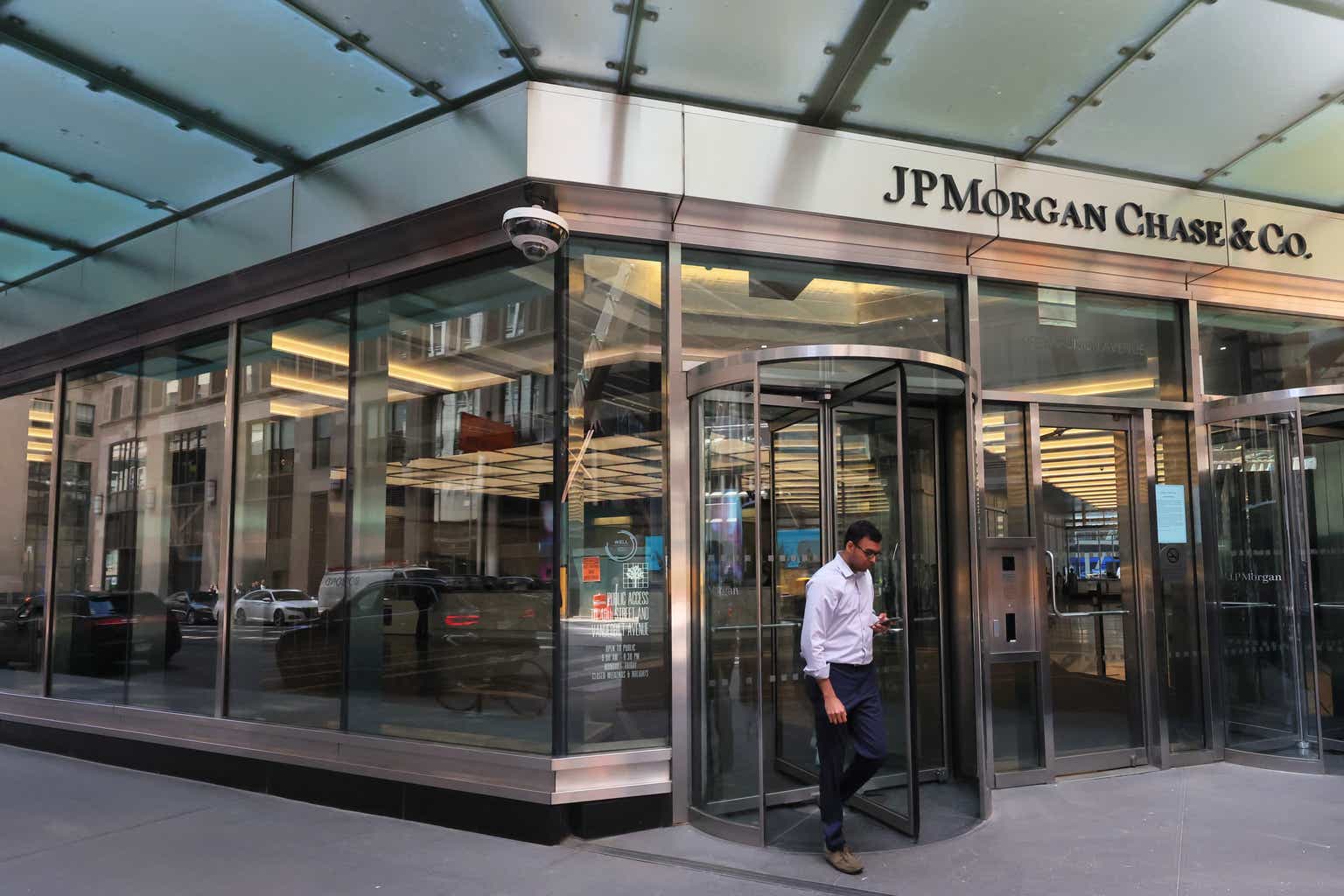
A week ago I took a look at how and why JPMorgan (NYSE:JPM) has been outperforming its largest rivals, and third quarter earnings underlined a lot of the major points I made – strong asset sensitivity that leverages higher rates, good funding costs, lucrative non-interest-based business, and a strong, competitive franchise that is taking lending share in an increasingly difficult market. Time will tell whether JPMorgan posts the most impressive quarter of the major banks (assuming there’s any way to decide “most impressive”), but it certainly hit almost all of the marks that investors wanted.
Given yet another boost to net interest income guidance, as well as operating expense guidance that points to additional operating leverage, my estimates go up once again for 2023. While I agree with management that they’re over-earning today, I think the bar for normalized earnings is rising and that pulls my long-term core earnings growth rate up to close to 5%. With these upgrades, the fair moves up to the low-to-mid-$160’s.
Hitting Almost All Of The Targets In Q3’23
JPMorgan didn’t post a perfect quarter, but there were few areas of major concern and even those really weren’t that weak relative to management’s prior guidance.
Revenue rose 20% year over year and 2% quarter over quarter, beating by about 3% (or $0.28/share). Net interest income rose 30% yoy and 4% qoq, with a small sequential decline in earning assets offset by 10bp of net interest margin improvement (to 2.72%). I expected JPMorgan to stand out on NIM leverage, and it did, with NIM up 63bp yoy and 10bp qoq versus a roughly 8bp qoq decline for peers.
Fee income was more mixed, up 10% yoy and down 1% qoq, and the Corporate & Investment bank business (or CIB) was one of the few areas to underperform expectations (though you can argue this is in part due to expectations getting ahead of management guidance). Trading was down 3% yoy and 8% qoq on weaker equity (down 10% yoy and 16% qoq), but this was still a strong area on balance.
Operating expenses rose 13% yoy and 4% qoq, adding another $0.03/share to the beat. The expense ratio worsened slightly on a sequential basis, but still compares well at 51%.
Pre-provision profits rose 28% yoy and declined 1% qoq, beating by over 6% or $0.31/share. Of the $0.59/share core beat, pre-provision profits were a little more than half, so I’d call that a solid beat. Looking at a few other metrics, tangible book value per share improved 17% yoy and 3% qoq, while CET 1 improved 50bp qoq to 14.3%. While accumulated unrecognized losses (tied to the securities portfolio) increased about $2.8B sequentially, it was still down about $2B from the prior year.
Good Growth In A Slowing Market
I continue to be impressed with JPMorgan’s ability to generate loan growth. This has been a priority for management for a few years now, and it would seem that the investments made into organic branch expansion, hiring, and digital capabilities is paying off.
Overall loans rose 4% yoy and 2% qoq on an organic basis, which was comfortably above the 1.5% yoy growth seen among large banks in the quarter, and only just shy of the banking sector as a whole. What’s more, the commercial bank generated 7% yoy and 1% qoq loan growth in a weak market for commercial lending (C&I lending was basically flat) – middle-market lending was up double-digits from the prior year (and 1% qoq), with CRE lending up 7% qoq.
On the consumer side, small business lending was weaker (down 0.5% qoq), but home lending was up slightly, auto lending was up more than 3% on an average balance basis, and card lending continues to grow strongly (up more than 15% yoy and about 3% qoq), while card spending rose about 9% and 1%).
JPMorgan also continues to do well in terms of deposits. Total deposits were down 1% yoy and qoq, with average deposits down 3.7% yoy and 1.3% qoq. Consumer deposits were a little better, down 2.6% and 1.2%, and average total non-interest-bearing deposits were down 7.8% yoy and 1.6% qoq, a fair bit better than the average seen so far this quarter.
On the credit side I didn’t see much to concern me. Charge-offs were higher than last year (0.47% vs. 0.27%) but stable sequentially. Credit card charge-offs continue to rise (2.49% versus 1.40% a year ago), but were down sequentially and still aren’t out of line with longer-term trends. Management did note worsening trends in office credits, but this isn’t a huge part of JPMorgan’s lending.
An Impressive House In Large Bank Neighborhood
I’m including a series of tables here to put JPMorgan’s strength and relative standing in better context, as well as some commentary. For this I’m using the largest comparable banks that have reported, including Bank of America (BAC), Citigroup (C), Citizens Financial (CFG), Fifth Third (FITB), M&T Bank (MTB), PNC Financial (PNC), Regions Financial (RF), Truist (TFC), U.S. Bancorp (USB), and Wells Fargo (WFC). For these tables the banks are listed by asset size (largest to smallest).
|
NIM (%) |
|||
|
Q3’23 |
Q2’23 |
change |
|
|
JPM |
2.72 |
2.62 |
0.10 |
|
BAC |
2.11 |
2.06 |
0.05 |
|
C |
2.49 |
2.48 |
0.01 |
|
WFC |
3.03 |
3.09 |
-0.06 |
|
USB |
2.81 |
2.9 |
-0.09 |
|
PNC |
2.71 |
2.79 |
-0.08 |
|
TFC |
2.95 |
2.91 |
0.04 |
|
CFG |
3.03 |
3.17 |
-0.14 |
|
MTB |
3.79 |
3.91 |
-0.12 |
|
FITB |
2.98 |
3.1 |
-0.12 |
|
RF |
3.73 |
4.04 |
-0.31 |
As this table highlights, JPMorgan has been the best performer among its peers in terms of sequential net interest margin improvement, and one of only four to improve, though the entire sector has done well, with only Fifth Third and Regions missing expectations.
|
Fee inc |
||
|
+/- qoq |
% of rev |
|
|
JPM |
-1.0% |
55.3% |
|
BAC |
-3.0% |
42.6% |
|
C |
6.7% |
30.0% |
|
WFC |
5.2% |
37.2% |
|
USB |
1.4% |
39.3% |
|
PNC |
1.8% |
34.4% |
|
TFC |
-8.1% |
36.8% |
|
CFG |
-1.6% |
24.2% |
|
MTB |
-3.1% |
23.8% |
|
FITB |
-7.3% |
33.3% |
|
RF |
-2.3% |
30.3% |
Fee income has not been a major positive driver for most banks, Citi and Wells excluded, but JPMorgan’s strong skew toward non-interest income has remained an important bulwark to maintain profitability despite challenging spreads.
|
Trading (ex-CVA/DVA) |
||||
|
Fixed Inc |
Equities |
Total |
I-banking |
|
|
JPM |
-1.2% |
-15.7% |
-7.6% |
8.0% |
|
BAC |
-1.5% |
4.6% |
0.8% |
-1.0% |
|
C |
0.9% |
-15.8% |
-3.0% |
37.9% |
|
WFC |
1.3% |
31.0% |
9.0% |
2.8% |
Trading has long been a major component of JPMorgan’s non-interest revenue, but this was a challenging quarter, not helped by the company looking to reduce risk, nor the active efforts from Bank of America and Wells Fargo to grow their presence in these markets.
|
ER (%) |
|||
|
Q3’23 |
Q2’23 |
change |
|
|
JPM |
51.0 |
50.3 |
-0.7 |
|
BAC |
62.5 |
63.1 |
0.6 |
|
C |
67.9 |
69.4 |
1.5 |
|
WFC |
62.9 |
62.9 |
0.0 |
|
USB |
60.4 |
59.4 |
-1.0 |
|
PNC |
61.6 |
63.3 |
1.7 |
|
TFC |
64.1 |
61.8 |
-2.3 |
|
CFG |
63.1 |
59.1 |
-4.0 |
|
MTB |
53.7 |
53.5 |
-0.2 |
|
FITB |
54.8 |
54.4 |
-0.4 |
|
RF |
58.2 |
56.4 |
-1.8 |
JPMorgan clearly stands out on costs, with only M&T and Fifth Third coming close, though Citi and PNC did manage meaningful sequential improvement (remember, lower efficiency ratio is better).
|
Profitability |
||
|
Pre-provision Op Inc / Average Earning Assets |
ROTCE (Q3) |
|
|
JPM |
2.4% |
22.0% |
|
BAC |
1.4% |
16.7% |
|
C |
1.2% |
8.2% |
|
WFC |
1.8% |
8.8% |
|
USB |
1.8% |
18.4% |
|
PNC |
1.6% |
18.6% |
|
TFC |
2.1% |
15.3% |
|
CFG |
1.5% |
12.0% |
|
MTB |
2.3% |
17.4% |
|
FITB |
2.0% |
24.7% |
|
RF |
2.5% |
20.6% |
While there are multiple ways to measure bank profitability, I like comparing pre-provision profits to earning assets and returns on tangible common equity. JPMorgan scores well here, though Regions is impressive as well. Keep in mind, this is a one-quarter analysis and not necessarily illustrative of full-year profitability.
|
Loans (avg) |
||
|
+/- qoq |
Loan Yield |
|
|
JPM |
2.0% |
6.79% |
|
BAC |
0.0% |
5.65% |
|
C |
1.3% |
9.02% |
|
WFC |
-0.3% |
6.23% |
|
USB |
-3.1% |
6.02% |
|
PNC |
-1.5% |
5.75% |
|
TFC |
-2.6% |
6.25% |
|
CFG |
-1.9% |
5.66% |
|
MTB |
-0.7% |
6.19% |
|
FITB |
-1.4% |
6.18% |
|
RF |
0.2% |
5.91% |
JPMorgan stood out among its peers with stronger loan growth (up 2% organically), helped by strong middle-market and CRE lending, likely due in part to other banks having to pull back on their lending, as well as the company’s own organic expansion/takeaway efforts. As you can see from the loan yields, meaningful card businesses are an important aid to loan yields for Citi and JPMorgan.
|
Deposits (avg) |
|||
|
+/- qoq |
Cost |
IBD Beta |
|
|
JPM |
-1.3% |
1.8% |
48% |
|
BAC |
0.0% |
1.6% |
42% |
|
C |
-1.0% |
3.4% |
60% |
|
WFC |
-0.5% |
1.4% |
36% |
|
USB |
3.0% |
2.0% |
46% |
|
PNC |
-0.8% |
1.7% |
43% |
|
TFC |
0.3% |
1.8% |
49% |
|
CFG |
1.8% |
2.0% |
48% |
|
MTB |
2.1% |
1.7% |
48% |
|
FITB |
3.0% |
2.0% |
50% |
|
RF |
-0.3% |
1.2% |
34% |
|
Avg |
0.6% |
1.9% |
46% |
On the funding side, JPMorgan was not so exceptional, with the weakest sequential performance in total deposits, though the cost of deposits is still very competitive and JPMorgan had the luxury of letting some deposits go versus paying more to retain the excess liquidity. Beta is a little higher than average, but not by a lot.
The Outlook
JPMorgan raised net interest income guidance for the fourth time this year and it looks like there will be a little more operating leverage as well. Management did make a meaningful presentation on the impact of proposed new capital rules (Basel IV, also called Basel III end-game) – noting that the bank’s return on tangible equity would decline about 300bp under the proposed rules and the cost of borrowing for businesses and consumer would head higher (and toward non-regulated channels).
To offer a little perspective, I’ve long pointed out that there has been a strong historical relationship between bank returns on tangible common equity and multiples (price to tangible book in particular). All things being equal, a 300bp hit to ROTCE would mean a roughly 0.4x decline in the P/TBV multiple, or roughly $32/share using Q3’23’s TBVPS.
Looking at my model, I’ve increased my NII assumptions for the rest of this year and for 2024, as I think JPMorgan will see a higher bar even with “normalization”, and I’m expecting a higher-for-longer rate scenario. I also think trading should turn around next year. Payments seem more at risk to me at this point, and I expect higher credit costs in the coming quarters. I also see relatively few options for significant cost-cutting – I think Citi, PNC, and Wells Fargo are probably stronger cost-cutting stories (and PNC recently announced some headcount cuts).
My 2023 core earnings number is now about 5% higher for JPMorgan, with some spillover into the following years (again, that “higher bar”). These adjustments pull up my 5-year core earnings growth rate to 5.8% (from 2022) and my 10-year rate to 5%. I’d note that relative to published estimates (which are probably not fully up to date), I’m slightly below Street for 2024, about 1% below for 2025, and 4% below for 2026, so I don’t think my numbers are all that aggressive (at least not relatively so).
Between discounted core earnings, ROTCE-driven P/TBV, and P/E, I believe JPMorgan is undervalued below $160-$168.
The Bottom Line
As has been the case for a little while, JPMorgan isn’t the cheapest bank stock. There are a lot of regional banks that have been pounded down much too far, and likewise there are still some large banks as well that trade at meaningful discounts to my estimates of their long-term fair value. But in terms of current performance, management quality, and overall business quality, I still believe that JPMorgan at a modest discount to fair value is a worthwhile holding on a risk-adjusted basis.
Read the full article here

