


Receive free Life & Arts updates
We’ll send you a myFT Daily Digest email rounding up the latest Life & Arts news every morning.
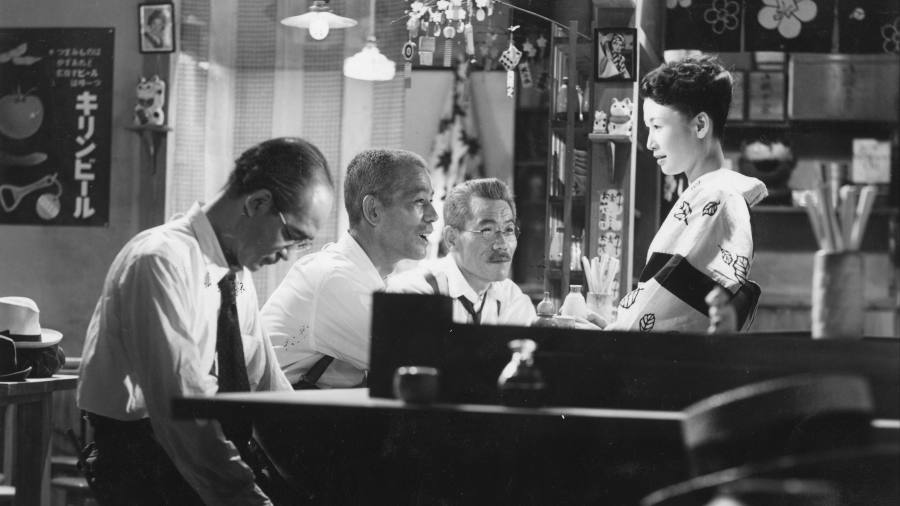
Owing to various round-number anniversaries — 70 years since its release, 120 since its director’s birth, 60 since his death — cinemas are showing Tokyo Story. In a decision I will rue this winter, I forfeit a couple of hours of vitamin D-gifting sunshine to attend an afternoon screening.
Yasujirō Ozu’s glacial masterwork follows an old provincial couple on a visit to their grown-up children in the capital. Their reception is one of strained tolerance rather than familial warmth. Sensing their obsolescence in the modern world (though General MacArthur has left town, their grandson is learning English) Ma and Pa go home. You keep waiting for the intergenerational recriminations but, as ever with neglected parents, it is the refusal to make a fuss that constitutes the pathos.
Tokyo Story might be the most acclaimed film ever made. It is certainly, despite taking years to be distributed outside Japan, Shakespearean in its universality. If only its view of urban life — that breaker of bonds, that defiler of simple virtues — wasn’t such a moral cliché.
The economic case for cities — the benefits of agglomeration and so on — is aired so often that it crowds out the more high-minded one. So here goes.
The fact that large cities aren’t wall-to-wall chaos is, before anything else, a moral achievement. It doesn’t depend on coercion — no police force can bring 10mn people into line — but on trust and goodwill, or, at the absolute minimum, enlightened self-interest. And this from a species that didn’t start living in settled populations until an hour or two ago on the historical clock. For all its nobility, the familial love that Ozu reveres is, or is meant to be, hard-wired. The millions of voluntary obligations that keep a city from disintegration are harder to fathom — and slower to be credited.
The problem, in my experience, is that anti-metropolitans just don’t know how safe these places are. Their grievance against the city is not, or not just, its wealth and hoity-toity manners, but the opposite: its squalor and turmoil. “How can you stand it there?” someone will ask, from a deindustrialised abyss or a town whose best restaurant is a Côte. Even allowing for a certain bluster (we all justify our residential choices to ourselves) I see their point. A place with no stable population, no shared memory, should fall apart.
This is the ancient mistrust of cities. (I’d call it metrophobia, but that means fear of poetry.) The Industrial Revolution was, give or take Newtonian mechanics, Britain’s highest feat. A chart of world living standards in the thousand years before 1750 is a flat-ish line. But the opening ceremony of the 2012 Olympics framed it as an alien assault, turning Eden into Manchester. In the US, too, and France, and China during the Cultural Revolution, the “real” nation is held to be the provinces. “But we pay the bills,” I would have said a while ago. I am now more inclined to defend the honour of cities, not just their productiveness.
To outgrow one’s parents is a kind of pre-bereavement before the actual one. It is also the universal tax on upward mobility, levied in all jurisdictions. But the alternative is what? Static communities? Knowing one’s place? It is an odd moral vision, but one with lots of takers on the de-growth left and the alt-right. Neither side can see that modernity creates different connections and duties, which are more touching, not less, for having no basis in blood or ethnic kinship.
Except in one scene, Ozu’s camera, like a good son or daughter, never leaves its starting place. It is also set low, as though the viewer is a house guest, kneeling on the tatami. This, the screen implies in all its stillness, is how we are meant to live.
Even the big cheerful face of the matriarch is visual code for small-town innocence. There she is, smiling through her little humiliations, too meek to ask the children for some patience for her unimportant life. That too, in the end, the city takes. This is an eternal work of art whose emotional power comes from its emotional restraint. It almost doesn’t matter that it gets us urbanites wrong, I think, as I stagger blinking into a city that shouldn’t hold together, and does.
Email Janan at [email protected]
Follow @ftweekend on X to find out about our latest stories first
Read the full article here

