


Unlock the White House Watch newsletter for free
Your guide to what the 2024 US election means for Washington and the world
The author is vice-chair at Oliver Wyman and former global head of banks and diversified financials research at Morgan Stanley
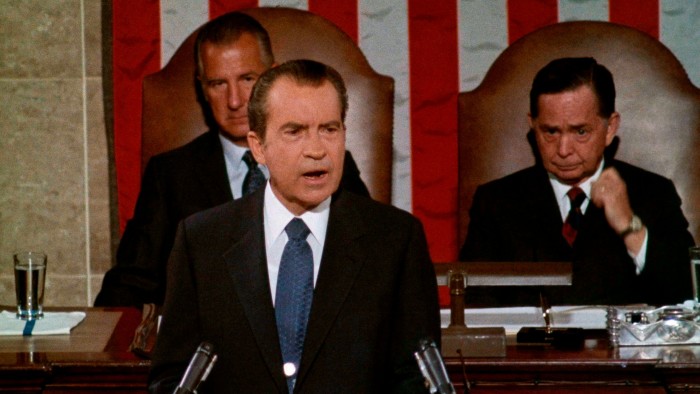
What will the longer-term financial consequences of Trump’s tariffs be? We may be in a 90-day pause but the question remains urgent. A look back at Richard Nixon’s experience in 1971 could help investors understand what might happen next.
Certainly recent events share some hallmarks with the “Nixon shock”, which occurred when the then president took the dollar off the gold standard, implemented a 10 per cent import tariff and introduced temporary price controls. This de-anchoring of the regime resulted in a period of global economic instability and uncertainty. It not only caused a loss in business confidence but led to stagflation. Nixon’s price and wage controls spectacularly backfired, triggering product shortages and helping to fuel a wage-price spiral. The whole episode was a pivotal contributor to the huge inflation of the ’70s.
As with Trump’s tariffs, Nixon’s were introduced to cudgel countries into changing the terms of trade to help reduce the US trade deficit. His biggest concerns were Japan and Germany. “My philosophy, Mr President, is that all foreigners are out to screw us and it’s our job to screw them first,” Treasury secretary John Connally had said to him.
In today’s hyperfinancialised world, we have already seen that bond markets can force the hands of politicians far more quickly. It took four months in 1971 before Nixon’s tariffs were removed via the Smithsonian agreement. But the shock had already done enough to catalyse extraordinary changes in finance, leading to the creation of new instruments to bet on the direction of interest rates and hedge currency risk, including FX futures and options.
The pain of stagflation in the banking system prompted a huge change in financial behaviour and financial regulation. Investors shifted asset allocation to gold and real assets to preserve value. Meanwhile corporates and depositors increasingly moved their activities from banks to bond markets. Bank lending as a share of total borrowing in the economy has been falling ever since. In short, modern finance was forged in the early 1970s.
There are parallels as well for countries outside the US currently worrying about tariffs. Back in 1971 there was also shoddy treatment for the US’s closest allies. Nixon hit Canada with tariffs despite its currency already floating. Like Prime Minister Mark Carney today, Canadians didn’t back down and eventually the tariffs were removed. It could have been even worse: Connally had also wanted the US to withdraw from a long-standing pact with Canada on cars and auto parts. But Paul Volcker fixed that, according to his memoirs, by cheekily encouraging a State Department official to tear off the last page of every press release which mentioned it.
Ultimately, the need to stabilise international relations with allies helped tip the balance away from the tariffs. Henry Kissinger, then the national security adviser, “grew concerned about the unsettling impact of a prolonged confrontation on allied relationships”.
Nixon also put huge pressure on the Fed for expansionary monetary policy to offset the shock. William Safire, Nixon’s speechwriter, recounts how the administration kept up a steady stream of anonymous leaks to pressure Fed chair Arthur Burns, including floating one proposal to expand the size of the Federal Reserve, so that Nixon could pack the committee with supportive new members.
At the end of it all, Nixon’s four-month tax may have helped facilitate dollar revaluation, but it fell short of the desired goals and had no discernible impact on imports. The move’s economic shockwaves, however, rippled through the decades. Even the creation of the euro stems from it. Might a digital euro or deeper European capital markets be next? It’s not yet clear but history suggests the fallout from this latest shock will be felt for years to come.
Read the full article here

