


Receive free US-China relations updates
We’ll send you a myFT Daily Digest email rounding up the latest US-China relations news every morning.
The writer, a senior fellow at the Yale Law School and former chair of Morgan Stanley Asia, is author of ‘Accidental Conflict: America, China, and the Clash of False Narratives’
US Treasury secretary Janet Yellen’s recent trip to Beijing was the economic policymaker’s carbon copy of Antony Blinken’s earlier diplomatic mission — plenty of talk but no meaningful conflict resolution. The same can be expected from climate envoy John Kerry’s trip to China. Both sides are aiming low, more intent on re-establishing connections than rethinking a deeply troubled US-China relationship.
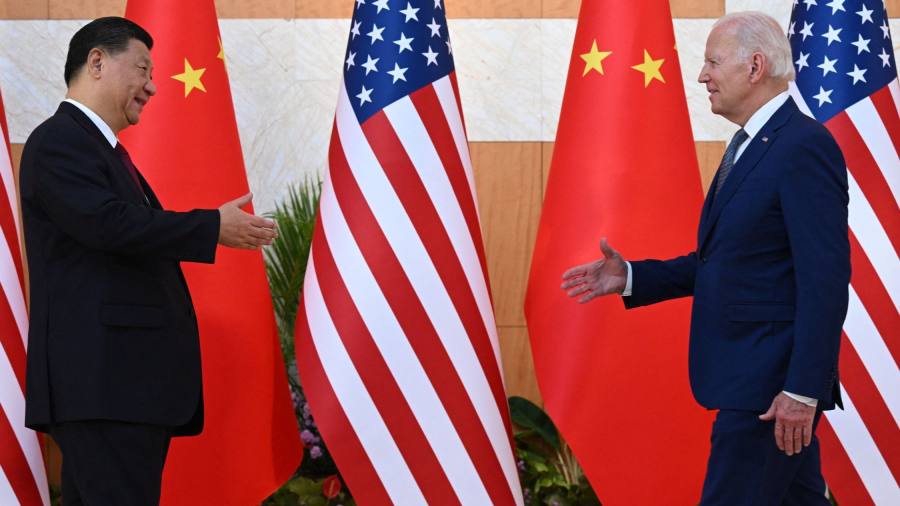
The problem is not with the messengers. The diplomats are just following orders, consistent with the leader-to-leader commitment Presidents Joe Biden and Xi Jinping made at the November 2022 G20 meeting in Bali to put “a floor” on the relationship. Yes, a floor is an improvement from a downward spiral, but it runs the very real risk of setting the stage for a new phase of conflict escalation.
Current efforts are a replay of an old, tired formula of US-China engagement. This featured periodic summits between 2006 and 2017, notably the twice yearly Strategic Economic Dialogues of the George W Bush administration followed by the broader annual Strategic and Economic Dialogues of the Obama era. These were grand and glorious exercises in event planning, but they failed to prevent the trade war, the tech war and the early skirmishes of a new cold war.
Now it seems that both Yellen and Blinken would like nothing better than to return to this failed approach. The same is the case with China. Li Qiang, the new Chinese premier, borrowed an elliptical page from one of his predecessors, Wen Jiabao, and spoke wistfully after meeting Yellen of seeing “rainbows” after a round of “wind and rain”.
This deeply troubled relationship needs far more than just a “floor” to prevent a new round of conflict escalation. That is the minimum that Biden and Xi expect from each other as responsible stewards of a fragile world. But without reinforcement, it could turn out to be surprisingly shaky.
The great February balloon fiasco is an example of how quickly matters can veer out of control in the face of the slightest glitch. This precarious state of affairs is an unavoidable consequence of an important shift in the priorities of US-China relationship management — a longstanding emphasis on economics and trade has now been supplanted by concerns over defence and security.
Unlike economics and trade, in which relationship conflicts are evaluated through the lens of hard data, security concerns are judged more on the basis of unsubstantiated presumptions of adversarial behaviour. China’s dual use of advanced technologies, blurring the distinction between commercial and military purposes, is a case in point. The US assumes that China will weaponise artificial intelligence just as it takes for granted that Huawei poses a backdoor threat to 5G infrastructure or TikTok will use proprietary data gathered from young US users for nefarious purposes.
China operates under the same paranoid mindset, presuming that Washington’s trade and technology sanctions are aimed at “all-around containment, encirclement and suppression”, to quote Xi’s words at this year’s Chinese People’s Political Consultative Conference. With both nations operating on the basis of presumption without evidence, the dangers of further escalation, especially in the face of looming risks for tech investment and strategic materials exports, cannot be ignored.
Old-style engagement is ill equipped to deal with these risks. In the end, that rests on leader-to-leader chemistry, which is always vulnerable to the tenuous interplay between domestic politics and the need for fragile human egos to save face. Today’s US-China conflict has outlived that approach.
For this reason, I am in favour of the establishment of a US-China secretariat as the centrepiece of a new architecture of Sino-American engagement — a permanent organisation, staffed by equal complements of US and Chinese professionals, located in a neutral jurisdiction with a broad remit for policy development, troubleshooting and conflict resolution. Its focus would be on a forward-looking, full-time approach to relationship management and dispute screening. A secretariat would shift the relationship framework away from the personalisation of endless diplomacy towards a more resilient institutionalisation of collaborative problem solving.
Stuck in the past, diplomats are now celebrating the thaw after a big freeze. While, for the time being, the escalation of tensions is on a tenuous hold, it is urgent that both superpowers seize the moment and push for an entirely new approach to conflict resolution — before it is too late.
Read the full article here

