


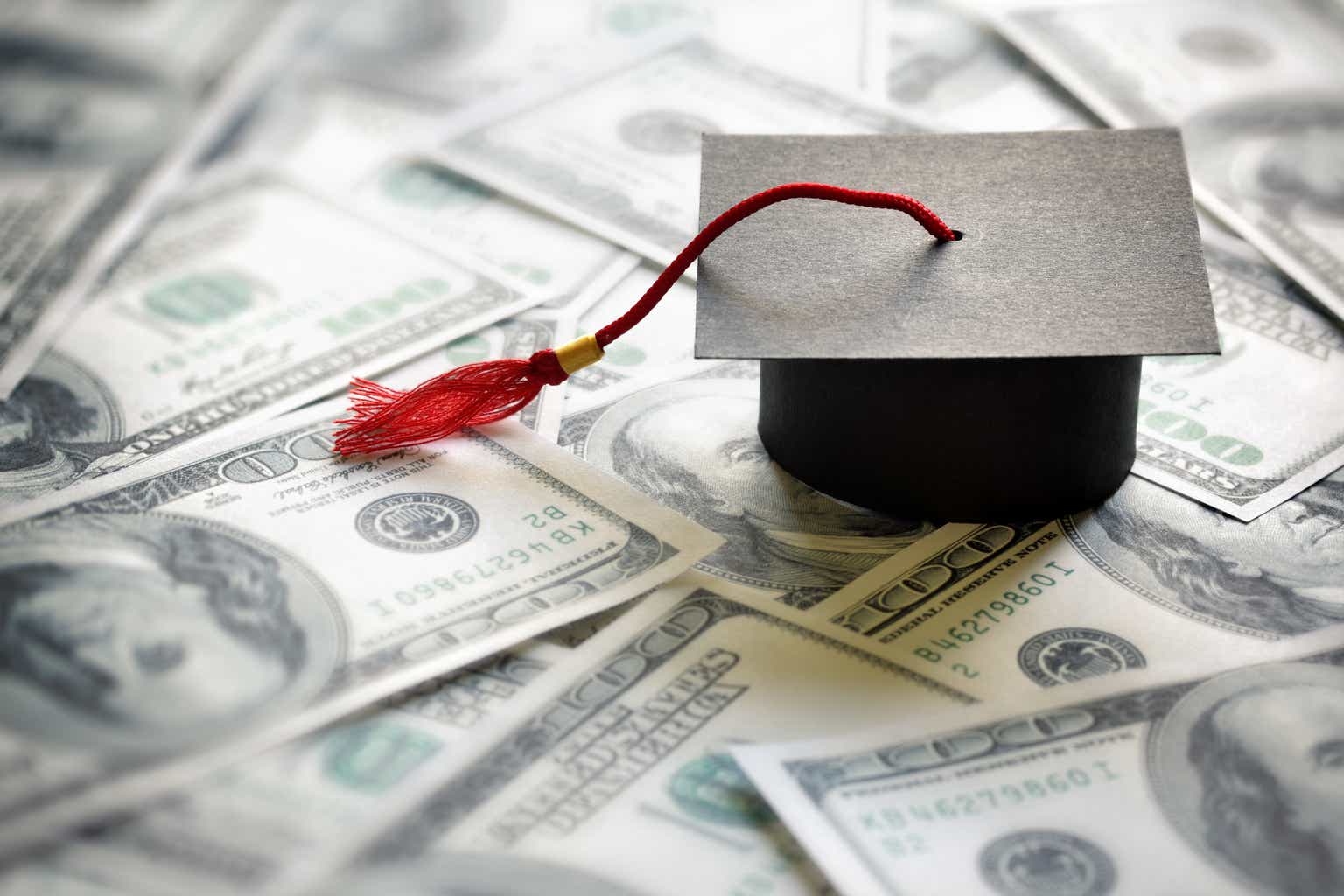
In March 2020, the federal government paused payments and interest accrual on most federal student loans in order to provide relief to millions of households during the pandemic’s economic uncertainty.
Many families became accustomed to the absence of student-loan repayments, and pressure built to simply forgive the debt for a portion of borrowers. On the 2020 presidential campaign trail, Joe Biden promised to cancel up to $10,000 of debt per borrower. After becoming president he asked Congress to enact this plan, but Congress balked.
In the 2021 discussions, senators Chuck Schumer (D-NY) and Elizabeth Warren (D-MA) raised the roof to canceling $50,000 of debt per borrower. Warren told Business Insider:
“Cancelling $50,000 in student debt would completely wipe out student loans for 84% of borrowers, including more than 3 million borrowers who have been repaying their loans for more than 20 years. This is the single most effective executive action President Biden could take to jumpstart our economy …”
Initially, Biden doubted the legality of taking executive action to cancel student debt but eventually warmed to the idea. In August 2022, he announced that he would use executive action to forgive $10,000 of debt for most borrowers, and $20,000 for Pell Grant recipients. He said 95% of borrowers would benefit from the plan, or about 43 million people, over 60% of whom would be Pell Grant recipients.
To justify his executive authority, Biden cited the Higher Education Relief Opportunities for Students (Heroes) Act, passed unanimously by Congress and signed into law by President George W. Bush in January 2002. It was extended and updated in 2003, extended again in 2005, and became a permanent fixture of the education industry in 2007.
Because the Heroes Act grants the Secretary of Education the authority to “waive or modify any statutory or regulatory provision applicable to the student financial assistance programs” of the Higher Education Act of 1965 to ensure that “affected individuals” are not worse off financially due to their financial assistance, Biden claimed the right to executive action.
In September 2022, various states challenged Biden’s debt forgiveness program, saying that it violated the separation of powers and the Administrative Procedure Act. In November 2022, the states were granted an injunction pending appeal. The federal government took the case to the Supreme Court. In December 2022, the Supreme Court agreed to hear arguments. Those arguments, for two related cases, Department of Education v. Brown and Biden v. Nebraska, were presented on February 28.
On June 30, the Court struck down Biden’s debt forgiveness program, in a 6-3 decision on Biden v. Nebraska.
The majority opinion held that the Heroes Act authority for the Secretary of Education to waive or modify loan agreements did not apply to the student loan forgiveness program, and that a debt cancellation of its magnitude required congressional authorization because it falls under the major questions doctrine. That doctrine is a standard of US administrative law that says courts should assume Congress does not delegate to executive agencies topics of major societal impact. Basically, if Congress can be sidestepped at will on significant matters, why does it exist at all in the separation of powers?
On the day of the Court’s decision, Biden announced a new student-debt forgiveness plan, saying: “Today’s decision has closed one path. Now we’re going to pursue another.”
The new path scraps the Heroes Act in favor of the Higher Education Act (HEA), signed into law by President Lyndon B. Johnson in 1965. That Act grants the Secretary of Education limited authority to waive education debt. The administration explained that it opted to try the Heroes Act first because it specifically addresses national emergencies, and the pandemic qualified as one.
By moving from the relatively speedy Heroes Act path, which gets things done quickly in light of its national emergency focus, to the HEA, the Biden administration waded into Washington’s usual prolonged political process. The rulemaking procedure is a lengthy one, which will likely feature a public comment period and other time-consuming phases.
Most analysts say nothing definitive will happen earlier than summer 2024.
Mark Kantrowitz is a student loan expert and author of How to Appeal for More College Financial Aid and Who Graduates from College? Who Doesn’t? He wrote in a July 3 commentary for Barron’s, “Game Over for Student-Loan Forgiveness,” that Biden’s “new way” to provide student debt relief is more of a campaign strategy than an effort to actually forgive debt:
“This effort will ultimately fail to survive legal challenges for the same reasons the prior plan was blocked. This effort may be motivated more by politics than policy, in an effort to hold out hope for forgiveness during the upcoming elections.”
He says that the HEA’s waiver authority applies only “when a borrower is unable to repay their debt, the federal government is unable to collect the debt through wage garnishment or Treasury offset of Social Security benefit payments and income tax refunds, the cost of collection exceeds the amount to be recovered, or there is doubt as to whether the government could win a lawsuit against the borrower.”
Kantrowitz told CNBC on July 12 that issuing new regulations can take as long as a year, thus: “If the Biden administration is successful in providing loan forgiveness under the HEA, borrowers could see forgiveness around the time of the election.” That’s November 5, 2024.
For now, no forgiveness.
Debt payments were initially scheduled to resume in February 2022, but this was postponed, eventually nine times to its current interest-accrual restart date of September 1, 2023. That’s when “normal” interest rates will kick in again. For most borrowers, the rate will be what they paid prior to the student loan pause, not today’s market rate. Bills for most restarted loan payments will arrive this September or October, with payment due at least 21 days later.
An additional extension of the pandemic pause is impossible because of a provision in the debt ceiling deal passed by Congress on June 2.
To help borrowers after the Supreme Court’s decision against debt forgiveness, Biden announced a 12-month “on-ramp transition period” for borrowers unable to make monthly payments. Those who miss payments will not fall into default, although interest on their loans will continue to accrue. Biden said: “During this period, if you can pay your monthly bills, you should. But if you cannot, if you miss payments, this on-ramp temporarily removes the threat of default or having your credit harmed, which can hurt borrowers for years to come.”
This battle is set on quicksand. It’s hard to know whether forgiveness will prevail or not, and therefore hard to know the impact on the economy and stocks.
Bearish stock analysts argue that the resumption of student loan payments will remove spending power from America’s consumer economy, thereby weighing on corporate performance. Bulls retort that less spending power should help the inflation fight. There’s a third view, which is that canceling student debt would help consumer spending and still help the inflation fight. Let’s look at that last one.
Nobel Prize-winning economist Joseph Stiglitz, who is a professor at Columbia University, argued in The Atlantic last August that Biden’s targeted loan forgiveness would help, not harm, the economy. In “Actually, Canceling Student Debt Will Cut Inflation,” he wrote that “the value of the reduced debt repayments is so small that the cancellation’s impact will be negligible.”
He estimated that the reduced payments would total tens of billions of dollars, not hundreds of billions as critics of the plan claimed. Student-loan debt often delays major life events such as getting married and having children, which contribute to economic activity. Research by the Philly Fed found that student debt weighs on new-business formation, particularly new businesses with one to four employees. Therefore, he believes, a comprehensive student-loan debt-cancellation program would have a valuable economic upside.
My inbox paints a picture of resumed payments crimping household discretionary spending at a meaningful level. One longtime subscriber from Kansas wrote last month:
“As (unfortunately) a person who has student loan payments that will restart, I know how big a deal it is—and it’s definitely weighing on my mind. I will absolutely have less disposable income starting in October, and I know I’m not alone. … I just don’t know if anyone is factoring in the reality that millions of people are going to have far less spending money going forward—and it’s not a short-term issue.”
His research found $1.78T in student loan debt, owed by 43.5 million people, with an average monthly loan payment of $337. This adds up to some $14.7B “being removed from the economy” each month after debt payments resume. I confirmed his figures.
But while an extra $337 in monthly outlays would certainly crimp the lifestyle of many households, it’s not clear that it would make much of an impact on the economy.
The latest Personal Income and Outlays report from the Bureau of Economic Analysis, for May 2023, shows that personal consumption expenditures (PCE) increased $18.9B (0.1%). The growth of personal income was driven by higher compensation, Medicaid payments, and higher personal interest income. If we subtract $14.7B in student-loan payments from May’s $18.9B increase in PCE, we reduce PCE growth to $4.2B. A big hit, but still growth.
On top of this, I’m not sure that the full portfolio of student debt is on the table. Getting figures from the Department of Education is trickier than you might think. Jordan Weissmann at Slate contacted the agency in March 2021 and found that in the last pre-pandemic year of data, 2019, the Department of Education collected $70.3B in loan payments. If we get back to that, the monthly impact on the economy would be $5.9B, which is 60% less than $14.7B.
Simon Moore at Forbes ran the numbers last month, starting from Weissmann’s $70B and comparing it with annual consumer spending of $19T as of April 2023, to conclude:
“Hence if the resumption of student loan payments causes consumer spending to drop by the same amount as the cost of student loan servicing, then that could be a drag on consumer spending of around 0.4%.”
Again, not good but not crushing.
Then there’s the question of whether the money really disappears from the economy. A more accurate description is that it moves to a different part of the economy. It’s possible that the resumption of student-debt payments would provide a boost to other programs advocated by the people who advocate student-debt forgiveness.
Brookings looked at this two years ago and found that the sums involved in debt forgiveness proposals sometimes exceed spending on many of America’s antipoverty programs. In “Putting student loan forgiveness in perspective: How costly is it and who benefits?” Adam Looney at Brookings wrote in February 2021:
“There are better ways to spend that money that would better achieve progressive goals. Increasing spending on more targeted policies would benefit families that are poorer … compared to those who stand to benefit from broad student loan forgiveness. Indeed, shoring up spending on other safety net programs would be a far more effective way to help low-income people …”
He offered perspective on the impact of writing off all $1.6T (now nearly $1.8T) of student debt. Note that Biden is not proposing this, but Senator Bernie Sanders (I-VT) does on the “College for All and Cancel All Student Debt” page of his website. In any event, considering the total offers the perspective that Looney promised:
“Forgiving all student debt would be a transfer larger than the amounts the nation has spent over the past 20 years on unemployment insurance, larger than the amount it has spent on the Earned Income Tax Credit, and larger than the amount it has spent on food stamps.”
Student loan debt is money owed, and if it is not repaid then something else in the federal budget would need to take a hit, or taxes would need to be increased, each of which presents a different kind of economic challenge.
Ultimately, the best factor we can observe is that the US economy was fine before student-loan repayment was paused. We should assume that there’s no reason to think it can’t cope with repayments again. The very nature of the word “paused” as opposed to “canceled” indicates that business and government should have been braced for this eventuality. On the list of what businesses have had to contend with in recent years, this looks minor.
I will monitor the impact on consumer spending in the fourth quarter, when we’ll see results of resumed student-loan payments.
For now, investors should not fret their impact on the economy and stocks.
Read the full article here

