


Unlock the White House Watch newsletter for free
Your guide to what the 2024 US election means for Washington and the world
Angela Merkel’s memoir is called Freedom. But it could just as well be titled No Regrets. In her newly published book, the former German chancellor goes back over her 16 years in power and argues that, all things considered, she got it right.
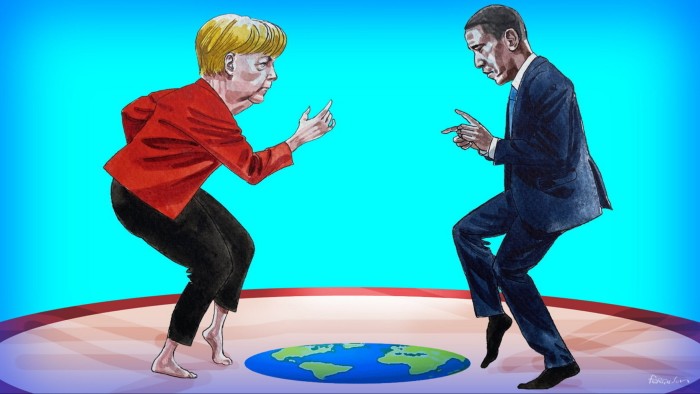
It will be interesting to see if Barack Obama is similarly defensive when he publishes the next volume of his memoirs. For the international legacy of the Obama-Merkel years is looking increasingly questionable with the passage of time.
From 2008 to 2016, Merkel and Obama were the two most powerful politicians in the western world. They got on well — which is not surprising, since they were similar characters. They were both outsiders: the first female chancellor of Germany and the first Black president of the US. They were both raised well away from the metropole, in east Germany and Hawaii respectively.
Both Merkel and Obama are self-assured, highly educated, intellectual and cautious by temperament. These are qualities that endeared them to cautious, educated liberals. (I plead guilty.) But, in retrospect, their careful rationalism made them ill-equipped to deal with ruthless strongman leaders like Vladimir Putin and Xi Jinping.
Both Merkel and Obama still have a huge fan base, many of whom look back nostalgically to their era as a period of stability and sane government. So it was, in many ways.
But it is increasingly clear that decisions taken by the two leaders — or often the decisions not taken by them — had a damaging, if delayed, impact on global stability. We are now witnessing major wars in Europe and the Middle East and sharply rising tensions in east Asia. Some of today’s problems date to mistakes made in a crucial period from 2012 to 2016.
Merkel did not like or trust Putin. But she did appease him. The mistakes made by the former chancellor — particularly after Russia’s illegal annexation of Crimea and attack on the Donbas in 2014 — were picked apart in many reviews of her book. Her eagerness to avoid a wider European war sucked Merkel into the futile “Minsk process” of talks among Russia, Ukraine, Germany and France. Her unwillingness to confront Putin also reflected her country’s economic interests — in particular, German industry’s thirst for cheap Russian gas.
Rather than pushing back against the mistakes made by the German chancellor, Obama compounded them. In his second term, he made three critical foreign policy blunders. Collectively, they sent out a message of weakness that contributed to the mess we are in today.
Obama’s first mistake was the failure to enforce his own red line over Syria’s use of chemical weapons. Promising to take military action and then retreating in the face of congressional opposition — and his own personal misgivings — looked weak. The decision could be easily rationalised. But it still resonated around the world.
The Trump camp would add Obama’s decision to sign a deal limiting Iran’s nuclear weapons programme to their indictment of his policies in the Middle East. But that is a much less clear-cut mistake than the decision not to enforce the chemical weapons red line.
The reason the Syrian decision mattered so much was that it formed part of a pattern. The second mistake made by Obama was a failure to react to China’s construction of military bases on the artificial islands that it had created in the South China Sea. In 2015, President Xi explicitly promised not to militarise the South China Sea in a statement made at the White House. In fact, it was already happening. Obama’s passive response made it look like an authoritarian leader had once again kicked sand in his face — and got away with it.
The third error was the failure to rearm Ukraine in response to Russian aggression. There are people in Berlin and Washington who claim that it was Merkel who led the way on this policy. If that is true, it was a mistake for Obama to listen.
But it also seems likely that the natural caution of Merkel and Obama reinforced each other. There were certainly people in Obama’s circle who were quietly dismayed by his timid reaction to the Crimean annexation. One later complained to me about America’s unwillingness to take actions that Putin might deem provocative, lamenting: “We were afraid of our own shadows.” President Joe Biden also came to the conclusion that Obama’s reaction to the 2014 attack on Ukraine was too weak. Biden is quoted as saying: “We fucked it up. Barack never took Putin seriously.”
Obama and Merkel could doubtless respond that their critics are blessed with perfect hindsight. Some of them, including Biden, went along with many of their decisions at the time. All government involves difficult trade-offs, and it is much easier to preserve a broadly satisfactory status quo than to demand sacrifices to ward off a threat that may never materialise.
Merkel has a PhD in quantum chemistry. Obama was a law professor. Their training told them to weigh the evidence and to avoid rash decisions. Unfortunately, international politics is less like a law school seminar or a laboratory than a playground in a tough area. Playground bullies tend to get nastier and more aggressive, until somebody finally stands up to them.
Read the full article here

