


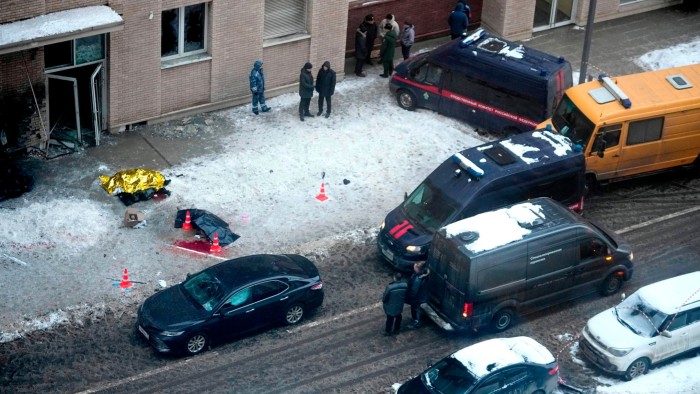
The scooter would not have seemed out of place parked outside an apartment block in Moscow, where the electronic two-wheelers are a regular mode of transport for many of the Russian capital’s 13mn residents.
But this one — a key element of an elaborate and lethal operation — carried something other than a rider: an explosive device fixed with between 100 and 300 grammes of TNT, according to Russian investigators.
The bomb had been placed near the building on Moscow’s Ryazansky Prospekt by a covert operative under orders from Ukraine’s brazen state security service, the SBU, said people familiar with the attack.
A hidden camera recorded what came next. The bomb was detonated before dawn as Lieutenant General Igor Kirillov, the head of Russia’s radioactive, chemical and biological defence forces, came out of the building with his assistant. The blast killed both men.
The assassination marked the latest strike in an escalating shadow war between Kyiv and Moscow, carried out by their vast and powerful state intelligence agencies, both successors to the Soviet Union’s spy agencies, with the SBU a direct descendant of the KGB.
Operating behind enemy lines, these agencies have targeted military officials and politicians, sabotaged energy infrastructure and railway systems, and used hybrid warfare tactics including cyber attacks and disinformation campaigns to sow chaos within each other’s borders.
On the Ukrainian side, the often controversial SBU, which the US and other allies have long urged Kyiv to reform, has been spurred on by internal competition with the military intelligence directorate known as the GUR. It has become what an intelligence official involved in planning operations called a “liquidator of Russians”.
An SBU official confirmed his agency was responsible for Kirillov’s death, calling him a “war criminal” who “gave orders to use banned chemical weapons against the Ukrainian military”. He warned: “Such an inglorious end awaits all who kill Ukrainians.”
The SBU is largely domestically focused, but since Russia invaded Ukraine in 2014 it has operated within Kremlin-occupied Ukraine and inside Russia. Since Moscow’s full-scale invasion in 2022, it has attacked Russia’s Crimea bridge and has destroyed much of its Black Sea fleet with naval drones.
The intelligence official noted several killings of pro-Russia separatist leaders in the Moscow-controlled regions of Donetsk and Luhansk between 2014 and 2021 carried out by Kyiv’s agents.
Another intelligence official, speaking on condition of anonymity, said the SBU’s own agents have operated within Russia’s borders, but it has also recruited anti-Kremlin Russians to carry out sabotage and even assassinations. The FSB said on Wednesday it had arrested an Uzbek suspect over Kirillov’s killing.
The SBU has become a crucial instrument for Kyiv as it battles Russia on multiple fronts. Russia has struggled to counter its efforts, said Andrei Soldatov, a senior fellow at the Center for European Policy Analysis. “The FSB [Russia’s main security agency] is very good at investigating what already happened, but not very good at collecting intelligence about what’s coming. It’s a different set of skills,” he said.
“For that, the agency should be a very good information collection agency, meaning there is trust, good sharing of information — something you don’t see among Russian agencies.”
Valentyn Nalyvaichenko, an MP who twice served as SBU chief, said the spy agency has “collected a lot of counter-intelligence information and data” on Russia’s military and intelligence leadership. It has found ways to plant moles, crack communications inside enemy territory, and identify vulnerabilities in Moscow’s intelligence network.
Part of the SBU’s effectiveness comes from its vast size, ironically a result of its Soviet legacy. When Ukraine gained independence in 1991, the SBU inherited many of the KGB’s structures, resources and responsibilities, and it did not downsize.
With more than 30,000 employees and even more off-the-books operatives, the SBU is nearly as large as the FBI, with its 35,000 agents. It is more than seven times the size of the UK’s domestic security service MI5, and more than four times the size of Israel’s Mossad.
“One of the key tasks of the Security Service of Ukraine, especially during wartime, is countering the enemy’s special services,” Vasyl Malyuk, chief of the SBU, said in previously unpublished responses to questions sent by the Financial Times earlier this year.
Malyuk declined to comment directly on operations inside Russia. But he said: “The position of the security service is clear and unambiguous: every crime of the aggressor must be punished.”
The SBU rarely claims explicit public credit for assassinations. Instead, it often chooses plausible deniability.
In August 2022, the agency planted a bomb in a car belonging to the Russia ultranationalist ideologue Alexander Dugin, a close ally of Russia’s President Vladimir Putin and proponent of the war in Ukraine. But Dugin was not driving; his daughter Darya Dugina was behind the wheel and was killed when it detonated.
The SBU’s work has often been controversial. It has carried out a faked assassination of a dissident Russian journalist in Kyiv to allegedly expose a team of hitmen hired by Moscow to destabilise Ukraine; engaged in surveillance of investigative journalists and activists reporting on alleged corruption within its ranks; and has faced multiple embezzlement scandals.
“[The SBU] wields enormous power — some would say too much power,” a western diplomat told the FT.
The diplomat said the agency had for years proved largely impervious to major reform, despite urging from Ukraine’s largest backer, the US, other members of the G7, and EU nations.
But amid the war with Russia, those western nations have set aside some complaints and strengthened ties and intelligence-sharing. The agency has developed especially close ties with the CIA, which has invested millions of dollars in training programmes for Ukrainian agents.
“What we started in 2014 is now working,” Nalyvaichenko said of its collaboration with western agencies.
The SBU has come a long way since late February 2014, when it was devastated by former president Viktor Yanukovych following the Euromaidan revolution. Before fleeing, Yanukovych ordered a raid on the agency, with his operatives stealing crucial state secrets and burning what they could not take out by car and helicopter.
The SBU, already struggling with trust problems, suffered significant defections in spring and summer that year, as Russia annexed Crimea and seized control of cities in eastern Ukraine.
As the new SBU director at the time, Nalyvaichenko inherited a fractured agency riddled with spies loyal to the Kremlin. Thousands of agents were suspected of collaboration. A purge followed, with authorities arresting scores of their own spies and launching treason investigations.
“We started from ground zero, from the burned operation files in our backyard at the SBU,” he said.
Nalyvaichenko said Kyiv brought in younger, patriotic agents whose allegiance was to the territory within Ukraine’s internationally recognised 1991 borders.
Since Russia’s full-scale invasion began nearly three years ago, hardly a month has gone by without a headline about a Russian official involved in its war effort being eliminated by the SBU’s operatives.
Last month, the SBU claimed credit for killing Valery Trankovsky, the chief of staff of the 41st Missile Brigade of the Russian navy’s Black Sea fleet, in a car bombing in occupied Crimea.
But there are times when the credit is given to its brother agency, the military intelligence directorate known as the GUR. Under the watch of its enigmatic chief Kyrylo Budanov, the unit has also conducted covert operations and assassinations far beyond enemy lines.
The two agencies compete for bragging rights, each trying to outdo the other by assassinating higher-ranking officials or striking bigger military targets deeper and deeper inside Russia. Sometimes they collaborate.
Not for the first time, the SBU’s work has left Russia’s defence establishment despondent. Yuri Kotenok, a Russian war reporter, wrote that Ukraine’s secret services “feel they have total impunity on Russia”. He added: “Obviously nobody doubted Kyiv’s role, but the fact that the enemy is all but openly bragging about it is pretty symptomatic.”
Read the full article here

