


Receive free UK privatisation updates
We’ll send you a myFT Daily Digest email rounding up the latest UK privatisation news every morning.
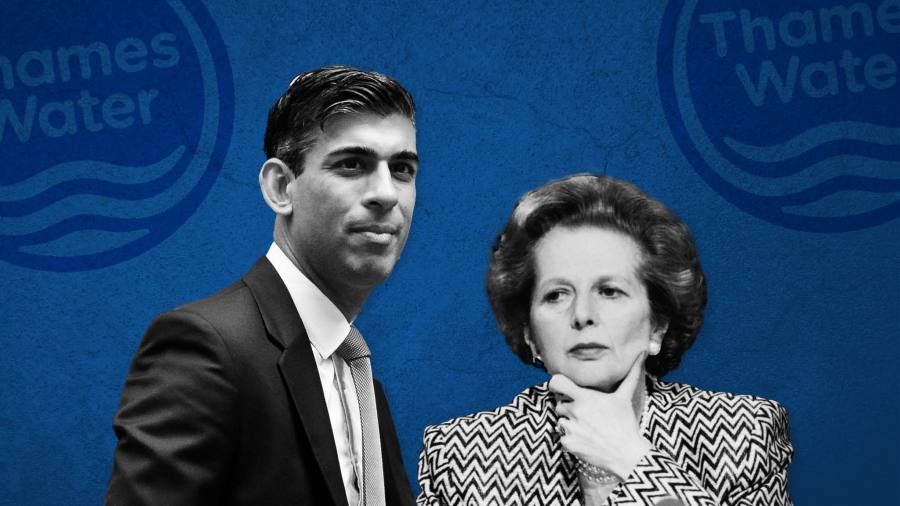
Almost 35 years after Margaret Thatcher sold off Britain’s water industry, the prime minister denouncing her opponents as “weak” left-wingers, the sector is facing its biggest crisis and is posing serious problems for her present-day Conservative counterpart.
On Wednesday, Rishi Sunak’s government was preparing contingency plans for a possible temporary nationalisation of Thames Water, one of a number of debt-laden companies in the sector struggling as interest rates surge.
When Thatcher privatised the water industry in 1989 she wrote off £5bn of the industry’s debts, leaving water companies to start their new life with zero gearing. More than three decades later they have a collective debt burden of £60bn.
In recent months the companies have also come under increasing pressure to deal with another problem as the public clamour grows for them to clean up their act and stop dumping sewage into rivers and the sea. The sector and its regulators — Ofwat and the Environment Agency — have been pilloried.
Last year, water companies were told by the government they would have to deliver £56bn of capital investment over 25 years to tackle storm sewage discharges, but capital markets are already getting jittery.
George Eustice, the former environment secretary who set out the plan, said: “I think there’s a problem. There’s a toxic political debate about the issue that makes it harder for the companies to raise the capital to fix the problem that people care about.”
The immediate crisis concerns Thames Water, but wider questions have been raised about the way the sector is regulated and whether private companies are able to deliver the vast infrastructure improvements demanded by the public at an affordable price.
On Wednesday, Downing Street tried to distance Sunak from the issue. A spokesman said he was “not aware” if the prime minister was personally engaged.
But behind the scenes Rebecca Pow, environment minister, and Ofwat were working with Treasury officials on a contingency plan to rescue Thames Water in the event the company collapsed.
The special administration regime for failing utilities has been used before, notably in November 2021 with the collapse of the energy provider Bulb. A year later the stricken company’s staff and customers were acquired by Octopus Energy.
Under the regime, the government provides funding during the administration and can recoup the costs at a later date. Government officials stressed this was a contingency plan and there was no suggestion it was about to be used in the case of Thames Water.
In 2021, Southern Water, which serves 4.2mn customers across Kent, Sussex and Hampshire, was rescued from the brink of bankruptcy after Australian infrastructure investor Macquarie agreed to take control of the company in a private deal with Ofwat.
But the prospect of Thames Water ending up in even temporary public control is real. “We have got to make sure that Thames Water survives as an entity,” said Kemi Badenoch, business secretary.
Eustice said Ofwat had been looking at the debt structures of water companies for about 10 years and had tried to improve those structures over time. Thames Water is weighed down by £14bn of borrowing.
Downing Street insisted the whole sector remained “financially resilient”. But the recent sharp rise in interest rates has put balance sheets under strain and raised questions about whether regulation should have been tighter.
Dieter Helm, professor of economics at Oxford university, said the business model of the water companies was “built on the era of cheap debt and low inflation”.
He added: “If interest rates are negative in real terms, then the debt is “free”. But what happens when it is 5 per cent plus, and when there is only a slim equity buffer to absorb the inflation shocks?”
A YouGov poll last year found that 58 per cent of Conservative voters thought water should be brought back under public control. Yet neither the Conservatives nor the opposition Labour party have any appetite to undertake the costly and complex business of renationalising the water industry or other parts of the British economy sold off in Thatcher’s privatisation drive.
A spokesman for Labour leader Sir Keir Starmer, who has already abandoned plans to renationalise the energy sector and mail services, said: “It’s not something we are looking to do.”
But that will not stop Labour taking political advantage of the chaos unfolding in the water sector, ahead of next year’s general election with the party leading the Conservatives in the polls. It has already done so with failing privatised rail services — four of which are now back in public hands.
“The cycle of privatising profit, usually for multibillion pound foreign-owned sovereign wealth funds and then nationalising risk isn’t sustainable,” said Jim McMahon, shadow environment secretary.
The chaos at Thames Water has also cast a cloud over a separate key Sunak policy — a series of reforms aimed at directing billions more of British pension savings into riskier, long-term projects such as infrastructure.
Asked whether that was still the intention, notably through reforms to so-called Solvency II rules for the insurance sector, Sunak’s spokesman responded: “Yes.”
Read the full article here

