


Canada has long been the largest export market for the Pinot Noir grown on the hillside vineyards of Sokol Blosser Winery in Oregon. Now that market has disappeared.
Alarmed by US President Donald Trump’s tariff threats and his calls to annex Canada, provincial authorities stopped purchasing alcohol from their southern neighbour. The national government has imposed 25 per cent tariffs on an array of US imports including wine, spirits and beer.
The measures have delivered another blow to a US industry in decline as consumers cut their drinking.
“We’ve been building this market for over 40 years and in one fell swoop, our president has basically lit that market on fire,” said Alex Sokol Blosser, president of the winery that bears his family name.
The cross-border booze trade has a long and colourful history that includes the bootleggers who smuggled Canadian whisky to the US during the prohibition era. Sales in both directions flourished after the North American Free Trade Agreement took effect in 1994, eliminating tariffs on alcohol.
When Trump and his counterparts in Canada and Mexico reworked the agreement during his first term, alcoholic beverages remained tariff-free. Canada has until recently been the largest foreign market for US wine and the second-largest for spirits after the EU, according to US Department of Agriculture data.
That changed when Trump announced new tariffs on Canadian goods days after his inauguration, then doubled down on threats to annex his northern neighbour. Anger at Washington sparked a wave of nationalism and boycotts of American products. Canada’s prime minister, Mark Carney, on Thursday warned the old relationship between the two countries was “over”.
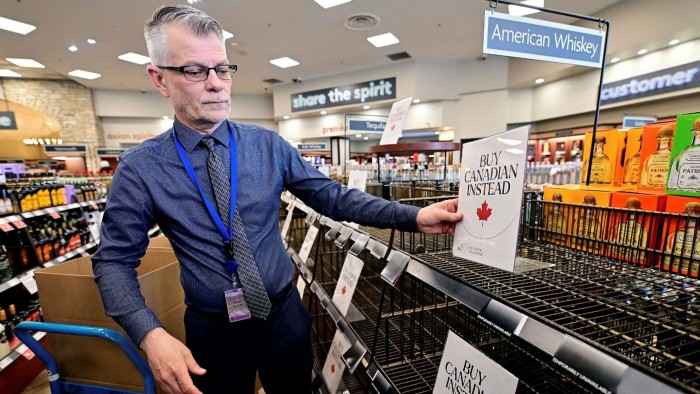
Empty shelves now line aisles of Canada’s liquor stores where US bottles and cans were once displayed, labelled with signs urging customers to “Buy Canadian Instead”.
Cutting off US producers’ access has been a relatively simple operation because most liquor stores are run by Canada’s provincial governments. The Liquor Control Board of Ontario said it “has replaced US products with suitable alternatives. This includes local Ontario-made and Canadian-made spirits, wine, cider, beer and ready-to-drink beverages.”
The board even launched ‘the EH List’ — a play on many Canadians’ tendency to end sentences with the exclamation — to promote 3,000 domestically made products.
The efforts are paying off for some local Canadian producers. Liebling Wines, a small-lot wine producer that grow grapes in Niagara-on-the-Lake, Ontario, makes about 500 cases of wine a year. But if current sales continue it may go up to 700, said Jess Oppenlaender, who runs the family business with her sister Ali and three brothers.
Ali Oppenlaender said: “There are many producers in Oregon and Napa, small family farms like ours, and it’s all on pause now. I feel for them. But this is a pivotal moment to reshape people’s mind to Ontario wine.”
The wine-rich province of British Columbia on Canada’s Pacific coast said it barred the sale of US booze in an attempt to “keep our dollars out of a country that is trying to economically harm Canada”.
Interest and pride in Canadian-made products has surged, said Paul Sawler, chair of Wine Growers British Columbia.
Beer is a little more complicated. The US exported only $41mn worth of the beverage to Canada last year because most US brands are produced locally from local ingredients. One of Canada’s most famous and oldest brewers, Molson, merged with US rival Coors in 2005.
The de facto embargo is affecting more than just small businesses. For Brown-Forman, the Kentucky-based distiller of Jack Daniel’s whiskey, Canada only accounts for about 1 per cent of the company’s $4bn in revenue. But chief executive Lawson Whiting called Canada’s actions “frustrating” and “a very disproportionate response”.
Removing bottles from shelves was “worse than a tariff”, he said earlier this month, “because it’s literally taking your sales away”.
Brown-Forman did not respond to a request for comment.

Chris Swonger, chief executive of the Distilled Spirits Council of the United States, a Washington-based lobby group, said he was hopeful the dispute with Canada will be resolved when Trump unveils so-called “reciprocal” tariffs on multiple trading partners as promised next Wednesday.
He noted the US’s $220mn in spirits exports to the northern neighbour are dwarfed by Canada’s exports to the US, shipments that include whiskys such as Canadian Club and Crown Royal.
“We hope and look forward to President Trump’s leadership really to untangle the US hospitality industry from tariffs,” Swonger said.
The impact is greater on independent craft producers. Jeff Quint founded Cedar Ridge Distillery in Iowa 20 years ago to take advantage of the state’s abundant corn crop to make bourbon. Cedar Ridge now sells about 80,000 cases a year.

He stopped shipping to the EU after the bloc imposed 25 per cent levies on American whiskey in response to US steel and aluminium tariffs during the first Trump administration.
Now, “we’re going to stop making any further effort to make inroads in Canada for the time being”, Quint said. “It’s enough of a battle when there aren’t tariffs. When tariffs enter the picture, it just gets difficult to overcome.”
The Wine Institute, the trade group for California wineries, said the tariffs and cancelled purchases put at risk decades of effort to building market share and brand loyalty in Canada.
“All of beverage alcohol is already facing unprecedented challenges in the marketplace so these tariffs and potential product removals come at a time when their impact will be particularly hard to absorb,” it said.
Sokol Blosser’s vineyard historically sold 2,000 to 4,000 cases of wine a year to Canada — orders that have been cancelled. He said future sales might survive trade battles, but he foresaw lasting damage from Trump’s assertions that Canada should become part of the US.
“If it’s just the tariffs, I think we can recover,” he added. “I think we can get through the next three and a half years and recover. I don’t know if we can recover from this 51st state bullshit.”
Read the full article here

