


Unlock the Editor’s Digest for free
Roula Khalaf, Editor of the FT, selects her favourite stories in this weekly newsletter.
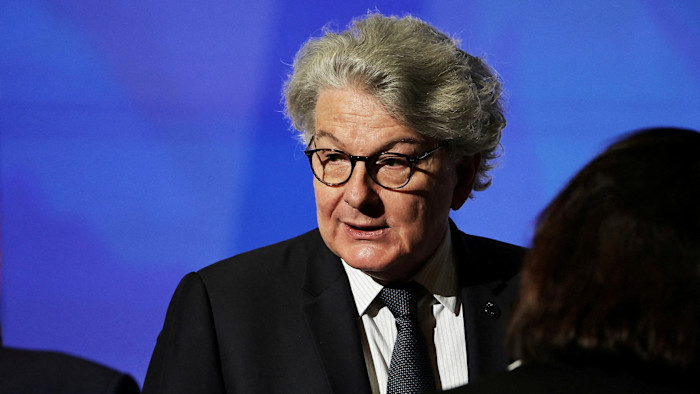
Washington has barred former EU commissioner Thierry Breton and four other people from entering the country over what it said was “censorship” and coercion of US social media platforms.
The visa ban on five Europeans followed a campaign of criticism and threats by the Trump administration over the EU’s Digital Services Act, which forces big tech companies to police content on their platforms more aggressively, and the Digital Markets Act, which aims to curb their power.
“For far too long, ideologues in Europe have led organized efforts to coerce American platforms to punish American viewpoints they oppose,” US secretary of state Marco Rubio said on X.
The US was taking steps to “bar leading figures of the global censorship-industrial complex from entering the United States. We stand ready and willing to expand this list if others do not reverse course,” he said.
Breton was the EU’s commissioner for internal markets from 2019 to 2024. US under-secretary of state Sarah Rogers said he was being banned as the mastermind of the Digital Services Act and for his behaviour in telling X owner Elon Musk he needed to comply with rules on illegal content.
Breton responded by asking if the 1950s US era of “witch-hunts” against suspected communists was back.
The European Commission said it “strongly condemns” the US travel ban and had requested clarifications from Washington. It vowed to “respond swiftly and decisively to defend our regulatory autonomy against unjustified measures”.
“The EU is an open, rules-based single market, with the sovereign right to regulate economic activity in line with our democratic values and international commitments,” it added.
French foreign minister Jean-Noël Barrot said France also condemned the ban. “The Digital Services Act was democratically adopted in Europe to ensure that what is illegal offline is also illegal online. It has absolutely no extraterritorial reach and in no way affects the United States,” Barrot said.
Rogers said the other people under sanctions were part of a “censorship-NGO ecosystem”.
Washington also banned four people from non-profit campaign groups that work to detect problematic, fake or violent content or hate speech online.
They are Imran Ahmed, head of the UK and US-based Center for Countering Digital Hate; Clare Melford, head of the London-based Global Disinformation Index; Anna-Lena von Hodenberg, founder of Berlin-based HateAid; and Josephine Ballon, co-leader of HateAid.
President Donald Trump’s administration has demanded changes to EU tech rules and threatened to impose tariffs in retaliation for the bloc’s actions against Silicon Valley groups. The commission has said its tech regulations are non-negotiable and objectively applied.
In recent months, the commission has opened probes into Amazon and Microsoft’s dominance in the cloud sector, launched investigations into the artificial intelligence models of Google and Meta’s WhatsApp, and handed out a €120mn fine to Musk’s X for breaking digital transparency rules.
Additional reporting by Paola Tamma
Read the full article here

