


Unlock the White House Watch newsletter for free
Your guide to what the 2024 US election means for Washington and the world
The writer is an FT contributing editor and writes the Chartbook newsletter
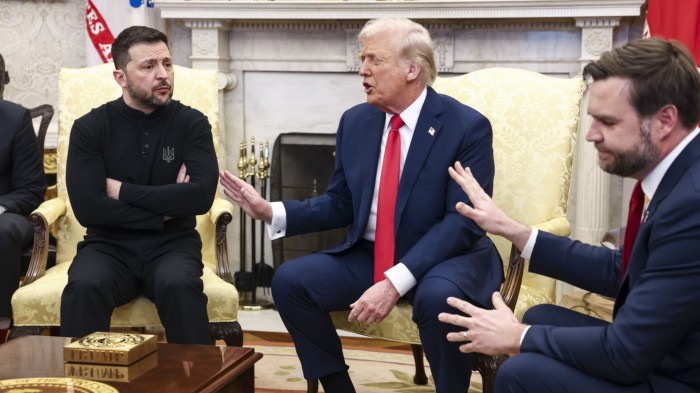
The ambushing of Ukrainian President Volodymyr Zelenskyy in the Oval Office last week is driving a frantic search for historical orientation.
It was clearly more shocking than anything that occurred during Donald Trump’s first term. But is it, in its consequences, worse than the push for the global war on terror under George W Bush? Worse than Richard Nixon’s disruption of the Bretton Woods system? Or America’s outrageous bombing of Cambodia and Laos? More egregious than numerous cold war coups or the brutal bargaining that took place, admittedly behind closed doors, during the second world war?
There have been just over 100 years of US globalism and it has not been plain sailing. The first bump in the road was catastrophic. In 1919 a Republican Congress refused to ratify the Treaty of Versailles and with it president Woodrow Wilson’s plan for a League of Nations. To the accompaniment of the “Red Scare”, race riots, the Scopes monkey trial and the rebirth of the Ku Klux Klan, US diplomacy retreated from the world.
In the 1930s, British and French governments of the right and the left faced the threat of Mussolini, Hitler and Imperial Japan alone. They placed their hopes in democratic procedures, long-term social equilibrium, reasonable budgets, managed currencies and new technology — the Maginot Line and radar. Meanwhile, appeasement was motivated by the hope that it would encourage reasonable conservatives in Berlin, Rome and Tokyo to restrain the men of violence. Was the US willing to help? It was not. The best that Congress offered was cash and carry. The European strategy for containing Hitler failed and in the desperation that followed the US swooped, exchanging a batch of second-hand destroyers for bases. America’s interest in Greenland dates back to this period.
The moment of US power that defines what we mean today by global hegemony was in fact very short — lasting from 1941 until the early 1960s. This was sustained by enlightened technocracy and an outward-facing US business community. In Washington it rested on New Deal liberalism and the Democratic party’s control of the racist Jim Crow South. What blew it apart was the completion of American democracy with the 1964 Civil Rights Act. This alienated the South from progressive Democrats and sent the white vote sliding towards the Republicans.
Trump is the legitimate heir to a reactionary, national-populist strain that runs deep in US democracy. What is also clear, however, is that he is the most brutish, self-deluded, undignified incumbent ever to have graced the White House. What has gone wrong?
The crucial thing is that elite checks and balances have failed within the Republican party. And with no strong leftwing grassroots movement, the result of elite weakness in the US is that democracy slides towards crass populism. A large part of the US electorate will vote for anyone other than a member of the liberal elite. A smaller, but still substantial, segment positively adores Trump. Added dynamism comes from the fact that, unlike during his first term, Trump is opening the door to a new guard of younger men, represented by vice-president JD Vance and Elon Musk.
Anyone who has tracked the radicalisation of the GOP since the 1990s, remembers Newt Gingrich and Sarah Palin and has felt the brittle grip of America’s self-satisfied meritocracy could see that this was a disaster waiting to happen.
It has been clear for some time that the US needed a new and much more restrained formula for foreign policy. Bernie Sanders, in the idiom of the old US left, called for an end to American imperialism. Barack Obama advocated restraint, although Hillary Clinton, his secretary of state, favoured a more expansive line.
Joe Biden oversaw a profoundly untimely revival of American claims to global leadership. The result was an administration that committed the US to the defence of Ukraine, backed Israeli escalation in the Middle East and engaged in brinkmanship with China. This satisfied the Washington “blob”, revived the spirits of Atlanticists and fed complacency in Europe. But despite the Biden administration’s claim to be pursuing a foreign policy for the US middle class, popular support for its approach was fragile.
Of course, Trump is a vandal. But in tearing down the status quo he does no more than confirm the obvious — that the elite coalition that favoured US global leadership has lost its political grip. If Europe wants something it likes to call a “rules-based order”, it will have to make it for itself.
At least within the compass of its own relations with the rest of the world, Europe has the means to do so and a political culture sufficiently robust to sustain it. In Berlin this week we finally heard an adequate answer, with chancellor-in-waiting Friedrich Merz agreeing to a coalition programme that would see massive increases in defence spending. This is not a done deal and it will not save Ukraine from horrible choices. But it does offer the prospect that Europe may be able finally to move beyond its humiliating fear of Russia and dependence on a once more unreliable America.
Read the full article here

