


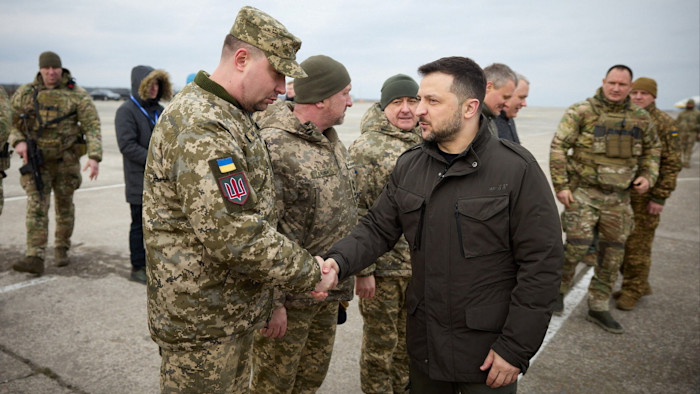
Two months ago, Volodymyr Zelenskyy faced the gravest political crisis of his presidency when his closest wartime ally resigned amid a widening corruption scandal that shook public confidence in Ukraine’s leadership.
Now the Ukrainian president is betting that his sweeping overhaul of the state apparatus in recent days — and the promotion of one of his main potential rivals — will project strength, allowing him to emerge better placed to confront either a fourth year of grinding war or the fraught prospect of a negotiated peace.
“It’s a demonstration that Zelenskyy is restoring and maybe even strengthening his power,” said Volodymyr Fesenko, a Kyiv-based political analyst. The Ukrainian president was also looking to “strengthen the effectiveness of the state, in a situation where the war is dragging on”, he said.
Zelenskyy appointed former military spymaster Kyrylo Budanov as chief of staff on Friday, securing the support of a respected military figure seen as a potential rival in a postwar election.
This week, Zelenskyy removed the popular head of Ukraine’s security service (SBU) Vasyl Malyuk, asserting his control and prompting outrage from Malyuk’s many supporters.
In between, a whirlwind of official statements from the Ukrainian leader announced changes in the defence, energy and digital transformation ministries. The head of the border guard service was also moved.
It is a turnaround from the Ukrainian president’s weakened position in November last year, when a raid by Ukraine’s top anti-corruption agency ended the reign of Zelenskyy’s powerful chief of staff and brother-in-arms Andriy Yermak. Yermak denied any wrongdoing and said he would co-operate with the investigation.
At that time, opposition figures openly discussed the prospect of the power vacuum ultimately turning Zelenskyy into a figurehead, his role limited to shaking hands with foreign dignitaries.

The Ukrainian president’s promotion of Budanov to Yermak’s former post could also bolster his position in any eventual postwar electoral campaign against Valeriy Zaluzhny. The former top general and current ambassador in London is consistently ranked in polls as the top contender in any hypothetical future presidential election.
All elections have been suspended since the beginning of the 2022 Russian invasion, and Ukrainian officials have warned that organising a vote would require a prolonged ceasefire.
Budanov’s appointment as head of the presidential office, following months of rumours about the alleged rivalry between the military intelligence chief and Yermak, stunned Kyiv’s political circles.
“I knew he was being considered for the post,” said Dmytro Razumkov, a lawmaker and former Zelenskyy ally who joined the opposition in 2021. “But I didn’t think he would accept.”

Oleksandr Merezhko, an MP in Zelenskyy’s party, said he also did not understand why Budanov accepted the post. “It’s a smart move on Zelenskyy’s part, but in the place of Budanov I’d rather stay in my place.”
Zelenskyy said the overhaul, which was meant to “make Ukraine more resilient”, would also include sweeping changes within the country’s diplomatic corps and lead to the heads of five regions being replaced.
But the Ukrainian leader, who said in his new year speech that a peace plan painstakingly negotiated with the US over the past months was “90 per cent ready”, struck a more cautious tone in some of his statements this week.
In a January 4 address, he insisted that Ukraine was preparing for both possible paths, “diplomacy, which we are pursuing, or continued active defence if the pressure from our partners on Russia proves insufficient”.
Ukraine may need to “reinforce [its] defence if, because of delays by our partners, it takes longer to bring this war to an end”, Zelenskyy said.
The president’s team will need to safeguard a fragile parliamentary majority in order to confirm the appointments of the new ministers.
But the scope of the reshuffle hints at broader ambitions, analysts say.
“Lots of people want to see the hand of elections here,” said Anton Hrushevsky, executive director of the independent Kyiv International Institute of Sociology.
“But I think it is largely about strengthening defence, while projecting the image of Zelenskyy as a national leader and protector of Ukraine,” he said. The appointment of Budanov, a figure known both for his military credentials and his experience in difficult negotiations with Moscow, also keeps Zelenskyy’s options open.
The announcement that the no-nonsense manager Denys Shmyhal would become energy minister drew cautious support across Ukraine’s political class amid jokes that he would go through every ministerial post. Shmyhal previously served as minister of regions and prime minister before a five-month stint as defence minister.
Zelenskyy proposed his longtime ally Mykhailo Fedorov to replace Shmyhal as defence minister.

For Malyuk, even a rare show of public support from top military figures last week amid his rumoured removal as SBU chief was not enough to stop him being shuffled from his post. Zelenskyy said Malyuk would be moved to a different position within the SBU rather than being outright sacked.
Zelenskyy offered no explanation for the change, leading to speculation that the spy chief was being punished for failing to prevent “Operation Midas”, the anti-corruption investigation that ultimately led to Yermak’s fall last year.
Daria Kaleniuk, director of the Anti-Corruption Action Center, a Kyiv-based watchdog, argued that Malyuk was fired because “he did not attack [the anti-corruption agencies] enough to prevent Operation Midas and the Yermak searches”.
Zelenskyy’s communication adviser Dmytro Lytvyn denied that Malyuk had been removed for that reason, calling the idea that the SBU could stop a corruption investigation a “fairy tale”.
Razumkov, the lawmaker, described the move as “revenge”, echoing a widespread view across Ukraine’s political class and civil society. Zelenskyy’s office and the SBU did not immediately respond to requests for comment.
Malyuk’s ousting drew widespread criticism — which may have been the point, said Fesenko, the political analyst.
“Zelenskyy is showing that he can remove anyone,” he said.
When Zelenskyy was asked about the rumour on January 3, he was unrepentant. “I’ll do the rotations that I’ve decided to do,” he told reporters during a press conference.
Read the full article here

