


Unlock the White House Watch newsletter for free
Your guide to what Trump’s second term means for Washington, business and the world
The EU must bring its mutual defence clause “to life”, Ursula von der Leyen has said, pitching the bloc as an alternative to Nato as a security guarantor for its members.
The European Commission president said the EU had to be “collectively ready” to defend itself and leverage the “European awakening” of defence spending in response to Russia’s war against Ukraine and Donald Trump’s questioning of Nato’s transatlantic security ties.
The declaration underscores the scale of Europe’s rethinking of its own approach to security after Trump raised fears over Washington’s commitment to protecting the continent. Last month the US president threatened the Danish island of Greenland with invasion.
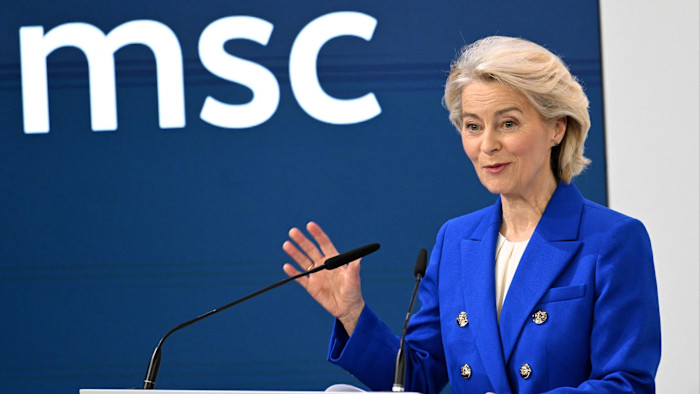
“I believe the time has come to bring Europe’s mutual defence clause to life,” von der Leyen told the Munich Security Conference on Saturday. “Mutual defence is not an optional task for the European Union. It is an obligation . . . our collective commitment to stand by each other in case of aggression. Or in simple terms, one for all and all for one.
“As they say in Ukraine, you change or die,” she added. “We must adopt this mantra too.”
Article 42.7 of the EU’s treaty calls for other member states to provide “aid and assistance by all the means in their power” if “a member state is the victim of armed aggression on its territory”.
As almost all of the EU’s member states are Nato members, it has never been considered a vital part of their defence strategy. It has only been triggered once, by France after the 2015 Paris terrorist attacks.
Von der Leyen described Europe’s neglect of its own security as an “uncomfortable truth” that now “has fundamentally changed”.
“Europe needs to step up and has to take on its responsibility,” she said.
“Admittedly, it has taken some shock therapy, and some lines have been crossed that cannot be uncrossed anymore,” she added. “The European way of life, our democratic foundation and the trust of our citizens is being challenged in new ways. On everything from territories to tariffs to tech regulations.”
Von der Leyen also said that the EU needed to “formalise the ad hoc beginnings of new security collaborations” with countries including the UK, Norway, Iceland and Canada, work in defence coalitions that may not include all of the bloc’s 27 members, and develop military capabilities.
“We must grow a European backbone of strategic enablers: in space, intelligence and deep strike capabilities. No taboo can go unchallenged,” she said. “We must be collectively ready.”
Read the full article here

