


Receive free Artificial intelligence updates
We’ll send you a myFT Daily Digest email rounding up the latest Artificial intelligence news every morning.
The writer is co-founder of LinkedIn, co-founder at Inflection AI and a partner at Greylock. This article is inspired by a commencement speech given at the Bologna Business School on September 8
Artificial intelligence will reshape all our lives. It will become the primary technology that we use to make decisions and navigate the world — a steam engine of the mind; a cognitive GPS; a tool for orientation, discovery and navigation.
But we have this technology in our hands — not the other way around. And with it, we have the opportunity to amplify and define the future of humanity.
Only a few innovations have had the potential to shape and to scale us in this way. The last two were the internet and mobile phones. AI not only belongs on that list, but should sit at the top of it, because of its potential to amplify how we use the internet, mobile phones and many other technologies.
What will the world shaped by AI look like? To answer that question let’s go back to a future we once imagined. In the 1950s, we thought flying cars were just on the horizon. We didn’t get them then, nor have we got them yet (though we have made strides in that direction). But in that same decade, US President Dwight Eisenhower established the Advanced Research Projects Agency, or Arpa, which generated the technology that created the internet.
We didn’t imagine we’d get something like the internet or mobile phones — but we did. And those tools have revolutionised the lives of the majority of humans on earth. Now, humanity is imagining a new future with AI.
Given the speed and spread of AI, some people fear it could usher in a potential apocalypse, while others argue that it will bring the new utopia. They either rejoice or worry about AI refashioning our world, whether their lens is gene editing, geopolitics, climate — or any other facet of life. But we should avoid setting up camp around either extreme, particularly at this stage of the technology’s development.
Let’s return to cars for a moment. Say cars were the nascent technology of today. We could focus on the utopian dream of spacefaring cars. Or we could focus on dystopian traffic jams. But, at this stage, I’d recommend that we focus on the car itself, both as an innovation and as a tool to transform society.
The answer to our challenges is not to slow down technology, but to accelerate it. Technology is a tool. And the faster we have it in our hands, the better we can solve the problems we have — and the problems it might create.
Let’s shape the tool that will in turn shape us — and consider three questions. How can I make it better? How can I increase beauty in the world? How can I make better tools and increase beauty to the benefit of my fellow humans?
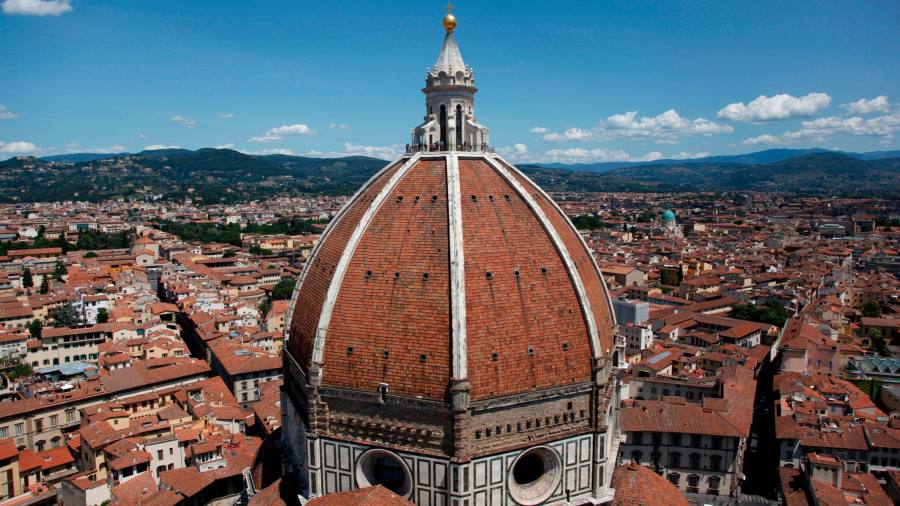
An example of humans asking — and acting — on these questions can be found in Renaissance Italy — specifically in Filippo Brunelleschi’s dome, which crowns Santa Maria del Fiore cathedral in Florence. The beauty of Brunelleschi’s dome can be attributed to many things. There’s the stunning fresco on its interior surface and its masonry vault. But to my mind its beauty lies also in what’s long gone: the people who built it and the tools they used to make it.
Brunelleschi took 16 years to build the dome, construction of which began in 1420. He had an ambition to build it without wood reinforcements, which wouldn’t have sustained a cupola of that size anyway. He had to innovate. So Brunelleschi invented mobile scaffolding. He also designed a crane for hoisting bricks, which he arranged in a double-shell structure in an innovative herringbone pattern. Not only did this provide stability for the interior brick, but it maintained the dome’s curvature.
Then there’s Brunelleschi’s collaboration with a range of professionals to assemble these tools and the dome. He worked with a famed Florentine mathematician to make calculations. He teamed up with blacksmiths and carpenters to create the cranes, mobile platforms and scaffolding. Hundreds of workers — from bricklayers to coopers — joined him.
Brunelleschi answered those three questions. But there is a fourth one: how can my work transcend me and benefit humankind, now and into the future?
In creating his dome, Brunelleschi carried forth past traditions of Gothic, Romanesque and Classical architecture and influenced how countless new buildings were made. He grew the toolbox for generations of artists and architects, having been credited with the invention of linear perspective and mobile scaffolding. His tools and techniques were not only used in art and architecture, but also in many other fields and applications.
Where Renaissance masters mostly reshaped the physical realm, AI now gives us the opportunity to do the same with the mental realm. We are already seeing how the technology can supercharge the way we share ideas or express ourselves, whether that’s through writing essays or books, creating art and poetry, or helping us communicate with each other in ways we might otherwise not have attempted.
Brunelleschi diligently shaped his tools and his tools shaped him — and all of us. As we contemplate a future shaped by AI, we should remember the famous dictum of media theorists John Culkin and Marshall McLuhan: “We become what we behold. We shape our tools and then our tools shape us.” AI is our cognitive “mobile scaffolding.” And it will help us build all kinds of cathedrals of the mind — many of which we could not have built before.
Read the full article here

