


Stay informed with free updates
Simply sign up to the Technology myFT Digest — delivered directly to your inbox.
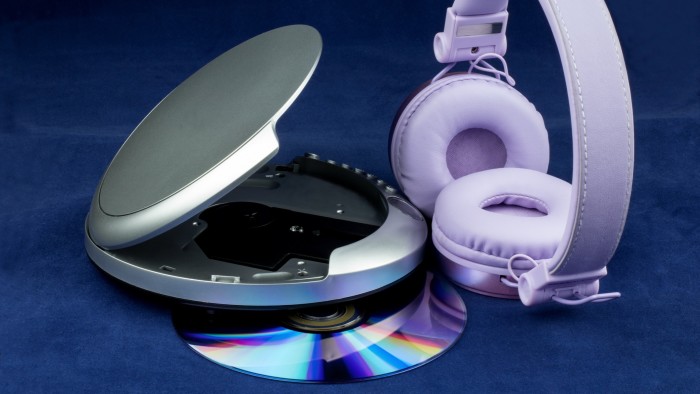
On my 13th birthday, my parents gave me a portable CD player and the masterpiece that was Fresh Hits 1997. Like more than 600mn other people, I have long since swapped my box of CDs for the Spotify app on my phone. But I found my old birthday present recently and discovered it still worked. Even using headphones from the 1990s, I was staggered by the richness of the sound.
My ears didn’t deceive me. CDs have a bit-rate of 1,411 kilobits per second, which is a measure of how much data is used to represent sound. Spotify Premium ranges from 24 kbps to 320 kbps, while free Spotify listeners are limited to 160 kbps at best. I realise this is hardly news to music aficionados. Neil Young, who grudgingly returned his music to Spotify this year after a spat involving Joe Rogan, complained, “There is so much tone missing that you can hardly feel the sensitivity.”
If hundreds of millions of normal music listeners (like me) have decided to trade audio quality for convenience and variety, then fair enough. But what disconcerted me is that I didn’t know that’s what I’d done. I had simply forgotten how much better music used to sound.
There should be a word for this phenomenon. Qualitynesia, perhaps? If wearing “rose-tinted glasses” is the act of thinking something was better in the past when it objectively wasn’t, this is its opposite: forgetting something was better in the past when it objectively was.
This is hardly new. In 1937’s The Road to Wigan Pier, George Orwell argued that a century of mechanisation had worsened the quality of food, furniture, houses, clothes and entertainment, but that most people didn’t seem to care. He blamed “the frightful debauchery of taste” rather than collective amnesia, though. “Mechanisation leads to the decay of taste, the decay of taste leads to the demand for machine-made articles and hence to more mechanisation, and so a vicious circle is established,” he wrote.
Most of the time, high-quality options carry on in a niche way, but they become more expensive or inconvenient, relatively speaking, and fewer people either remember what they’re missing, or are willing or able to pay the extra. In the UK, for example, clothing accounted for 10 per cent of the average family’s spending in 1957; last year it accounted for 3 per cent.
There are, of course, plenty of counter-examples of products which have improved in quality over time, such as computers and phones. All the same, my realisation about music left me with the question: what is there in the world today which people will have qualitynesia about in the future? One obvious place to look is the creative sector upon which AI is now beginning to encroach.
Research so far suggests that when people know something “creative” was made by AI, they find it mediocre and soulless. But if they don’t know, they quite like it. A recent study found that people couldn’t distinguish AI-generated poems from human ones, and actually preferred AI poems “in the style of” famous poets such as William Shakespeare and Sylvia Plath to real poems by those poets. The researchers’ theory is that the AI poems were less challenging.
Similarly, Coca-Cola’s new AI-made Christmas advert, a version of its famous “Holidays are Coming” one from the 1990s, was popular when tested on people who weren’t told it was AI. Andrew Tindall from System One, which performed the tests, told me that was because the AI version was leaning heavily on “a great creative idea invented over 30 years ago, by a human marketing team that has built that idea and invested in it over 30 years.”
That sounds reassuring for people who want to believe in the irreplaceable value of human creativity. And in any case, just because people liked one AI advert doesn’t mean they would enjoy AI films or novels, which matter more to most of us. What’s more, history does offer some examples of people reacquiring a taste for quality. A new generation of young people is now driving a small rise in CD sales, for example.
Yet the unsettling thought lingers. If people do like AI-remixes of familiar-feeling, once-human content, and if they’re increasingly hard to detect and much cheaper to produce, we could drift into a world of steadily worsening remixes of previous remixes of previous remixes. And by that point, would we even know what we’d lost?
Joni Mitchell once sang: “Don’t it always seem to go, that you don’t know what you’ve got ’til it’s gone.” But there is a sadder possibility: that by the time it’s gone, you don’t even remember that paradise was better than the parking lot.
Read the full article here

