


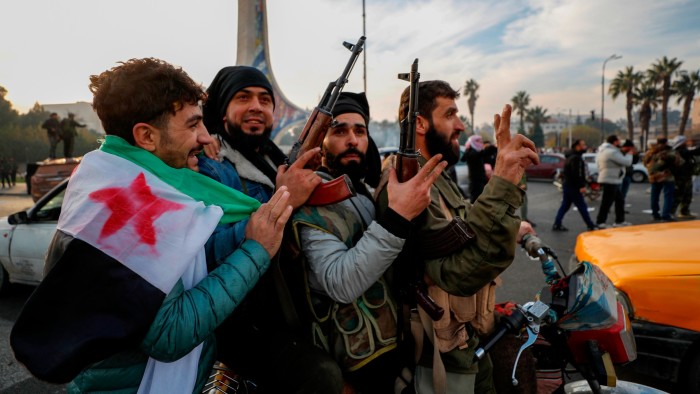
After more than a year of relentless conflict in the Middle East, the stunning capitulation of Syrian President Bashar al-Assad’s regime will go down in the region’s history as one of its greatest shocks.
In just 12 days, rebels marched from the north and then the south to the heart of Damascus, capturing the capital and ending the Assads’ more than 50-year dynastical rule over the nation. In less than two weeks, they achieved what tens of thousands of armed opposition fighters had failed to do in 13 horrendous years of civil war.
Moscow and Tehran, Assad’s main backers, were unable, or unwilling to stem the tide, both caught up in their own conflicts — Russia in Ukraine, Iran and its proxies in their 14-month conflict with Israel.
In many ways, the regime’s spectacular fall appears to be one of the inadvertent consequences of Israel’s ferocious retaliations against its foes since Hamas’s October 7 2023 attack. The following year has upended all previous norms in the region, fostering a combustible, unpredictable environment.
Israeli forces have for months been launching air strikes on Syria, killing Iranian and its proxies’ commanders, while bombing facilities linked to Iran and Hizbollah, the Lebanese militant movement that also supported Assad’s regime during the civil war.
But more than anything, the rebels’ lightning offensive underlined the parlous nature of Assad’s broken, corrupt regime.
Assad, who succeeded his father Hafez al-Assad in 2000, was a brutal despot. He used the cruellest of means to put down his opponents during the civil war: chemical weapons, barrel bombs, siege and starvation tactics, mass detentions, torture and murder.
More than 12mn people — half the population — have been forced from their homes during the decade of war. There are more 100,000 so-called “disappeared” — people who were taken by the security forces, their whereabouts still unknown.
As the parasitical regime bled the country dry, even those from his own minority Alawite community, who had sent their sons to die in Assad’s war against his own people, had become demoralised, hopeless after years of deepening economic and social woes.
Assad’s demise will be welcomed by the many millions who suffered under his rule as he refused to compromise and negotiate a political settlement with his opponents that could have stabilised the country and put it on a different trajectory.
But the massive outpouring of jubilation will be tempered by wariness about what comes next.
The offensive was led by the most powerful rebel force, Hayat Tahrir al-Sham, an Islamist group that is a former affiliate of al-Qaeda, branded a terrorist organisation by the UN, the US and other states. Its leader Abu Mohammad al-Jolani, who publicly stated his desire to conquer Damascus and now appears the key decision maker, once fought with Isis, the jihadist group, and has a $10mn US bounty on his head.
During the six years since HTS has ruled the north-western province of Idlib through a civilian-led government, he has sought to rebrand the group as a more moderate Islamist movement. But it maintained control with an iron grip, and UN agencies have documented abuses.
If 42-year-old Jolani does succeed in his ambition to rule, that will create conundrums for western powers and international agencies about how they should engage with him and HTS.
But HTS is only one of numerous opposition groups that are the remnants of the original rebellion and took part in the assault. And in the past, the various factions have clashed with each other.
During the latest offensive, there was co-ordination between HTS and Turkish-backed factions that operate under the umbrella of the Syrian National Army, and other groups that encircled Damascus from the south.
The real test, however, will come when the factions seek to divvy up the spoils of victory — and power.

Malik al-Abdeh, a Syrian analyst, said he takes solace from the fact that the rebellion appears to have been clearly co-ordinated between HTS and the various other groups, describing the assault on the regime as a “controlled demolition plan”.
“This sense of euphoria and pride has also been tempered by the sense there might be violence — it’s almost too good to be true,” Abdeh said. “But it’s clear there is a plan, it’s been very carefully communicated by HTS and Jolani that there is a map. This has reassured a lot of people.”
Aside from the Sunni Muslim rebel groups, there are Kurdish-led forces — which the US backed in the fight against Isis — that control a swath of north-eastern Syria.
Turkey, however, considers them an extension of Kurdish separatists that have fought the Turkish state for decades.
Turkish troops have for several years deployed in northern Syria to push back against the Kurdish militants and its links to the Sunni rebel groups. This means Ankara is now arguably the most powerful actor in its neighbour, and will play a pivotal role in what comes next.
Turkey, however, has a complex, at times awkward relationship with HTS, which it has also designated a terrorist organisation.
The US, meanwhile, has about 900 troops in the country to support the fight against Isis.
In addition to the risk of intra-rebel clashes, there will be fears that Isis — which once controlled large parts of northern and north-eastern Syria — will seek to exploit the chaos and make a comeback.
Minority groups across Syria, long one of the region’s most secular countries — a factor that served Assad as a member of a minority himself — will be concerned about what comes next. The country has a diverse population of tribes, religions and sects.
During the offensive, Jolani, an urbane pragmatist, reached out to tribes, former opponents and brokered surrender agreements while ordering the protection of minorities.
Neighbouring countries, including Israel, Jordan and Lebanon, will also be cautious, as will Gulf states that re-engaged Assad in recent years and view Islamist movements as destabilising forces.
It served Syria’s neighbours to see Assad weakened, and Israel has long wanted an end to Iran and Hizbollah’s presence on its northern border. But there will also be concern at the potential prospect of a fragile, hollowed-out state in chaos with Islamist groups at the fore.
When popular uprisings against authoritarian regimes swept across the Middle East in 2011, a wave of optimism rippled across the region. But it was all too brief.
Syria descended into its devastating civil war. In Egypt, the army seized power in a popularly backed coup two years after veteran president Hosni Mubarak was toppled and is ruled by one of the region’s most autocratic regimes.
In Libya, there was a momentary dalliance with democracy before rival armed factions turned on each other and the north African nation remains fragmented and chaotic.
The challenge facing Syria now that Assad has finally been ousted is whether it can navigate the pitfalls and avoid the calamities that blighted other nations after the fall of despots, and start the daunting process of rebuilding and reconciling.
Read the full article here

