


Good morning. Stocks, especially tech stocks, had an ugly morning yesterday but rallied in the afternoon. Biotech stocks, particularly Moderna, Charles River Labs and other vaccine makers, were hit hardest, after a top Food and Drug Administration vaccine official resigned over the weekend. Email us: [email protected] and [email protected].
Liberation day
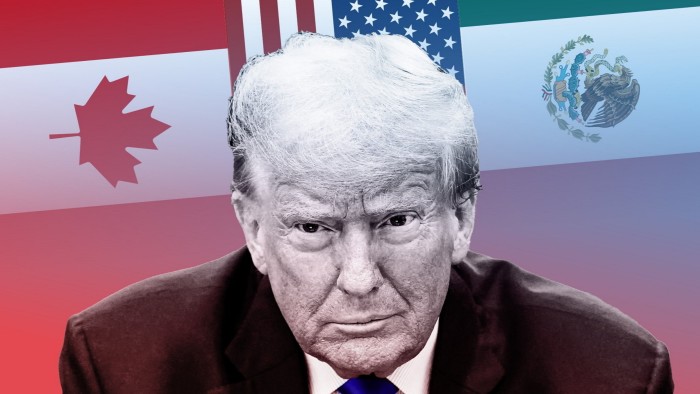
Tomorrow is President Trump’s “liberation day”: the moment, we are told, he will announce the substance of his trade policy, especially on reciprocal tariffs. Reams of Wall Street research on the topic has washed up in Unhedged’s inbox, and despite a lot of talk of uncertainty, a fairly clear set of consensus expectations emerges from it. There are four points of broad but hardly universal agreement (note that much of the research was written before Trump’s weekend comment that “essentially all” US trade partners would be hit with tariffs):
-
The tariff programme that Trump announces will leave average levies on US trading partners at between 10-20 per cent, with most commentators placing the number in the lower half of that range. There are lots of charts floating around comparing these figures to historical levels. This one comes from David Seif at Nomura:
-
Immediate or near-immediate tariffs will be announced on the group of countries with the largest trade imbalances with the US (China, the EU, Mexico, Vietnam, Ireland, Germany, Taiwan, Japan, South Korea, Canada, India, Thailand, Italy, Switzerland and Malaysia). These will be imposed using some or other form of executive privilege.
-
Implementation of sectoral tariffs, besides the automotive tariffs, will be pushed off to a later date, pending further study by the administration. But sectoral tariffs on semiconductors, pharmaceuticals, lumber and copper are all expected eventually.
-
Many on Wall Street expect signalling of a potential softening of the tariffs on Mexico and Canada, perhaps coming in the form of confirmation that goods that are “compliant” under the USMCA trade agreement between the three countries will remain tariff free.
On the other hand, Wall Street doesn’t know what to think about two essential points. It remains unclear which tariffs will “stack” on top of one another, and where only the highest tariff will apply. And the severity of treatment of non-tariff barriers (quotas, license restrictions, other taxes etc), real or imagined, is all but unknown.
As far as the market implications of tariffs, the consensus is very clear that it is negative for equities (it will diminish earnings) and positive for the dollar (the “relief valve” for big changes in relative prices). Many also view it as positive for bond prices. Here is Michael Zezas, head of US policy research at Morgan Stanley, summing things up yesterday:
The outcome that would be most beneficial for fixed income relative to equities is the one where investors receive high clarity on substantial tariff hikes. This could look like tariff increases that go beyond tariff differentials, to account for foreign consumption taxes and non-tariff barriers, as well as a clear indication that the bar is high for negotiation with trading partners to mitigate the new actions. Here, per our economists, there’s clear downside to our already below-consensus US growth expectations.
Is all this priced in already? Most analysts say “no”. The crucial issue is that no one seems to quite believe what Trump says, but at some point he will actually do something and keep doing it, at which point the market will be forced to price it in.
Trump likes uncertainty, because it gives him negotiating leverage by keeping his opponents off-balance and keeping the attention on himself. This is not going to change soon. If we do get a reduction of policy uncertainty on Wednesday, Unhedged expects it to prove temporary.
Wealthy consumers
The rich are the engine of US consumption. Households in the top 10 per cent of the income distribution accounted for half of consumer spending last year, according to Moody’s Analytics — a big increase from a few years ago, says Mark Zandi, its chief US economist:
Their share of spending was steadily rising over the years, but it took off significantly after the pandemic, because of the surge in stock values and house values. [Expensive] homes and stocks are disproportionately owned by the well-to-do. That has led to a powerful wealth effect: if people see [the value of] what they own rising relative to what they owe — in other words, wealth — they tend to be more aggressive spenders.
If asset inflation drove the post-pandemic consumption boom, couldn’t weaker markets cause a slump? If the rich pull back, might a downturn become a recession?
We have received some soft indicators that the wealthy might ease off on their spending. The University of Michigan consumer sentiment survey showed it sinking among the top third of earners faster than other cohorts:

Wealthier households are also more exposed to the stock market — and, as such, the recent correction. According to Q4 data from the Federal Reserve, the top 10 per cent of households by wealth in the US account for 87 per cent of all the equities owned. The top 0.1 per cent alone own 23 per cent. Since the week of Donald Trump’s election in November, the top 10 per cent of the wealthiest US households have seen $2.7tn of their wealth wiped out in the market, as compared with $656bn for the bottom 90 per cent. Yesterday, we noted that the most recent PCE data showed an uptick in the personal savings rate and softer than expected consumption. Wealthier households could explain much of that.
But the impact should not be overstated. While the correction crunched the brokerage accounts of the well-to-do, it only destroyed a comparatively small portion of their overall assets: 2.4 per cent for the top 10 per cent, and 3 per cent for the top 0.1 per cent. And that is after several years of runaway stock market returns and house price appreciation. According to Samuel Tombs, chief US economist at Pantheon Macroeconomics, even after the correction the highest 20 per cent of earners still have plenty of liquid assets, as compared to previous slowdowns and the lower earning cohorts (chart from Tombs):

We have not seen downturns in the restaurant and hotel sectors, two areas of consumption carried by the rich. And, historically, big stock market falls have not always caused the highest income consumers to pull back, according to Tombs:
The top 20 per cent of households by income kept increasing their spending in 2001 and 2002, despite [a] sharp fall in the total return index for the S&P 500 of 12 per cent and 22 per cent, respectively, as well as more recently in 2022 (-18 per cent).
Wealthier households have higher price elasticity of demand, too, and may be able to look through any inflation from Trump’s tariffs, as they did during the 2022 inflationary surge. They are also less likely to be employed in the sectors that could be most affected by tariffs: manufacturing, homebuilding and consumer electronics.
A pullback by wealthy consumers would be very concerning for the economy. That may happen if the market takes another big leg down. But for now, the rich look set to keep spending.
(Reiter)
Correction
In yesterday’s letter, we said core PCE rose 4 per cent month on month. That was an error — it was 0.4 per cent, which is still the highest monthly rise since January 2024. We apologise.
One good read
OpenAI, less-than-open communication.
Read the full article here

