


Stay informed with free updates
Simply sign up to the Life & Arts myFT Digest — delivered directly to your inbox.
So. A big, round-numbered and menacing birthday coming up in a few weeks. Not to give too much away, but in the month I was born, Momoe Yamaguchi’s Fuyu no Iro was electrifying the charts, Terror of Mechagodzilla was about to hit cinemas, and Okinawa was busying itself with last-minute preparations for Expo ’75.
There are various ways to put this sombre milestone in context. I am a year younger than Hello Kitty, a decade younger than the Shinkansen bullet train and 100,000 years younger than Mount Fuji. All of those are still going strong, I suppose, although none are troubled by high cholesterol, resting-rate ruefulness or the ever-louder clicking from the mileometer of missed opportunities.
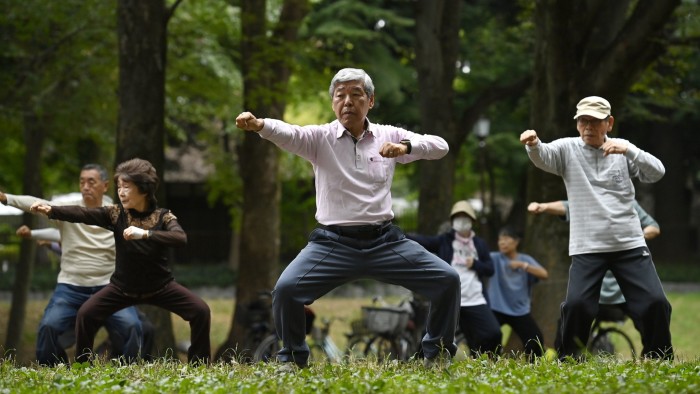
But then I remember, more cheerfully, that this birthday will be taking place in creaking, ageing Japan — a land where grey is the new black, lumbago is the new “Lambada” and 50 is not only the new 20, but more or less the median age.
Japan’s candle-at-both-ends demographics put it on the global frontline of both care home citizenship and youth-erosion. In a crisis now simply referred to by both the public and private sector as “the 2025 problem”, the giant, 8mn-strong generation of postwar baby boomers born between 1947 and 1949 have moved from the category of merely “elderly” to “advanced elderly”. By 2030, predicts the government, more than 8mn Japanese will be performing some sort of caregiving role, 40 per cent of those on top of an actual job.
It is impossible to miss. From this year, one in five Japanese will be over 75 and almost 30 per cent of the population will be over 65. Demographics, warn some economists, are about to wreak as much havoc on Japan as the collapse of the 1980s asset bubble. No population on Earth has ever been this old at this ratio to the rest of the population and with this many open questions about how it will cope. No population this peaceful, healthy and well-fed has ever shrunk at such a rate. Japan’s numbers are economically, socially and existentially terrifying, but they don’t half make a 50-year-old feel young.
And as well as being just another member of the average aged set, in theory, all I need to do to counter the creeping downsides of age is to remain in Japan and hope statistics take care of the practical side.
On paper, for example, I should become healthier. In 2023, after a three-year hiatus caused by the Covid-19 pandemic, Japan resumed its multi-decade pattern of advancing life expectancy. Japanese women lead the world in average longevity with an expectancy of 87.14 years, but, according to the health ministry charts, a male my age can expect to live for another 32.6 years.
The averages suggest I will also be rolling in it. By hitting one’s half-century in Japan, you edge into the large “over 50s” segment of society that statistically hoards almost 66 per cent of the nation’s $7tn stash of cash and deposits. That segment is now going to inherit the estates the very old leave to the merely quite old.
And more generally, being 50 gets you disproportionate political heft in Japan. Even in what is already a thoroughly silver democracy there are more 50-year-olds than any other cohort, and the country has delivered masterclass after masterclass in matching fiscal largesse to electoral maths. Dotage is votage.
The over-50s in Japan are the last generation that, according to the finance ministry, has been a net lifetime beneficiary of state outlay (in terms of education, healthcare etc). Everyone younger is in the red and will remain so until the heat death of the universe. And the peripheral perks are good too. By the time my generation needs one, the billions of taxpayer yen funnelled into the development of carer robots might finally have produced a semi-decent Nurse-o-tron. Maybe.
All of this, with the exception of rising life expectancy, is clearly quite dismal stuff. The promotion of healthy, happy older age is an obvious good. But there is a financial (the 260 per cent gross national debt-to-GDP ratio) and emotional (who will care for mum and dad) burden accumulated for younger generations that has quietly supported this and now looks utterly, alarmingly unbearable.
And that ultimately is why Japan, for the wrong reasons, is the perfect place to turn 50. As a nation, it is a global pioneer not just of being old, but in the comforting mass delusion that it can get away with it. In an ageing society, we are all technically getting younger. Relatively speaking.
Leo Lewis is the FT’s Tokyo bureau chief
Find out about our latest stories first — follow FT Weekend on Instagram and X, and sign up to receive the FT Weekend newsletter every Saturday morning
Read the full article here

