


Unlock the Editor’s Digest for free
Roula Khalaf, Editor of the FT, selects her favourite stories in this weekly newsletter.
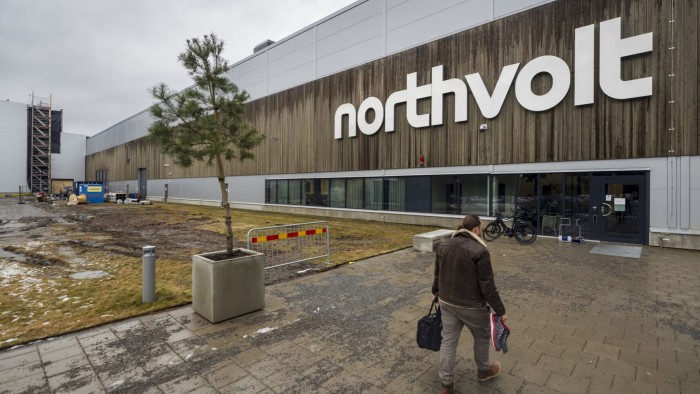
Last summer, I travelled through the pine forests of northern Sweden to a place called Skellefteå on the fringe of the Arctic Circle. I had managed to book the last room available in a pretty basic hotel next to a busy road, which cost more per night than a nice hotel in central Stockholm. The man on reception told me Skellefteå was bursting at the seams: Northvolt, the electric vehicle battery-maker, had transformed it from “left behind” to “boom town” practically overnight.
So when Northvolt filed for bankruptcy last week, it wasn’t just a blow for Europe’s hopes to develop a homegrown EV battery supply chain. It was also a blow to the story — a favourite among many politicians — that the road to net zero will be paved with secure “green jobs” in places that need them.
In truth, the public never found this tale as compelling as politicians seemed to think. Steve Akehurst of Persuasion UK, which analyses the effectiveness of political messages, has tested a number of “green jobs” arguments as a way to “sell” climate action, but they all tend to fall pretty flat with the public. Politicians, on the other hand, lap them up. “[They] work really well with elites — if you poll MPs, particularly Labour MPs, the best argument is ‘jobs’. When you poll the public, it’s mid-table at best,” he told me.
This isn’t just British cynicism. When Potential Energy, a global non-profit marketing company focused on climate, surveyed 60,000 people in 23 countries, it found a straightforward argument about “protecting the planet for the next generation” was on average 12 times more popular than “creating jobs”.
Why might that be? The context matters. Employment levels have been pretty high in most OECD countries in recent years so “more jobs” isn’t a particularly salient idea for now. In the US, where the Biden administration successfully catalysed green jobs growth, cannily (or so his team thought) concentrated in Republican districts, they didn’t reap the political rewards. One reason was that other issues, such as inflation and immigration, were far more pressing.
Of course, there are communities where unemployment is high, but many are understandably sceptical of politicians promising new jobs because they have been disappointed before. As Northvolt demonstrated, it is difficult to set up vast new factories from scratch in hitherto declining areas. And these ventures are not immune from problems like hubristic mismanagement or poor health-and-safety standards just because they are “green”. In a rare demonstration of British efficiency, Britishvolt, the UK version of Northvolt, saved everyone some time by going bust before it had even been built.
If green jobs don’t have much sway with the public, does that mean the loss of “brown” jobs would be met with a shrug too? Perhaps. But people tend to fear losses more than they value gains. And certain communities have a lot to lose. On average across OECD countries, workers displaced from high-emissions industries face a 24 per cent bigger decline in annual earnings in the six years after dismissal than people losing jobs in low-emission industries.
OECD data shows that high-emission industries are heavily concentrated in specific, mostly rural, places, while the fastest-growing occupations boosted by the transition to net zero are “skill-intensive and predominantly located in urban areas.” Technocratic plans to reskill and relocate people from “brown” to “green” industries look good on paper, but can unravel when it is time to commit to funding and guarantees. Last month, for example, the European gas industry walked away from plans to implement a “just transition” agreement with unions which would have involved retraining for energy workers.
I don’t mean this to be a counsel of despair. Green jobs are far from a mirage: they are being created in their tens of thousands. And it’s not impossible to manage the transition in such a way as to minimise the losses and maximise the gains. But it requires a pragmatic focus on what’s possible and a sharp eye on geography. Sam Alvis, director of energy at UK policy research agency Public First, told me the Labour government’s decision to get Carbon Capture Utilisation and Storage technology off the ground was a good example. CCUS, which captures and stores the carbon otherwise emitted from sites like power stations or cement factories, will create clusters of jobs in communities still dominated by industry such as Teesside, and it will also allow more industrial jobs to continue to exist.
Transitions are hard. But the public already knows that. It’s time for politicians to put down the Pollyanna-ish press releases and get on with it.
Read the full article here

